Tuesday, 12 February 2008

Temple in Samut Sakhon ( central Thailand ) pt 2


Main door of the templeImage of LP Tuad

Temple was located after tha chin river, along highway no 33.
**The name of the temple is Wat Jaleonsukhalam( Wat Bangpaitie) - translated
Temple in Samut Sakhon (Central Thailand) pt 1


Temple was located after tha chin river, along highway no 33.
**The name of the temple is Wat Jaleonsukhalam( Wat Bangpaitie) -
translated

Bad Mood

Don't think you have a valid excuse for "bad" behaviour when you are moody (in a bad mood).

Don't think you can just say something offensive, followed by, "Sorry, I didn't mean that. I'm in a bad mood today." You can't just walk away like that. Do you expect others to understand that and forgive you-again and again when you do it again and again?

We can control our moods- we are our master.
Master your Mind
or
beMastered by Mind.

Not a single angry word slipped out of the Buddha's lips even when the party He was talking to cursed and swore at Him. Nope-no moody blues for He who is ever mindful and is a master of His mind. Don't want any excuse from you again!

Source: www.thedailyenlightenment.com

Saturday, 9 February 2008

FORGIVENESS

A friend realised something rather amusing yet enlightening.
He became a more forgiving person when he realised that he had been letting himself off again and again, readily forgiving himself for his own misdeeds to others big and small, while being easily unforgiving and grudge-bearing towards others for their little mistakes. He realised how fat his ego was. It was as if he alone had all the right in the world to be wrong and forgiven, while the rest of the world should do him no slight wrong.
Being a forgiving person is part of the path of practice towards Enlightenment. Forgiveness liberates both pain and guilt. It unties knots of tensed negative karma, stops ill seeds from growing into greater hatred. Being unforgiving is nurturing our sense of hatred - which is no less than one of the three poisons that keep us swirling in Samsara's vicious cycles.
However, forgiving another does not mean we allow the same wrong to be repeated. We have to realise that while it could be our negative karma that we are wronged, we should put in the effort to prevent the person who did us wrong from doing more harm, creating more negative karma for himself. By being complacent, we could well be creating more negative karma for ourselves! Remember - forgiveness is "for giving". It is a gift of reassurance - it sets both parties' hearts and minds at peace.

Source: http://www.thedailyenlightenment.com/

Thursday, 7 February 2008

SEE THE BUDDHA

Some friends have visions or dreams of the Buddha,
where He is all magnificent,
smiling, beckoning…
But what would you do if you see the Buddha in person?
After bowing, paying respect?
Do you just gaze on in a daze of amazement?
Do you just bask in His glory?


Truth is, if you do not ask for the Dharma,
you are not a true Buddhist, not a Truth-seeker;
you are merely a Buddha worshipper.

Wednesday, 6 February 2008

The 6 Senses

See with your Eyes every Sight.
Hear with your Ears every Sound.
Smell with your Nose every Smell.
Taste with your Tongue every Taste.
Feel with your Body every Feeling.
Think with your Mind every Thought.
Function pure untainted by Greed or Hatred.
Penetrate deep and mindfully into your experiences.
Relish every sensation.
But do not become attached.

Your six senses-
Be forever liberated by learning best you can from them, or be forever trapped by indulging worst you can in them.


Source: http://www.thedailyenlightenment.com/


Tuesday, 5 February 2008

The 9 Sacred Temple in Thailand

Remember I talk about visiting the 9 Sacred Temples in Thailand in my previous blog and I have explained that if we could visit these 9 temples in one day then it will be very good for us, but how good? And WHY?


The following are the list of "benefit" we get by paying the temple a visit.
  1. Wat Suhat - Good Vision

  2. Wat Chanasongkram - Vistory over difficult obstacles

  3. Wat Arun (Temple of Dawn) - A prosperous life

  4. City Pillar Shrine - Discard bad luck and lengthen your life with good fortune

  5. Wat Kanlayanmit - A safe trip

  6. Wat rakhang - To become more popular and likeable

  7. Wat phra Kaeo ( Emerald Buddha ) - Wealth and rich rewards

  8. Wat Pho ( Reclining Buddha) - A happier and more peaceful life

  9. Chao Phor Seua Shrine - Offer more power and stature

EYE


One should not consider the faults of others,
nor their doing or not doing of good or bad deeds.
One should consider only
whether one has done or not done good or bad deeds.
-Dhammapada

The eye that sees
does not see
the eye that sees.
The eye that sees
others' faults and blindspots,
in this sense,
is too at fault.
It is too,
a personal blindspot.

Monday, 4 February 2008

True Friends

There are four kinds of stout-hearted people who should be known as true friends: the helper, the friend in both good times and bad, one who gives good counsel, and one who sympathizes. The helper is a true friend for four reasons. He guards you when you are off your guard; he guards your property when you are off your guard; he comforts you when you are afraid; and when something has to be done, he gives you twice what you require. The friend in both good times and bad is a true friend for four reasons. He tells you his secrets; he keeps the secrets you tell him; in trouble he does not forsake you; he would even lay down his life for you. The friend who gives good counsel is a true friend for four reasons. He discourages you from doing wrong, he encourages you to do good, he tells you things you have not heard, and he points out the way to heaven. The friend who sympathizes is a true friend for four reasons. He is sad at your misfortunes, he rejoices at your good fortune, he restrains others from speaking ill of you, and he commends those who speak well of you.


A friend who always lends a hand,

A friend in both sorrow and joy,

A friend who offers good counsel,

And a friend who sympathizes too -

These are the four kinds of true friends,

And one who is wise, having understood this,

Will always cherish and serve such friends,

Just as a mother tends her only child.

Sunday, 3 February 2008

恭喜发财 ! 万事如意 ! 身体健康 ! 财源广进!

As the CNY is round the corner and I've been rather busy at work and preparing for the CNY as well as the prayers (**拜天公, 接财神) on CNY Eve at home. Therefore, before I forget, I'll like to take this opportunity to wish all readers, A Very happy Lunar New Year!恭喜 ! 恭喜

**天公指的是“玉皇大帝”,天公烧的是天公金,上头的字样为叩答恩光,在烧完金纸时,要用水淋圆,这样的意义是要水官上帝将心意传达给天公知道.

Burmese Astrology

Burmese Astrology remains very popular in Myanmar and everybody knows their own signs for month, year, and especially day of birth. Myanmar astrology is based on the day of the week ... There are eight signs (the extra one is for Wednesdays) - Mon, Tues, Weds AM, Weds PM, Thu, Fri, Sat, Sun.

A child’s name and personality are based on birth sign. Each of the eight day signs also corresponds to a cardinal point and at temples one can go to pray at the point (north, north east, south, south east, etc.) corresponding to one’s sign and at other points depending on the advice of an astrologer.

The exact origins of the eight animals of Myanmar astrology - the Garuda, Tiger, Lion, Elephant, Tuskless Elephant, Rat, Guinea Pig and Dragon - remain a mystery. Nevertheless, these animals are important in Myanmar astrology. They are much more than general signposts to the day and to the possible good or bad times ahead for us all. The eight animals of the Myanmar astrology are considered to be a reflection of the universe itself.

Sunday Born (names: Aung, Aye, Ei, Ohn)
Sunday is the day of the GARUDA (galoun), the mythical king of birds. The northeast direction is your own and lucky direction. Sunday is the day of the Sun. You are very definite in purpose and energy and go-ahead spirit is in your mind and in your soul. You are very stubborn. Anything that is difficult and laborious interests you. Too good and too generous to others is not good for you; people will take advantage of that. According to Myanmar believe Sunday Born are mostly blessed with luck!

Monday Born (names: Cho, Khin, Kyaw, Kyin)
Monday is the day of the TIGER. The east direction is your lucky direction. Monday belongs to the Planet Moon. In character your patience, perseverance, and solidarity are outstanding. You are always reliable. You are very ambitious. Your aim in life is to make success of things. Monday born are supposed to be very bright and alert!

Tuesday Born (names: Cid, Nyi, San, Zaw)
Tuesday is the day of the LION. The southeast direction is your lucky direction. Tuesday belongs to the Mars. You want to do work with some prestige and dignity attached to it. You are a natural self-promoter. Your idealism motivates you to seek challenges and to dedicate yourself to great and worthy causes. You attract people because of your honour and strength of character. In Myanmar it is widespread that Tuesday born have a "sharp tounge"...


Wednesday Morning Born (names: Shwe, Ye, Yin, Yu)
Wednesday is the day of the ELEPHANT. The south direction is your lucky direction. Wednesday belongs to the Mercury. In character you are hasty in temper, impulsive, independent, and you desire to be your own master. People here claim that Wednesday morning born are unpatient...

Rahu (Wednesday afternoon Born; names: Lay, Lin, Lwin, Win)
One born in the afternoon of Wednesday is called Rahu born. Rahu is the ascending node of the Moon, the day of the TUSKLESS ELEPHANT. The northwest direction is your lucky direction. You are a person who has a wide circle of acquaintances, but few close associates, as you do not make friends easily. You want to do work with some prestige and dignity attached to it. You are a natural self-promoter. You idealism motivates you to seek challenges and to dedicate yourself to great and worthy causes. You attract people because of your honour and strength of character. In character you are hasty of temper, impulsive, independent, and desire to be your own master. Your aim in life is to make a success of things. BUT Wednesday afternoon born are even more unpatient - that's what they say here!

Thursday Born (names: Moe, Myint, Po, Phyu)
Thursday is the day of the RAT. The west direction is your lucky direction. Thursday belongs to the Jupiter. Serious-minded in your approach, you quietly go about whatever you have to do. Ambition is your driving force. Your aim in life is to make a success of things. You are very ambitious. Thursday born? It is also said that they are patient!

Friday Born (names: Than, Thein, Thida, Thun)
Friday is the day of the GUINEA PIG. The north direction is your lucky direction. Friday belongs to the planet Venus. Sensitivity is one of your best virtues, and you empathize with the difficulties of others. You have the restless nature, and dislike being tied to any situation. Try to raise your performance to your full potential. You can show your abilities and talent favourable. It is believed that Friday born are quite talkative!

Saturday Born (names: Dwe, Htet, Ni, Nan)
Saturday is the day of the DRAGON. The southwest direction is your lucky direction. Saturday belongs to the Saturn. You are naturally very intelligent and quick-minded. You tend to be very hard-working, and this should bring you various rewards. You will probably find it very difficult to work in a group or a team. Try to be patient, you will become the leader of the group. In Myanmar most parents don't want their first child born on Saturday - as they believe it will bring "unluck" to their partnerships...

(Excerpts copied from Myanmar Information Committee, Yangon 1999)

Saturday, 2 February 2008

Embrace Your Karma

In the film "Little Buddha", there is the opening scene where a monk tells the story of a priest who sacrificed goats for offerings.


One day, he encountered a goat that laughed. The priest asked him in shock, "Why are you laughing? You are going to be killed!" The goat replied that he had been a goat for five hundred lives, and that in his next birth, he will be human again.

Then the goat cried. And the priest asked, "Why are you in tears?" The goat replied, "Five hundred lives ago, I was a priest like you, killing goats for offerings!" Of course, karma does not always operate so simplistically.

Whenever there is suffering in our lives, we should be happy that we are clearing our "previous karmic debts". We should be grateful and joyful, rather than sad and grumpy. It is much better to clear our negative karma as humans than as beings in the lower realms - as we get to accept the effects of our karma graciously and mindfully. This is important because it can lead us to better comprehend the law of karma, and to transcend it ultimately in liberation.

Source: www.TheDailyEnlightenment.com

The 12 Interdependent causes and their effects

Beginning with ignorance, which is spiritual blindness, illustrated by an old and sightless man with a stick, unable to find his way.

The second picture shows a potter, his pots being symbolic of his own deeds (acting,speaking and thinking) with which he moulds his own karma, popularly called ~~ FATE.

The third picture depicts a tree and a monkey springing from branch to branch: this symbolises the major consciousness which in ignorant people springs uncontrolled from object to object. For this reason, by analysis leading to the understanding of inner and outer phenomena, Buddhist psychology aims at the full control of consciousness.

The fourth picture shows a boat with two people, symbolising name and form,spiritual and physical energy, inseparably floating on the stream of life.

The fifth picture is of a house with five windows and a door, symbolising the five senses and the faculty of thinking, those entrances (i.e.the sense organs) by which the outer world is perceived.

The sixth picture, a man and a woman embracing, demonstrates contact, the consequence of sensual perceptions.

The seventh picture is dedicated to the emotions by which one is stuck, as by an arrow in the eye.

The eighth picture, of a woman offering a drink to a man, illustrates desire, stimulated by perceptions and emotions and leading to the so-called thirst for life.

The ninth picture illustrates sensual entanglement: the longing to keep that which is desired, represented by a man plucking the fruits from a tree.

The tenth picture symbolises the procreation of a new life, here depicted by a beautiful bride.

The eleventh picture shows the consequence: procreation is followed by birth, a woman giving birth to a child, shown here in the natural crouching position.

The twelfth and the last picture
shows old age and death, the inevitable end of all earthly existence, illustrated here by bearers with a bier, the corpse swathed and in the fetal posture ready for the next rebirth and further misery in one of the symbolic six worlds.

Friday, 1 February 2008

The Wheel of Life - The Symbolic Six Worlds

The first of these transitory worlds is the abode of the so-called Gods. It is a temporal paradise achieved by good deeds, and it is illustrated in the uppermost sections of the Wheel. Here the Buddha with the lute is seen reminding the gods of their limited pleasures and guarding them against vanity and haughtiness, which encourages them to believe in their own imperishability. But these gods are not yet freed from sorrow;they too, after thousands of human years, are subject to old age and death. Their special suffering is the illusion of the eternity of their paradisal state: their misery lies in their eventual comprehension of the error.

In the upper half of the wheel, the World of Men is depicted: driven by egoism and ignorance, they suffer from the permanently repeated cycle of birth, sickness and death.
( The Buddha with the Begging bowl of a wandering monk comes to help them)

In the lower half of the wheel, the World of Animals illustrates their special suffering: oppression by the other beings. The devour each other and become beasts of burden.
( Here the Buddha holding a book appears to the animals)

The last world follows with the cold and hot hells. They are places of torment for all those who have committed evil deeds out of hatred and anger. But this infernal life, however long, is not eternal;after atoning for sins, rebirth into a better world is always possible. In the World of Hells an assistant of the Lord of the Dead weighs the deeds of the deceased who are entering his kingdom, but this is administrative work because the fate of the dead has already been decided by themselves.
(Here the Buddha appears, bearing a flame to bring light and hope to these darkest regions)

The fifth world is the realm of the insatiable, greedy ghost, suffering from hunger and thirst which they can neither appease nor quench; they present a ghastly picture with tightened throats and bloated bellies.
(Here the Buddha appears with a jar of nectar for the hungry ghosts)

To the right, the World of Titans is illustrated: they are permanently warring against the gods and fighting for the fulfillment of their desires; their suffering is the endless war, the result of envy and insatiable ambition.
(Here the Buddha appears with a flaming sword, and ministers to the titans)

The Wheel of Life - Detailed Note

Buddha Figure
The appearance of the Buddha commemorates the potential Nirvana, inherent in all beings, because all creatures- the proud gods, the insatiable monsters, the warring titans, suffering men, as well as the tormented beings in hell and the animals – have the possibility of attaining salvation in a future good rebirth in the World of Men.
The Bodhisattava
Avalokiteshvara – the lord who looks down in compassion, the Bodhisattava of Compassion who weeps as he beholds the manifold suffering of all beings in the six realms and three spheres of existence. The Bodhisattava is the link between the mundane and the Transcendental. He represents the drive within the mundane to fulfill itself in the Transcendental.
The Monster of Impermanence
The Monster of Impermanence appears above the rim of the Wheel, a ferocious face with three fiercely glaring eyes and a crown of skulls. Holding the Wheel of Life in his claws, he is a symbol of the transitory nature of all earthly phenomena.
The Roots of Evil
The motive force that drives a wheel is at its hub. Thus, at the hub of the Wheel of Life are the cock, the snake and the pig, the forces that keep it turning. They are known as the "Three Unwholesome Roots"because they corrupt us from within. The cock represents greed, the snake hatred and the pig ignorance, and it is these three that underlie all human bondage and misery.
The Dark Path
The picture-path to follow begins in the center arrow of the wheel. There, the three spiritual poisons are depicted: a black pig for ignorance, a green snake for envy and hatred and red cock for lust and greed. Whoever delivers himself up to these basic evils walks along the Dark Path leading to hells and bad rebirths.
The White Path
The other way is the Path of Bliss leading to better rebirths and upwards to final liberation. Both paths are illustrated by the ring surrounding the center of the picture scroll: saints and sages lead the virtuous along the Path of Bliss, and demons, armed with nooses, drag the sinners along the Dark Path. In this way, the ignorant and the sinful, by the twelve interdependent causes and their effects are mercilessly driven through the Wheel of Life.

The Wheel Of Life

The Wheel of Life illustrates in a popular way the essence of the Buddhist teachings, the Four Truths: the existence of earthly suffering, it’s origin and cause, the ending or prevention of misery and the practice path to liberation from sufffering.
The Wheel of Life describes the cause of evil and its effects. Mirrored in earthly phenomena just as it is experienenced by everyone from the cradle to the grave. Picture by picture it reminds us that everyone is always his or her own judge and is responsible for their own fate, because, according to Karma, causes and their effects are the fruits of one’s own deeds.
The circular composition of the Wheel of Life guides the viewer from picture along the black path or the white path. It leads him or her through the twelve interwoven causes and their consequences to rebirth in one of the so called Six Worlds. Projected on one plane, they fill the whole inner sphere of the Wheel of Life. But the meaning of this painting is to show the way out of these worlds of suffering into the sphere beyond.

Explanation of Sections:
Standing Buddha (right)
The Bodhisattava ( left)
The Monster of Impermanence ( holding the wheel)
The Roots of Evil ( center)
The Dark Path ( center left of the hub)
The White Path ( center right of hub)
The Symbolic Six Worlds ( inner circle)
The Twelve interdependent Causes and their Effects ( outer circle)


Thursday, 31 January 2008

佛教小常识 - 卍字

字,梵语srivatsa或svastika,本为一种德相符号,意译为「吉祥云海」、「吉祥喜旋」义,为佛的三十二相、八十种好之一。

此符号在不同佛典中分别出现在佛陀的胸臆、发间、手足或腰间,皆具光明吉祥之义。卍字可能因为与俗体「万」字形相及意思相近,后世遂通称为「万」字。有学者认为卍字与十字同是阿利安族先祖居住在巴克特里及鄂斯河流域时代的重要宗教符号,故两者皆成为日后神圣的标志.

有趣的是:泰国佛教徒向人问候时,皆是双掌合十,称「sawadeeka」,有人认为此词的音义,可能是源自梵语「svastika」,即「卍」字的祝福。

Do Not Harm Yourself Needlessly

Suppose an enemy has hurt you in his own domain.
Why should you annoy yourself & hurt your mind in your domain?
In tears you left your family, who were kind and helpful always.
So why not leave behind your enemy & the anger that brings so much harm?
This anger which you embrace eats away at the very roots of all the virtues you strive to develop.

Who would be such a fool? Someone else does evil deeds & you get angry.

Why? Do you wish to copy him & act as he does?
Suppose someone, to annoy, provokes you to do some evil act.
Why allow anger to arise and thus do exactly as he wants you to do?
If you get angry then maybe he will suffer, maybe not.
But by feeling anger yourself - -You certainly do suffer.
If enemies blinded by anger are content to walk the path of woe,

Do you wish to follow them by getting angry yourself?
If a foe provokes you to hurt yourself by getting angry,

Let that anger subside. Do not harm yourself needlessly.

Arahant, Lohan 罗汉

Requested by friends to put up the infomation in English since I had given the information on Lohan in chinese before.

Arahant or Lohan is one who has followed the Eightfold Path and has achieved deliverance of this earthly existence. He has reached "the other shore" and is saved for all eternity. In him the asavas - the craving for sensual pleasures, earthly existence, ignorance and wrong views - are gone. He is subject to no more rebirths and karma.

Lohans are well-known for their great wisdom, courage and supernatural power. Due to their abilities to ward off the evil, Lohans have became guardian angels of the Buddhist temple and there in the main hall standing guard are the ever-present, indomitable-looking 18 Lohan figures.

According to tradition, there were originally only 16 lohans. Two were added on the list by the Chinese in the Tang Dynasty.
Legend has it that the first portraits of the 18 Lohans were painted by a Buddhist monk Guan Xiu, in 891 A.D. Guan Xiu lived in Chengdu, the capital of a small kingdom, the Former Shu, formed at the decline of the Tang Dynasty in what is today's Sichuan Province. He was adept at the scholarly pursuits of painting, calligraphy and poetry.
It was because of his expert painting skill that the Lohans chose him to paint their portraits. They appeared to him in his dreams to make that request.

The traditional order of the 18 Lohans is based on the order in which they appeared in Guan Xiu's dreams, not on the strength of their power.

The order are:

  • Deer Sitting (PINDOLA, the Bharadvaja)
  • Happy (KANAKA, the Vasta)

  • Raised Bowl (KANAKA, the Bharadvaja)

  • Raised Pagoda (NANDIMITRA)

  • Meditating (NAKULA)

  • Oversea (BODHIDRUMA)

  • Elephant Riding (KALIKA)

  • Laughing Lion (VAJRAPUTRA)

  • Open Heart (GOBAKA)

  • Raised Hand (PANTHA, the Elder)

  • Thinking (RAHULA)

  • Scratched Ear (NAGASENA)

  • Calico Bag (ANGIDA)

  • Plantain (VANAVASA)

  • Long Eyebrow (ASITA)

  • Doorman (PANTHA, the Younger)

  • Taming Dragon (NANTIMITOLO)

  • Taming Tiger (PINDOLA)
For a detailed version of the various Lohan, you may like to visit this website :

http://www.buddhanet.net/e-learning/history/lohans.htm

Wednesday, 30 January 2008

THE GIFT OF TRUTH

Image Hosted by ImageShack.us

The gift of food is useful only till hunger returns.
The gift of clothes is useful only till they are torn.
The gift of a house is useful only till it is dilapidated.
The gift of medicine only delays sickness and death.
But the gift of the Dharma protects a person
throughout his rebirths -
it even helps him break free from rebirth altogether.

If you spend most of your life,
lying to yourself and others,
your life is basically a lie,
self-deception -
not a true life,
not truly living.
It is the sustenance of delusion,
that only propels you into greater delusion.
But the moment you snap out of it,
you seek the Truth,
you become true to yourself
and your whole life turns around.
The Truth is always there -
you only need to turn around.

坤平将军

据说坤平出身于一个将领的家庭,天生聪慧、正直。年纪小的他已很讲义气,扬言长大后必效力国家,为帝王宝命也绝不言辞。他从小就学习武功,到年纪较长时已是十八般武艺皆精通,对骑马射箭更有他的一套,百发百中。由于他从小习武的缘故,所以他身材健硕,魁壮结实,加上他天生英俊非凡,真可说是一名标准的美男子。也因为家庭背景的助力,坤平自然而然也当上了当地的一名将领,后来要因为减赋有功而被封为将军。 将军他不但威勇善战,样貌更是俊朗不凡,深受女孩子欢迎,因此坤平妻妾之多无人能及,而且其中一名妻子更是邻国将军的女儿。 一次,坤平将军接到国家的命令,要攻打妻子的国家,便哀求丈夫不要攻打自己的家乡,但军命难为,坤平将军没有接受妻子的哀求,见丈夫不接受自己的哀求,便在坤平将军的食物中下毒,但坤平将军是天神化身,有天神秘佑,所以未能毒害坤平将军,事件已败露,坤平将军一时气愤,便张妻子杀死,但躺下后,坤平将军,才发现妻子已怀有身孕,便张死去的儿子,制成干骸佩带在身,以作记念,这就是现今人称金童子之鬼仔(泰国称作古曼童)的来历,坤平将军佩带了儿子的干骸金童子后,百战百胜,每当遇上危险都能化险为夷。 据说坤平将军喜爱斗鸡,斗鸡是泰国一种赌博活动,而坤平的斗鸡竟和坤平将军一样威勇善战,百战百胜,有神鸡称号。因此往后便有流传,坤平将军手抱神鸡的佛牌,会对赌运有所帮助。

Tuesday, 29 January 2008

Our Parent

There are two people you can never repay. What two?
Your father and your mother.
Even if you were to carry them on your back
and live a hundred years, supporting them, anointing them with medicines,
bathing and massaging their limbs
and wiping up their excrement after them,
even this would not repay them.
Even if you were to give them absolute rule over the whole world,
this would not repay them. And why?
Because parents do much for their children -
they bring them up, nourish them, they introduce them to the world.
But whoever encourages his un­believing parents to believe,
his immoral parents to be virtuous,
his stingy parents to be generous,
his foolish parents to be wise,
such a one by so doing does repay,
does more than repay his parents.

**My best friend's mum who was a very holy person was diagnosed with cancer. She said she have faith that Buddha will help her to pull thru this difficult stage. Me too, that's why I've been praying for her.

Daily Reading from the word of Buddha

A believer can be recognised by three things. What three? He desires to see those who are virtuous; he desires to hear the good Dhamma; and with a heart free from stinginess, he lives at home generous, clean-handed, delighting in giving, one to ask a favour of, one who delights in sharing things with others.

These ten things nourish the ten things that are desirable, liked, charming and hard to win in the world. What ten? Energy and exertion nourish wealth. Finery and adornment nourish beauty. Doing things at the proper time nourishes health. Friendship with the beautiful nourishes virtue. Restraint of the senses nourishes the holy life. Not quarrelling nourishes friendship. Repetition nourishes great knowledge. Lending an ear and asking questions nourishes wisdom. Study and examination nourishes the teachings. And living rightly nourishes rebirth in the heaven world.

"What do you think about this?" said the Lord. "What is the purpose of a mirror?"
"It is for the purpose of reflection, sir," replied Rahula.
"Even so, an action to be done by body, speech or mind should only be done after careful reflection."

Mahali said to the Lord: "Sir, what is the reason, what is the cause of doing, of committing an evil deed?"
"Greed, hatred, delusion, not paying proper attention and wrongly directed thoughts - these are the reasons, these are the causes of doing, of committing an evil deed."
"Then what, sir, is the reason, what is the cause of doing, of committing a beautiful deed?"
"Generosity, love, wisdom, paying attention and rightly directed thought - these are the reasons, these are the causes of doing, of committing a beautiful deed."


Monday, 28 January 2008

Karma

The definition of KARMA is stated as: "for every event that occurs, there will follow another event whose existence was caused by the first, and this second event will be pleasant or unpleasant." Karma is not about retribution, vengeance, punishment or reward; karma simply deals with what is.
The effects of all deeds actively create past, present and future experiences, thus making one responsible for one's own life, and the pain and joy it brings to others. Many that have believed in rebirth have believed that it may involve working off the karmic debt of past lifetimes and therefore hardship and sufferance in the present lifetime has often been attributed to any past life karmic debt, that has been brought forward by negative actions of past life onto the present life and incarnation, thus any present life suffering might be attributed as a consequenting result of the karmic laws and be seen as karmic debt and therefore unavoidable. The karmic laws being the laws that are thought to maintain an equilibrium through action causing reaction and for every action there will be consequenting reactions, therefore positive action is thought to result in positive reaction and negative action resulting in negative reactions, either in this present time or in some later incarnation.

Buddhism relates karma directly to motives behind an action. Motivation usually makes the difference between "good" and "bad", but included in the motivation is also the aspect of ignorance; so a well-intended action from a deluded mind can easily be "bad" in the sense that it creates unpleasant results for the "actor".

Sunday, 27 January 2008

天狗吃月亮的传说

传说古时候,有一位名叫“目莲”的公子。生性好佛,为人善良。十分孝顺母亲,但是,目莲之母,身为娘娘,生性暴戾,为人好恶。

有一次,目莲之母突然心血来潮,想出了一个恶主意:和尚念佛吃素。我要作弄他们一下,开晕吃狗肉。她吩咐做了三百六十只狗肉馒头,说是素馒头,要到寺院去施斋。目莲知道了这事,劝说母亲不听,忙叫人去通知了寺院方丈。方丈就准备了三百六十只素馒头。藏在每个和尚的袈裟袖子里。目莲之母来施斋,发给每个和尚一个狗肉馒头。和尚在饭前念佛时,用袖子里的素馒头将狗肉馒头调换了一下,然后吃了下去。目莲之母见和尚们个个吃了她的馒头,“嘿嘿”拍手大笑说:“今日和尚开晕啦!和尚吃狗肉馒头啦!”方丈双手合十,连声念道:“阿弥陀佛,罪过,罪过!”事后,将三百六十只狗肉馒头,在寺院后面用土埋了。

这事被天上玉帝知道后,十分震怒。将目莲之母打下十八层地狱,变成一只恶狗,永世不得超生。
目莲是个孝子,得知母亲打入地狱。他日夜修炼,终于成了地藏菩萨。为救母亲,他用锡杖打开地狱门。目莲之母和全部恶鬼都逃出地狱,投生凡间作乱。玉帝大怒,令目莲下凡投身为黄巢。后来“黄巢杀人八百万”,传说就是来收这批从地狱逃出来的恶鬼。

目莲之母变成的恶狗,逃出地狱后,因十分痛恨玉帝,就窜到天庭去找玉帝算帐。她在天上找不到玉帝,就去追赶太阳和月亮,想将它们吞吃了,让天上人间变成一片黑暗世界。这只恶狗没日没夜地追呀追!她追到月亮,就将月亮一口吞下去;追到太阳,也将太阳一口吞下去。不过目莲之母变成的恶狗,最怕锣鼓、燃放爆竹,吓得恶狗吞下的太阳、月亮,又只好吐了出来。太阳、月亮获救后,又日月齐辉,重新运行。恶狗不甘心又追赶上去,这样一次又一次就形成了天上的日蚀和月蚀。民间就叫“天狗吃太阳”,“天狗吃月亮”。直到现在,每逢日蚀、月蚀时,不少城乡百姓还流传着敲锣击鼓、燃放爆竹来赶跑天狗的习俗。

Saturday, 26 January 2008

天狗

天狗是中国民間传说中的一種動物。

最早記載於《山海经》中,原文是:「又西三百里,曰阴山。浊浴之水出焉,而南流于番泽。其中多文贝,有兽焉,曰天狗,其状如狸而白首,其音如榴榴,可以御凶。」

如文中所述,天狗是种像狐狸而頭部白色的动物,並是御凶的吉兽,很可能是某种古代哺乳類动物,是真实存在过的。但后来演变成用来形容彗星流星,古人将天空奔星视为大不吉,所以天狗也变成了凶星的称谓。《史記·天官》載:“天狗狀如大奔星,有聲,其下止地類狗,所墮及炎火,望之如火光,炎炎沖天。”

由於古代中國的人缺乏天文學知識,便把日食、月食现象说成是“天狗吃月亮”或“天狗吃太陽”。該現象出現時,人们会敲锣打鼓放鞭炮来嚇走天狗。

傳說后羿為民除害射落了九個太陽,王母娘娘為了獎賞他,便送了他靈藥,但後被嫦娥偷吃了,獨自升天,門外后羿的獵犬黑耳眼見此,就吠叫著撲進屋內,把剩下的靈藥舔盡,然後也跟著朝天上的嫦娥追去。嫦娥聽見黑耳的吠聲,慌忙闖進月亮裏。而黑耳毛髮直豎,身體不斷變大,一下子撲上去,把嫦娥連月亮吞下。

當時玉帝及王母娘娘得知月亮被一條黑狗吞吃了,便下令天兵天將去捉拿,當黑狗捉來後,王母娘娘認出牠是后羿的獵犬,便封牠為天狗,讓牠守護南天門。黑耳受到恩封,便吐出了月亮和嫦娥,而嫦娥自此居於月亮上。

张仙射天狗的故事是,天狗阻挡了天上的星宿下凡投胎,张仙把天狗打跑这样人们可以顺利得到孩子,因此张仙也得到送子张仙之称。

另外,天狗也是二郎神杨戬的「哮天犬」的称呼,它帮助二郎神降妖除魔。

来自“ http://zh.wikipedia.org/

**韭菜芭城隍庙就有一尊天狗让人们祭拜. 地址: No. 15, Arumugam Road, Singapore 409960

Friday, 25 January 2008

Four Things Woman Win Power in this World

With four things women win power in this world, this world is in their grasp. What four? Concerning this, a woman is capable at her work, she manages the servants properly, she is loved by her husband and she guards his wealth.
And how is a woman capable at her work? Whatever her husband's home industries, whether in wool or cotton, she is deft and tireless, gifted with an inquiring turn of mind into ways and means and able to arrange and carry out the job.
And how does she manage the servants properly? Whether there be servants, messengers or workers in her husband's household, she knows the work of each and what has been done, she knows what has not been done, she knows the strengths and weaknesses of the sick, she divides the food, both hard and soft, ­according to their share.
And how is she loved by her husband? Whatever her husband considers unlovely, she would never do, not even to save her life.And how does she guard her husband's wealth? Whatever money, grain, silver or gold he brings home, she secures, watches and guards; never does she steal, misuse or waste it.

Thursday, 24 January 2008

Ti Tsang P'usa: Ksitigarbha Bodhisattva

Ti Tsang P'usa is an extremely popular Bodhisattva among the Chinese and Japanese Buddhists. 'Ti Tsang', meaning 'Earth-Store' is a direct translation of the Bodhisattva's name KSITIGARBHA in Sanskrit. Among the countless Bodhisattvas in the universe, he and three others have firmly captured the hearts of the Mahayanists.

These four main P'usas or Bodhisattvas are depicted in the Chinese Buddhist Pantheon and they represent four basic great qualities:
  1. KUAN SHIH YIN(观士音) as Great Compassion

  2. WEN SHU (文殊) as Great Wisdom

  3. PU HSIEN (普贤) as Great Love and Perfect Activity

  4. TI TSANG(地藏) as Great Vow to help and to deliver all beings.
Ti Tsang P'usa has often been mistaken by uninformed Buddhists to be Mogallana who was a disciple of Sakyamuni Buddha, because he too had a similar experience of descending to the Hell Realm to seek and save his mother. The stories may sound similar but they happened at different times and adopted quite different methods to save their mothers. Many others also tend to mistake Ti Tsang as Hsuan Tsang, the famous Tripitaka master of the Tang Dynasty who made the harzadous journey to the West to seek the Buddhist scriptures. This is mainly due to the Sangha robe and the five-leave crown which both are seen to wear. Ti Tsang P'usa is again taken by many to be "Yen-Lo-Wang" or Yama, the "Over-Lord of Hell." It must be mentioned that Ti Tsang is a Bodhisattva and not a mere King of the Fifth Hell. He does not judge the dead but seeks to save them from their suffering.

Ti Tsang may be represented in sitting or standing posture. He always has a kind and benevolent look and carries either, or both, his symbols of the Cintamani or "Wish-fulfilling Jewel' and the "Ringed-Staff", which is also called the Khakkhara. This ringed staff is often carried by Buddhist monks in their travels so that the sounds caused by the jingling rings can warn small animals and insects of their approach lest they be trod upon and killed. It is also sometimes called the alarm-staff. In the much treasured picture of Ti Tsang P'usa, which is found in many Buddhist homes and temples, he is seen seated upon a lotus throne. His hands holds the precious flaming pearl which has vast magical powers beyond description. He wears the robe of a Northern Buddhist monk and on his head is the "five-leave crown, where the representation of a Dhyani-Buddha can be seen on each of the leaves.Ti Tsang's compassion is not practised exclusively for the benefit of the beings of the hell realm, he also gives blessings to those of the world who seek his help and he is a comforter of the poor, oppressed, sick, hungry, and those who are troubled by spirits and nightmares. Those who have firm faith in him can easily receive his protection.

With faith one needs to recite any of these simple prayers:

"NAMO TI TSANG WANG P'USA' or"NAMO KSITIGARBHA BODHISATTVA YA".

The birthday of Ti Tsang P'usa falls on the 30th day of the 7th moon of the Chinese lunar calendar. All over the world Buddhist temples offer prayers to Ti Tsang P'usa during the 7th lunar month for the benefit of the dead. Ti Tsang's popularity among the Chinese and Japanese Buddhists is second only to Kuan Shih Yin P'usa as he takes upon himself the fearful and difficult task of bringing relief and consolation to the suffering beings of hell.


Wednesday, 23 January 2008

Buddha's word on Wisdom & Self control


  • Thoughts of greed

  • hatred

  • harming.
These three types of thought cause blindness, loss of sight and ignorance, they put an end to wisdom, are associated with trouble, and do not conduce to Nirvana.

  • Thoughts of giving up

  • love

  • helping

These three types of thought give vision, seeing and knowledge, they increase wisdom, are associated with harmony, and conduce to Nirvana.

Look not to faults of others nor to their omissions and commissions.
But rather look to your own acts, to what you have done and left undone.
When one looks down on another's faults and is always full of envy, one's defilements continually grow; far is one from their destruction.


If only you would do what you teach others then being yourself controlled, you could control others well. Truly, self-control is difficult. You yourself must watch yourself. You yourself must examine yourself, and so self-guarded and mindful.

Tuesday, 22 January 2008

Zeeba (Tibetan legend)

Zeeba or Zipak (Tibetan)

(First glance at the picture, we thought it's Rahu but after reading the story we realised it's not, but for sharing purpose, I've decided to write out. )


The Zipak originates in a Shaivite legend from the Shandha Purana. Shiva created a demon called Jalandhara from the blaze of his third eye. Jalandhara assumed great power and desired an incestuous relationship with Parvati, the consort of Shiva and Jalandhara’s adoptive mother. Jalandhara persuaded Rahu, one of his demonic friends, to demand Parvati’s favor. When Shiva got wind of this, he was understandably outraged, so his third eye blazed again. Thereby creating the Zeeba, who made a beeline to devour Rahu. Rahu decided that Zeeba was going to eat him bones and all and begged Shiva for mercy;whereupon, Shiva offered forgiveness and called off Zeeba. Because Zeeba had not had anything to eat since coming into the world and had been deprived of his only prey, he turned on himself and devoured his own body until only the head and hands remained. Shiva was very pleased with his handiwork and invited Zeeba to remain as the guardian to his door. Since then, he has become a reminder of the consequences of gluttony and greed and also stands as a guardian of practitioners. Zeeba’s finger point to his missing body to show what can happen when someone is overcome by avarice.


Sunday, 20 January 2008

Sharing - Wisdom

  • Wisdom is the light by day and Right mindfulness is the protection by night. If a man lives a pure life nothing can destroy him; If he has conquered greed nothing can limit his freedom.
  • One is to cultivate the seven factors of enlightenment: mindfulness, investigation into phenomena, energy, bliss, tranquility, concentration, and equanimity. [Buddha, Maha-parinibbana Sutta 9]
  • The thought manifests as the word; The word manifests as the deed; The deed develops into habit; And habit hardens into character. So watch the thought and its ways with care, And let it spring from love Born out of concern for all beings.

Saturday, 19 January 2008

Friday, 18 January 2008

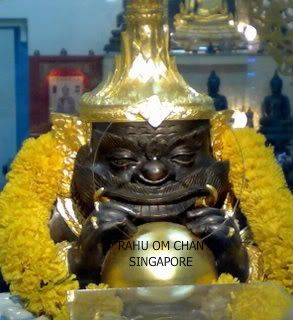
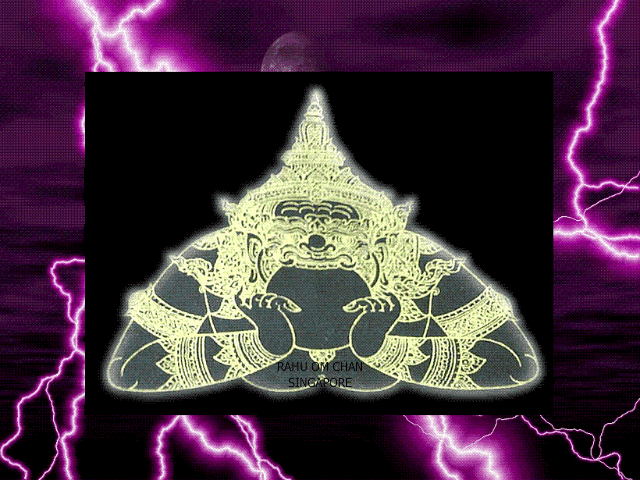
Rahu

Rahu swallowing the sun. (Image taken from Bali Sekala Niskala Vol. 1, Fred B. Eiseman, Jr., page 66.)
Rahu swallowing the moon. (Image taken from Island of Bali, Miguel Covarrubias, page 299.)

Wednesday, 16 January 2008

Tuesday, 15 January 2008

Fengshui Tips

This year, 2008 the 5 Yellow star and the 3 Killings are both located in the south hence this may be a challenging year if the main entrance to your living space is in this direction.

Here are some general tips:
  1. Tai Sui (God of the year or Grand Duke Jupiter) occupies N2 direction (352.5° to 7.5° N). Do not challenge him by facing him when you’re seated. Instead, sit with him behind you to gain his support.
  2. The 5 Yellow enjoys peace and quiet, if your main door is located in the south, you should try using another door. If this is not feasible, place a big golden bowl of water in the south to please him.
  3. The 3 Killings are also in the south this year and contrary to the Tai Sui, you must always face them. For 2008, you’ll be in tune with the Tai Sui and 3 Killings if you sit facing south, provided south is one of your auspicious direction.
  4. Wu (Horse) is in direct conflict with Zi (Rat) because they are directly opposite each other as shown in the compass below. Please remember that you should keep the south direction quiet and peaceful, with minimm activities and noise. Do not undertake renovation, digging, construction or demoltion work in all the above mentioned sectors without the advice from your Feng Shui Consultants.
  5. Star # 2 is located in the NW, if you'd spend a lot of time here or if this is your bedroom, don't forget to place a Hu Lu for good health... get it activated as well.
  6. Star # 3 is in the west. This star represents conflicts, disputes, etc. when it's untimely, but it can also bring us abundance of wealth if timely.
  7. Star # 7 commonly known as Robbery star, occupies SW in 2008. When timely, it will bestow financial gain on us.
  8. Spend as much time as possible in the East and SE with your family in 2008, when timely, it will bring us happiness, success, and good fortune.

The above serve as a general guide, hopefully it will be useful.

Monday, 14 January 2008

Words from the Buddha - Right Companion

If the one who does no wrong
Follows one who is evil,
He himself will be suspected of evil
And his reputation will decline.

According to the friends one makes,
According to who one follows,
So does one become.
Like one's associates one becomes.

Follower and following,
Toucher and touched alike,
An arrow smeared with poison
Infects those arrows that are not poisoned,
So that all are fouled.

The upright person not wishing to be soiled
Should not keep company with the fool.
If one strings a piece of putrid fish

On a blade of kusa grass,
The grass will smell putrid too;
The same with one who follows the fool.

If one wraps frankincense
In an ordinary kind of leaf,
The leaf will soon smell sweet too;
The same with one who follows the wise.

Remembering the example of the leaf wrapping
And understanding the results,
One should seek companionship with the wise,
Never with the fool.

Sunday, 13 January 2008

Words from the Buddha- Winning Respect

One who is wise and disciplined,
Kindly always and intelligent,
Humble and free from pride -
One like this will win respect.
Rising early and scorning laziness,
Remaining calm in time of strife,
Faultless in conduct and clever in actions -
One like this will win respect.
Being able to make friends and keep them,
Welcoming others and sharing with them,
A guide, philosopher and friend -
One like this will win respect.
Being generous and kindly in speech,
Doing a good turn for others
And treating all alike -
One like this will win respect.

Saturday, 12 January 2008

Daily word of the Buddha

Greed is to be slightly blamed but it is slow to change. Hatred is to be greatly blamed but it is quick to change. Delusion is to be greatly blamed and it is slow to change.

Wisdom is purified by virtue, and virtue is purified by wisdom. Where one is, so is the other. The virtuous person has wisdom, and the wise person has virtue. The combination of virtue and wisdom is called the highest thing in the world.

The past should not be followed after,And the future not desired.What is past is dead and gone,And the future is yet to come.
But whoever gains insight into thingsPresently arisen in the here and now,Knowing them, unmoved, unshaken -Let him cultivate that insight.


Friday, 11 January 2008

Thai Amulet

One of the most unique and beautiful things you will experience in Thailand, are the amulet
that is made by the monks in certain Wats (Buddhist temples) to commemorate special events,festivals, or an anniversary.

For centuries, the monks have been crafting these little treasures. They come in all shapes and sizes, but generally, each Wat makes its own particular shape and size. Each amulet is infused with prayers, secret ingredients, and a little magic. They are said to endow their wearer with special powers, even up to the point of making the owner indestructable, and able to strike mortal terror into the heart of his enemies. Others are made to attract love, success, or happiness.
Possibly the oldest Thai amulets whose origins are traceable are the amulets from the Haripunchai period. Today this area is known as Lampoon province. Around 1,200 - 1,400 years ago there was a strong Mon/Burmese influence here and this area was its own distinct kingdom.
The first Thai amulets where made and blessed by devout monks and given to warriors and fighters to enhance and strengthen their ability to fight the enemies of Thailand. Many times the Thai amulets were worn as buttons or as talismans. This power then and today was acquired through a faith in the power of the Buddha and as protection against their enemies to be beaten, injured or killed in battle. Although the names of the kingdoms have changed and we have a host of new monks, the power and the belief in magical attributes of these Thai amulets remains very strong.


The collecting of these images is serious business in thailand. Great care is used to determine the age and authenticity of each piece. The most famous is the "Benjapakee" or "The Grand 5 Set".

The motif images of Thai Buddhist amulets were usually the Buddha, it was until the past century when images of Arahants (disciples of Buddha whom had achieved Nibbana), famous monks and Devas gained much more popularity. In fact, the Buddha had forbidden the worship of his images in attempt to achieve enlightenment, but rather achieve enlightenment through practising the Dhamma. The worship of Buddha's images may also lead to the wrong practise of worshipping idols instead of practising and understanding the Dhamma. No images of the Buddha were made during the life of the Buddha, and after the Buddha's passing away, Buddhist paid respect to the Buddha's relics, Stupas and to his footprints.

Thai Buddhist amulets are made by monks from since the last century. As mentioned earlier, the majority Thai Buddhist amulets depicts the image of the Buddha, however images of Arahants, popular monks and Devas had also gained popularity in recent decades, especially the images of popular holy monks. These images often bear words from Buddhist scriptures written or inscribed in old Khymer language scripts and contemporary Thai language scripts. The name of the particular monk and temple making and commissioning the amulet are oftenly also included on the amulet, along with the date it was made and issued. Yantra scripts and other Buddhist symbols such as images of Stupas, Bodhi leave, etc, are also oftenly included on the amulet.New period of Thai Buddhist images are made for a few purposes other than for Stupa storage, some common purposes are; to rise funds for the purposes of temple building or repair, fund rising for building hospitals, orphanages, etc.

Wednesday, 9 January 2008

Website

I came across a website for Rev Luang Pu Hong, unfortunately, it was in Thai... I tried using a translator to read, not easy, but I'm really happy that someone actually came up with this idea. The web was nicely done up with pictures showing ceremonies conducted at the temple, biology of Luang Pu and many other more info.

If you would like to find out more about Luang Pu Hong and most importanly, if you can read thai, this is the website for you.

http://www.luangpuhong.com/

Thai Buddha for each day of week (part 2)

Thursday ( Jupiter ): Pharutsabodi (Brihaspati) is the heavenly seer who carries a slate and rides a deer. He corresponds to Jupiter, tutor of the gods. Thursday, his day, is dedicated to teachers.
Friday ( Venus ): Sukra, the god who presides over Friday, rides a bull. He is considered one of the heavenly seers as well as a tutor of the gods. He is the diety of wealth and fine art.
Saturday ( Saturn ): Phra Sao (Sani), equivalent to Saturn, with bow and trident in his hands, is considered the god of difficulty. The people who are born under the influence of Saturn are believed to fall easily into grief, despair, and difficulties. He is seated on his vehicle, a tiger.


Tuesday, 8 January 2008

Thai Buddha for each day of week (Part 1)

Sunday ( Sun ): Phra Athit (also Aditaya or Suriya), the Sun, the god of light, is seated on his chariot of seven skyhorses driven by his rider, Phra Arun.
Monday ( Moon ): Phra Chan (or Chandra), the Moon, is a male deity who rides a chariot drawn by ten horses. His nature is suave and gentle.
Tuesday ( Mars ): Phra Angkhan (Angaraka) rides a water buffalo. He is Mars, the god of war, hard-work and conflict.
Wednesday ( Mercury ): Buddha is an Indian equivalent of Mercury and Woden. He rides an elephant. He is the deity of wisdom, communication and books.


Monday, 7 January 2008

Merit-making helps spirit rest

The ceremony helps the deceased to rest in peace.

Without dhamma or Buddhist chanting by monks, the spirit, with an unconscious mind, might be lost in an unknown destiny between the worlds of the deceased and the living.When their karma - activities that bring upon oneself inevitable results, good or bad, either in this life or in a reincarnation - causes them to be born again, as only enlightened persons will not be born anew, they might suffer a sad fate.

For deceased royal personages, the ceremony must be held with elegance to honour those returning home in Buddhist heaven. In terms of deva-raja (god-king), which is based on Brahmin and Buddhist beliefs, royals, especially the king, are incarnations of god or angels in Buddhist heaven, coming to earth to take care of the people.
Although Thais nowadays do not believe in deva-raja, they feel it's more polite to say that their beloved royal personages have returned to their home in heaven.

In general, merit-making for the deceased begins on the first day of the funeral. The deceased will be laid on a bed with head turned to the west. The most respected or eldest person in the family will comb the body's hair halfway from front-to-back and halfway from back-to-front.After that, relatives and friends will sprinkle holy water on the right hand of the deceased.
At a later time, the deceased will be put into a coffin decorated with flowers and a photo of the deceased. When the monks finish preaching the fourth cycle of Phra Abhidhamma, a collection of analytical treatises based on lists of categories drawn from the teachings in the Buddhist discourses, close relatives will offer robes and necessities to the monks and the monks will pray for the deceased.
The merit-making ceremony might continue for three, five, seven or 100 days, depending on what the relatives agree to.
In the royal merit-making ceremony, honorary ornaments will be put in the front and to the side of a coffin including a golden urn decorated with golden flowers, golden and silver flower bushes and royal honorary necessities.
For the Princess Mother's funeral in 1995, His Majesty the King invited monks from nine royal Buddhist temples - Phra Chetupon, Saket, Maha That, Suthat, Chakrwat Rajawas, Rakang, Prayurawongsawat, Anongkaram and Rajasitharam - to preach Phra Abhidhamma at Dusit Maha Prasat Throne Hall for 100 days. After that, members of royal families, top government officials and other senior figures held the merit-making ceremony until February 29, 1996 - nine days before the royal cremation on March 10.
During that time, the special royal merit-making ceremony took place every Tuesday, the day the Princess Mother passed away.

*source : nationmultimedia.com

僧王法諭新年賀詞

僧王法谕新年前赐一首诗,以赐福全民,其大意为:新年来临,尘世烦燥而纷乱,是世俗长期积累的后果,可惜泰国有佛道这么久,佛祖道法无边,超越一切是非,世人应虔心向佛,遵循仁慈之道,摒弃恶行,一心向善,净化心灵,则佛祖必会以德阴庇,国泰民安。

此外,僧王法谕还赐新年祝语,希望佛教善信持续守戒律,修身养性,以实现自身幸福和国家和谐,并祈祷一切神圣力量保佑大家全年吉祥。


本文引用地址:http://www.udnbkk.com/article/2008/0102/article_28921.html

Sunday, 6 January 2008

Lp Waen

There’s a story about a pilot of the Royal Thai Air Force, who, on a practice flight over Mae Pang mountain, saw a monk sitting in meditation upon a cloud, and he had to practice much skill in swerving away to avoid hitting the apparition.

Having grounded the plane, the pilot with his flight map in hand went scouting on the mountain, and there he recognized Luang Pu Waen as the monk he had seen in the clouds.

The news of Luang Pu Waen’s power of levitation and flying spread quickly – it was broadcast on the radio and splashed in the newspapers. And public's demand for his medallions soared.

Friday, 4 January 2008

You have a choice

When people talk or read about suicide, there are various reactions to it. Some may just shook their heads and say, " What a stupid thing to do. .." whereas some just feel a sense of remorse thinking how a life could’ve been saved if someone had just listened.

A life is wasted just to end their suffering or for some, other people’s sufferings. Sufferings that people often say that it could be solved. They always say that after the person has taken his life. They alway say " we’re here to help…"" blah blah blah..
By the time, it’s too late.
Living in regret after they’ve killed themselves will not rewind time.
You think if the person is alive and well, people around them will really come forward to help? Chances are .. VERY unlikely. Becos the problem to one person ( who is normal) may seem trivial but to one ( who is severely depressed), it may be deemed dead serious. Hence they will brush aside like many others will. To you, it may be ridiculous but to them,.. it’s not.

When there is a call for help, please don’t ignore it becos it is something preventable. Like I said before, blaming yourself afterwards won’t bring him/her back.

If you choose to ignore or rejest that call.. inevitably you will feel responsible for his/her death becos you were the last person he/she thought of, whom he/she felt reliant on and thought could possibly help him.. but unfortunately.. didn’t. And that is the saddest part.
Remembering them after their death is painful but relatively pointless becos they won’t know anyway.
As anyone who has been close to someone that has committed suicide knows, there is no other pain like that felt after the incident.
And for people who is thinking of committing suicide __ You have a choice. Live or die. Every breath is a choice. Every minute is a choice. To be or not to be.

Thursday, 3 January 2008

出家仪式变枪战 1死12伤

安纳乍能府2群青年30日在华达攀县参加剃度法会时,双方因发生争执打起群架。期间有1名青年,疑不熟炸弹的用法,令到自己被炸死,并连累身边的朋友,导致另12人受伤。

警方获报县内2群青年在叻那哇尼镇打群架,且有枪械及炸弹等武器,因此派人前去调查。警方发现有1人死亡,12人受伤后,已将所有伤者送交县内2所医院急救。警方稍后证实,该因不熟炸弹用法,反被炸死的17岁青年塔威萨,其腹部及胸部均被炸弹碎片打中,合共7处伤口。此外,另有3名伤势较重的伤者,分别是隆蓬(15岁)、信提速(15岁)及乃典(57岁),当中以乃典最为严重,需入住心切治疗病房接受观察。

该名肇事民居的65岁屋主颂女士称,当日由於42岁儿子阿隆剃度出家,因此聘请专人前来表演庆祝。不料突有2群自外地前来观赏活动的青年发生争执,且持酒瓶打群架。期间2群青年曾离开现场,但在10分钟过后,双方竟持手枪及炸弹回来,但塔威萨手持的炸弹突然爆炸,导致造成伤亡。

邬汶府边境警察第22小队透露,经检查炸弹的碎片,证实该颗炸弹并没有保险钳,推测塔威萨因不熟爆炸的用法,炸死自己,且连累身边的朋友受伤。


本文引用地址:http://www.udnbkk.com/article/2007/1231/article_28856.html

曼谷市長迎請神聖佛像 供民眾膜拜

曼谷市長阿披叻30日主持迎請神聖佛像到皇家田廣場供奉儀式,供廣大民眾在新年期間前往膜拜祈福。阿披叻強調,今晚在中央世界廣場和皇家田廣場將舉辦的新年倒數計時活動,安全工作已全面就緒。 阿披叻市長昨天和曼谷市政府官員一同主持迎請神聖佛像到皇家田廣場中央供奉儀式,以讓廣大佛教善信前來膜拜祈福。阿披叻市長為佛像安座舉行點燭,意味著曼谷市慶祝新年活動正式拉開序幕。佛像將供奉在皇家田廣場直到2008年1月1日。每天早上6時45分將為181名僧人進行齋僧。而皇家田廣場舉行的新年倒計時慶祝活動,將以彩燈和音樂為主,並突出曼谷王朝的文化特色。

本文引用地址:http://www.udnbkk.com/article/2007/1231/article_28896.html

HRH Princess Galyani Vadhana passes away

Her Royal Highness Princess Galyani Vadhana passed away at Siriraj Hospital, announced the Royal Household Bureau. She was 84.The Princess' condition worsened on Tuesday night and she passed away at 2.54 am on Wednesday January 3, 2007.
The Princess had been received treatment for cancer at the hospital for months. Well-wishers had flocked to the hospital since the news spread that she was admitted.
The Princess is the elder sister of two kings of the Chakri Dynasty - King Rama Ananda and the present King Bhumibol Adulyadej.
The royal funeral will take place at the Dusit Mahaprasart Throne inside the Grand Palace. Public who wants to pay respect to the late Princess should head to Sala Saha Thai Samakom inside the grand palace from 1pm to 4pm today.
The mourning period has started from today until the 100th day of her departure, according to the Bureau.
Shortly after the news of her death was announced, people in black dress rushed to the hospital to pay respect to the Princess portrait.
At the time of the announcement, all members of the Royal Family were still on the 16th floor of the hospital a huge crowd was waiting to have an audience with His Majesty the King.
The hospital decorated inside the Chalerm Prakiart Building with black and white clothes to mourn the departure of the Princess.

Source: http://www.nationmultimedia.com/

皇姐昨驾薨 享年84岁

泰国甘拉雅妮瓦她娜皇姐殿下昨天(2日)凌晨2时54分,在曼谷驾薨,享年84岁。
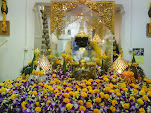
遗体已从诗里叻医院移至大皇宫披曼叻达雅皇殿入殓,进行长达100天的吊唁。国务院则通令全国政府部门向皇姐殿下致哀15天。受全民爱戴的甘拉雅妮瓦她娜皇姐殿下,从去年6月15日起,因胃肠癌症复发住进曼谷诗里叻医院接受治疗。宫务处昨天凌晨5时发布公告指出,由於病情不断恶化,皇姐殿下於昨天凌晨2时54分驾薨,享年84岁。

皇上谕示全体皇室成员按照传统的皇家葬礼和仪式,让皇姐殿下遗体在大皇宫入殓,并举哀100天,公家单位降半旗,公务员著黑色服装15天。同时赐准民众到大皇宫向皇姐殿下致哀。数千名泰国人昨天在诗里叻医院外摆放致哀的花束及花圈。甘拉雅妮瓦她娜皇姐殿下的遗体於昨天下午3时被移往大皇宫入殓,并从昨天下午起举行为期100天的皇家吊吊仪式。皇上及各位皇室成员均驾临。

泰国通讯社指出,甘拉雅妮瓦她娜皇姐殿下不仅是泰皇蒲美蓬的长姐,也是上1任泰皇的姐姐,她见证了两位泰皇在20世纪的成就,也见证了泰国在20世纪的进步与成长。甘拉雅妮瓦她娜皇姐殿下於1923年5月6日出生在英国伦敦,并在英国接受教育,对艺术、语言及历史极有兴趣,也曾经在朱拉隆功大学与法政大学教授法文、法国文学与历史课程。

本文引用地址:http://www.udnbkk.com/article/2008/0103/article_28947.html

Tuesday, 1 January 2008


HAPPY NEW YEAR!

May This New Year -

Bloom with Happiness & make your heart Replete with Joy


泰国佛牌的由来

相传古时泰国有一位督信佛教的高官,在家里供奉了一尊佛像,每天早晚均会诵经。有一天,泰国某地区出现旱灾,泰皇得悉此事便派遣高官前往灾区视察,於是,高官便回家准备前往灾区。

由於他是一位虔诚的佛教徒,希望带同那尊佛像前去灾区,好让他能早晚诵经祈福,同时藉著佛像,希望能保佑灾区,但可惜佛像太大,未能一同带往。当晚,高官做了一个奇怪的梦,梦见佛像叫他可用寺庙的泥土,按他的模样制作一个牌佩戴在身上,一同前去灾区,这样便能得到他的保护,使他平安、顺利,他醒后便按梦中指示制作牌佩戴身上。

到了灾区后,他依然每晚诵经祈福,不久,灾区的情况便好转起来及后,高官因年时已高,便向泰皇告老还乡,并将身上佩戴的佛牌奉献给泰皇,希望此佛牌能带给全国国泰民安。
其后,高官在乡间寺庙里当上僧侣修行,在修行期间,还制作佛牌,给善信奉请,希望他们也能得到佛祖的庇佑,带来好运,至此,佛牌便在民间流传开去。

时至今日,制造佛牌的材料已不单是寺庙的泥土,有些更是用一些得道高僧的骨灰、衣物、舍利子、花粉、佛门圣物等制造,而佛牌的像相、种类繁多,善信可按不同需要奉请适合的佛牌。
 
eckhart tolle