Showing posts with label Buddha. Show all posts

Thursday, 27 May 2010

Stories of Buddha

PRINCE SIDDHATTHA’S BIRTH
Queen Mahamaya, a wife of King Suddhodana of Kapilavatthu gave birth to prince Siddhattha, the Buddha-to-be, at Lumbini Park, on the Vishahka’s Full Noon Day (the sixth lunar month), 80 years before the Buddhist Era (623B.C)

ON ROYAL PARK VISIT
Prince Siddhattha (the Buddha-to-be) came across the Four Sights on his trip outside the palace: (1) an old man, (2) a sick man, (3) a dead man and (4) a wandering monk, which made him weary of conditioned things. Upon seeing these four sights, he was inspired to go forth in the Great Renunciation

THE GREAT RENUNCIATION
Returning from the last visit and learning that Yasodhara, his wife had given birth to a son named Rahula, the Prince, the 29 years old Prince cut off his hair with a sword and began an ascetic life in search of spiritual freedom from suffering

THE PRACTICE OF AUSTERITIES
The Bodhisatta, first approached some ascetics to learn their theories and practices, but was dissatisfied with them. He, then, tried by himself to discover the best way to liberation by practicing several austerities such as fasting and self mortification by with the group of Five Companions in attendance nearby.

THE MIDDLE WAY
The Bodhistta, having undergone for six years these austerities, realized that self-mortification is not the right way to enlightenment. He, then, gave it up and started the practice of Mental Development known as “the Noble Eight fold Path” or the Middle Way.

THE ENLIGHTENMENT
The Bodhisatta at the age of 35 through the Middle Way attained Enlightenment under the Bodhi Tree in Bodhagaya, India, at the dawn of the Visakha’s Full Moon Day. Thereafter, he became known as the Buddha, the Enlightened One or the Awakened One.

PREACHING THE FIRST SERMON
After two months, the First Sermon was delivered to the group of Five Ascetics at Isipatana, The Deer Park Varanasi. The principles of the Sermon were based on the Four Noble Truths: Suffering, It’s Causes, its Cessation and the Path leading to Cassation of suffering. This is known as “ The Turning of the Wheel of truth”.

THE GREAT LEADER OF 1,000 ASCETICS
At Uruvela, there were three renowned religious teachers known as “Matted Hair Ascetics”. The elder was called Kassapa having a following of 1,000 ascetics. After hearing the Buddha’s teachings, they all joined the order. When the Buddha met King Bimbisara of Rajagaha, the king and his royal retinue doubted his teachings. To eliminate their doubts, Ven Uruvela Kassapa declared himself “ the follower of the Buddha”.

THE HEART TEACHING OF THE BUDDHA
On the Magha’s Full Moon Day, nine months after his Enlightenment, the Buddha gave his most significant teachings known as “ Ovadapatimokkha”, (the Principle Teachings) to 1,250 Holy Noble Monks who assembled themselves without a prior appointment at Veluvanaram, Rajagaha.

THE GREAT COUPLE DISCIPLES
Sariputta and Moggallana, the two beloved friends of Rajagaha, along with their 250 followers approached the Buddha and asked for ordination. Later on, they both became the most well known chief disciples of the Buddha in propagating his teachings.

THE ALLOWANCE OF BIKKHUNI SANGHA
The Buddha allowed and accepted Queen Maha Pajapati, his aunt and step-mother into the Order of Bukkhuni (Buddhist nuns) along with her 500 Royal women the opportunity to experience the highest wisdom in life

THE LAST DISCIPLE
On his death bed at Kusinara, the Buddha, as his last gift, ordained Subhadda, the Wanderer, who came seeking spiritual guidance. He was the last monk who was ordained by the Buddha.

PASSING AWAY
Having preached to his last disciple, Subhadda, the Buddha passed away into Parinirvana (perfect Extinction) on the Visakha’s Full Moon Night at Salavanodayana. The Malla’s Garden one year before the Buddhist Era(543 B.C) at the age of 80. Parinirvana (Parinibbana) means “Utter or Final Nirvana” the ‘Total Letting Go’ at the moment of death of a Fully enlightened Being ( a Buddha or Arahant).

Saturday, 3 October 2009

Luang Phor Sothon

According to legend, Luang Pho Sothon floated down the Bang Pakong River to the site of the temple(temple is situated on the west bank of the Bang Pakong River, 2 Kms. south of the city hall). Efforts to retrieve it were unsuccessful until a villager had a small shrine erected on the site and performed a ceremony welcoming the image to the community.

Monday, 28 September 2009

Phra Pitha

พระปิดตา(译音)帕必达,其中ปิดตา泰文的意思是闭眼或遮眼的意思 因此可以称之为闭眼佛或是遮眼佛,而泰国的遮眼佛有很多种类型 有双手遮眼的法相,也有四臂、六臂、或是布满经咒文如同皱纹般的法相 都是属於遮眼佛(必达佛),不同的译音只是外在的法相特徵不同而已
而必达佛的佛牌,是泰国民众普遍喜爱佩带的佛牌之一,据说佩带遮眼佛 可以帮信众挡掉很多不好的事情、麻烦、避灾挡险,能够保信众的平安 也能够帮信众招来很多很好的财运,因此必达佛也是泰国的致富佛像之一!


当帕必达在世时,几世之前就已经不断累积很多的福德资粮 。在其中一世,有许多僧侣与帕必达一起修行,结果没想到在某天夜晚时, 发生了洪水,眼看就要将他们灭顶。此时,佛陀赶紧命令帕必达前去 将水阻止不动,以免这些僧侣灭顶。因此当时有许多的天人和凡人们,
都因此信服他的能力,并对他非常敬仰。此外,在帕必达之前的一世中, 他常常用鲜花供养佛陀及许多的高僧。接著帕必达转世在另一世之後, 则生为一户养牛人家的孩子。早晨的时候,他常常看到高僧沿街托钵化缘後, 会在一个空地修行打坐。由於他看到高僧总在烈日下修行,想到这必然非常辛苦, 因此趁高僧不在时,为高僧搭起简单的棚子,让高僧在打坐时可以遮阳避雨, 他也因此累积很大的福德。因此在临命终时,得升天道;但他在生为天人後,
并未耽溺於天道的逸乐,反而常常广行佛事,不断地累积福德资粮。此後, 帕必达的法像就被制作为如今所看到的样子,象徵祂用手将六根遮住, 即眼、耳、鼻、舌、身、意皆被遮止;以免受到这六根所对应到的六尘所扰, 此六尘则为外界的色、声、香、味、触、法,让人能谨记佛陀的教诲。

因此佛子佩带必达佛牌的时候,无论是在修行佛法 或是行事思考之时, 都能够让心念更加全 心专注,提升自己的思考层面;此外,在世俗上,
帕必达的法像亦被一般大众认为是挡灾避险的姿势,让人可以免於危难


Sunday, 20 September 2009

Buddha With Sunglass


There is a small shrine in Maha Chai province Thailand, it is about 2 hours drive from Bangkok. The shrine is just next to a very busy fishing port where seamen load and unload their catch daily. There is a story why this particular Buddha is wearing sunglasses.

Luangpor Poo above is one special Buddha in Wat Krok Krak at Samutsakorn Province. The statue of Luangpor Poo actually floated along the large river bank nearby and a shrine was later enacted especally for him. Maha Chai used to be just a small fishing port but has now become a major and important place where business takes place. A man once went to Luangpor Poo and seeked for helped hoping that his life and business would improve. His wish was granted not too long and this faithful devotee actually went back to do thanks giving. He did what any normal devotee would by giving traditional offerings, before he left the temple he was asking himself what else has he not given to Luangpor Poo alas he found that he has a sunglass with him and he put it on the Buddha.I am not sure if this one here is true but someone actually removed the sunglasses from the buddha because he thought that it was disrespectful. Some people said that he became blinded after doing that and he went to replace the glasses back.

Luangpor Poo is also known to grant his devotees wishes qucikly and swiftly so if you want your wish to come true go pay Luangpor Poo a visit.

Friday, 28 August 2009

四面神/四面佛

四面神是婆罗门教三大主神之一「大梵天」,所以正确来说,它是四面神而不是四面佛. 四面佛只是人们不知底蕴下,对祂的称谓。

在婆罗门教的传说中,大梵天是在那拉亚那神的肚脐上发芽的莲花中诞生。大梵天创造了人类、神仙以至魔鬼。

四面神的四个头分别朝向四方,祂的四面、八耳、八臂、八手,每隻手都拿有不同圣物,各有不同意思。

其中一种说法是指,一手持令旗(代表万能法力);一手持佛经(代表智慧);一手持法螺(代表赐福);一手持明轮(代表消灾、降魔、摧毁烦恼);一手持权杖(代表至上成就);一手持水壶(代表解渴、有求必应);一手持念珠(代表轮迴);一手持接胸手印(代表庇佑)。

不过,也有传说认为,大梵天其实也属佛陀的护法天神,有慈悲、仁爱、博爱、公正这四种性格,四面也对应了佛学的慈、悲、喜、捨。

拜祭有守则
很多人到泰国拜祭四面神或四面佛,不过对于真正的拜祭方式却未必人人知晓。当然,不同的人自然有不同的说法,不过最多人相信的,便是拜祭四面佛时,若自己工作的行业属正当行业,便依顺时针方向拜祭,若是做偏门的行业,则以逆时针的方向拜祭。插香时也有不同的做法,平常的人会在每一边插三支香,不过也有一种做法,就是点起七支香,由自己选择开始拜祭的方向次序,到第七支香供奉的一面,便代表这个方向的四面佛和自己的缘份较厚。

另外,有说还神要跳裸舞,其实只是因为四面佛喜欢看到人间的欢乐和热闹,并不是四面佛心存绮念。

四面各有意义
四面神的正面代表慈,顺时钟转去则是第二面代表悲,顺转下去到第三面代表喜,最后顺转到第四面则是捨。四个方向除有不同的意义外,也对应代表祈求不同的事情。正面的慈代表求取学业、事业、声望和地位,第二面悲代表求取爱情、婚姻等人际关係,第三面喜则是求取收入、富贵等,第四面捨是求健康、解难消灾等。

Tuesday, 25 August 2009

观世音

妙善公主
有关观音菩萨来源的传说,最常见当属妙善公主的说法。据说观世音父为印度的妙庄王,母为宝德后,观音名叫妙善,是三公主,爱修行学佛。她违抗父命到白雀寺出家,触怒父王把她处死。她的灵魂游览阴府后再还阳,在大香山苦心修炼,成了正果。后来更济度她的父母,观音既救苦救难,同时亦普渡众生,为了要同时应付众生的求助,所以观世音亦有多个化身,随时准备回应呼救。
本为男儿
在一些佛经传说中,观世音本为印度一位国王的长子,名叫不煦,和父亲及弟弟都随释迦出家修行,后来释迦牟尼佛给他父子改了名,父亲称「阿弥陀佛」,两个儿子称为「观世音」与「大势至」。观世音在左掌慈悲门,大势至在右掌智慧门,共同襄赞阿弥陀佛的教化,合称「西方三圣」。到唐朝时,因避太宗李世民之讳,把「世」字去掉,简称为「观音」。观世音在印度、东南亚、西藏等地都是男身,起初传到中国也是男人形象,唐末以后才有女身出现,而且法相变化多端。观世音有多变的形象,可能多达三十三种,最常见的有千手千眼观音、白衣观音、送子观音等,为了应世点化世人,观世音就会幻化出无数种形象,解救人们于危难之中。另有传说指古时候有堕胎和难产而死的女子下地狱后要在血池中受苦,只有观世音菩萨头上的九头龙,可以接近血池,吸乾血水拯救妇女,此为观音救苦救难的其中一个传说。

Sunday, 23 August 2009

History of Lord Buddha

Siddhartha (Buddha) was born around 563 B.C. in the town of Kapilavastu (located in today's Nepal). Siddhartha's parents were King Shuddhodana and Queen Maya, who ruled the Sakyas. His history is a miraculous one...

One night, Queen Maya dreamed that an elephant with six tusks, carrying a lotus flower in its trunk, touched her right side. At that moment her son was conceived. Brahmins (learned men) came and interpreted the dream. The child would be either the greatest king in the world or the greatest ascetic (a holy man who practices self-denial). The future child would be named Siddhartha, which means "he whose aim is accomplished." Later when Queen Maya was going to her father's home to prepare for the birth, she stepped off her chariot in the Lumbini Gardens and held the branch of a sal tree to rest. In that instant, Siddhartha emerged from her right side without any help. The infant walked seven steps each in four directions of the compass, and lotus flowers sprouted from where his foot touched the earth. Then the infant said, "No further births have I to endure, for this is my last body. Now shall I destroy and pluck out by the roots the sorrow that is caused by birth and death." Seven days later Queen Maya died.

Mahaprajapati, Maya's sister, looked after Siddhartha. King Shuddhodana shielded Siddhartha from all kinds of suffering and hardship. When Siddhartha was about 20, he married Yasodhara, daughter of one of the King's ministers, and one year later they had a child named Rahula (meaning "fetter" or "impediment"). At age 29, Siddhartha asked his charioteer, Channa, to take him out of the city two times without the consent of the king. During these two trips, Siddhartha saw "Four Sights" that changed his life.

On the first trip, he saw old age, sickness, and death. The second trip, he saw a wandering holy man, an ascetic, with no possessions. Siddhartha started questioning the holy man, who had a shaved head, wore only a ragged yellow robe, and carried a walking-staff. The man said, "I am... terrified by birth and death and therefore have adopted a homeless life to win salvation... I search for the most blessed state in which suffering, old age, and death are unknown." That night, Siddhartha silently kissed his sleeping wife and son, and ordered Channa to drive him out to the forest. At the edge of the forest, Siddhartha took off his jeweled sword, and cut off his hair and beard. He then took off all his princely garments and put on a yellow robe of a holy man. He then ordered Channa to take his possessions back to his father.

Siddhartha then wandered through northeastern India, sought out holy men, and learned about Samsara (reincarnation), Karma, and Moksha (freedom from the cycle of life and death). Attracted to the ideas of Moksha, Siddhartha settled on the bank of Nairanjana River, and adopted a life of extreme self-denial and penances, meditating constantly. After six years of eating and drinking only enough to stay alive, his body was emaciated, and he was very weak. Five other holy men joined him, hoping to learn from his example.

One day, Siddhartha realized that his years of penance only weakened his body, and he could not continue to meditate properly. When he stepped into the river to bathe, he was too weak to get out, and the trees lowered their branches to help him. In that instant, a milk-maid named Nandabala came and offered a bowl of milk and rice, which Siddhartha accepted. The five holy men left Siddhartha after witnessing this. Refreshed by the meal, Siddhartha sat down under a fig tree (often referred to as the Bo tree, or Tree of Enlightenment) and resolved to find out an answer to life and suffering. While meditating, Mara (an evil god) sent his three sons and daughters to tempt Siddhartha with thirst, lust, discontent, and distractions of pleasure. Siddhartha, un-swayed, entered a deep meditation, and recalled all his previous rebirths, gained knowledge of the cycle of births and deaths, and with certainty, cast off the ignorance and passion of his ego which bound him to the world. Thereupon, Siddhartha had attained enlightenment and became the Buddha (enlightened one). His own desire and suffering were over and, as the Buddha, he experienced Nirvana... "There is a sphere which is neither earth, nor water, nor fire, nor air...which is neither this world nor the other world, neither sun nor moon. I deny that it is coming or going, enduring, death or birth. It is only the end of suffering." Instead of casting off his body and his existence, however, Buddha made a great act of self-sacrifice. He turned back, determined to share his enlightenment with others so that all living souls could end the cycles of their own rebirth and suffering.Buddha went to the city of Sarnath and found the previous five holy men that deserted him earlier at a deer park. When they saw Buddha this time, they realized that he had risen to a higher state of holiness. The Buddha began teaching them what he had learned. He drew a circle in the ground with rice grains, representing the wheel of life that went on for existence after existence. This preaching was called his Deer Park Sermon, or "Setting in Motion the Wheel of Doctrine." Siddhartha revealed that he had become the Buddha, and described the pleasure that he had first known as a prince, and the life of severe asceticism that he had practiced.

Neither of these was the true path to Nirvana. The true path was the Middle Way, which keeps aloof from both extremes. "To satisfy the necessities of life is not evil," the Buddha said. "To keep the body in good health is a duty, for otherwise we shall not be able to trim the lamp of wisdom and keep our mind strong and clear." Buddha then taught them the Dharma, which consisted of the Four Noble Truths and the Eightfold Path. The five holy men and others soon joined Buddha, accompanying him everywhere. As more joined, Buddha organized the Sangha, a community of Bhikkus (dedicated monks and later nuns). The Sangha preserved the Dharma, and allowed Bhikkus to concentrate on the goal of Nirvana. On raining seasons they would settle in Viharas (resting places in cave dwellings). Upasaka, followers who believed in Buddha's teachings, but could not follow the strict rule of the Sangha, were taught to follow the Five Precepts.

Buddha returned to his birthplace in Kapilavastu, and his father was mortified to see his son begging for food. Buddha kissed his father's foot and said, "You belong to a noble line of kings. But I belong to the lineage of Buddhas, and thousands of those have lived on alms." King Shuddhadana then remembered the Brahmin's prophesy and reconciled with his son. Buddha's wife, son, and cousin (Ananda) later joined the Sangha. When Buddha was about eighty, a blacksmith named Cuanda gave him a meal that caused him to become ill. Buddha forced himself to travel to Kushinagar, and laid down on his right side to rest in a grove of shala trees. As a crowd of followers gathered, the trees sprouted blossoms and showered them on Buddha. Buddha told Ananda, "I am old and my journey is near its end. My body is like a worn-out cart held together only by the help of leather straps." Three times, Buddha asked the people if they had any questions, but they all remained silent. Finally Buddha said, "Everything that has been created is subject to decay and death. Everything is transitory. Work out your own salvation with diligence.
After passing through several states of meditation, the Buddha died, reaching Parinirvana (the cessation of perception and sensation).

Thursday, 2 July 2009

Buddhism Ritual

Buddhism rituals and practices comprise of very intricate and detailed prayers. Prayer or Puja in Buddhism is mainly a way of expressing dedication towards God and making offerings to Him. Meditation also forms a part of the rituals & practices in Buddhism.

Following of the rituals moves a person forward, on the path to enlightenment. The prayers are initiated with the evoking of a sangha. After the Sangha has been evoked, sadhaka or dharma student performs three prostrations, also known as three gates or three aggregates.

They consist of the body, the speech and the mind. They also indicate that the student has acknowledged the three bodies of Buddha, namely the Dharmakaya, the Smbhogakaya and the Nirmanakaya.

In the prostrations, five parts of the body touch the ground. These five body parts include the two palms, the two knees and the forehead, signifying the five elements of earth, water, fire, air and space. The other interpretations of the protestations symbolize the five wisdoms emanating from the five Buddha families and the five Buddha energies.

As a student performs these protestations, he surrenders himself to the Buddhas of past, present, and future and ten directions. The folded hands also connote a deeper meaning as a part of the Buddhist rituals. The touching of the ten fingers with each other symbolizes the ten directions. The right hand represents the male, active, yang energy, while the left hand represents the female, receptive, yin energy. When both of them join, they epitomize the Buddha's enlightening activity of upayakaushalya.

A number of other rituals also, follow these offerings to the deities and the three Jewels. These rituals include Bodhisattva vows, the 100-syllable Vajrasattva mantra, mandala offerings and the seven-line prayer of Guru Rinpoche and mon-lam prayers. After these rituals have been performed, the student practices meditation on shunyata or emptiness. The prayers come to an end with a ritual in which people express joy over the good deed and merit of others. They also request Buddha to teach them and not enter in parinirvana.

Tuesday, 30 June 2009

Buddhism Facts

Buddhism is the fourth largest religion of the world. Founded by Gautam Buddha, it is a path of spiritual development that helps a person in finding the true nature of life. Buddhism emphasizes on experiencing, rather than teaching or learning.

It considers meditation as the means to enlightenment and is based on a number of principles. The followers of Buddhism do not worship any God and follow the noble eightfold path to lead a meaningful existence. In the following lines, we have provided some quick information on Buddhism in a brief form. Read on to know some facts about Buddhism …

Meaning: System taught by the Buddha
Founded In: 6th Century BC Place
founded: North India
Founder: Siddhartha Gautama ("the Buddha"), an Indian prince
Followers: 376 million
Size: Fourth largest religion in the world
Main locations: China, Japan, Korea and Southeast Asia
Main Sects: Theravada and Mahayana
Sacred texts: Pali Canon (Tripitaka), numerous Mahayana sutras
Original language: Pali
Spiritual leader: Monk (lama in Tibetan Buddhism)
Place of ritual: Temple, meditation hall.
Theism: Varies - Theravada is atheistic; Mahayana is more polytheistic.
Ultimate reality: None, Nothing is permanent.
Holidays: Buddha's birthday, Buddha's enlightenment and lunar quarters

Monday, 29 June 2009

What is Theravada Buddhism

Theravada literally means 'The Way of the Elders'. This term embodies the entire sect in itself, as Theravada Buddhism is based on the original beliefs and practices of the Buddha and the early monastic Elders.

Also known as Hinayana Buddhism, it is mainly predominant in southern Asia, especially in Sri Lanka, Myanmar (Burma), Thailand, Cambodia and Laos. Just like Mahayana, Theravada is also based on the Pali Canon, which comprises of an early Indian collection of the Buddha's teachings.

Theravada Buddhists have a sole purpose in life, which is to become an arhat. Arhat is the name given to a saint who has reached nirvana and will not be born again. For this, they follow a rigorous austere existence and renounce the world. As per Theravada or the 'Lesser Vehicle', a layman can never ever achieve nirvana. There are the following four stages through which a Theravada Buddhist can become an arhat:
Sotapanna (Stream-enterer)
Sotapanna is the stage where the person is a convert. To attain this stage, he has to triumph over the false beliefs.
Sakadagamin (Once-returner)
The stage of Sakadagamin is that of being reborn again. It can be achieved by conquering lust, hatred and illusion.
Anagamin (Never-returner)
The stage of being reborn in heaven is known as Anagamin. It is the stage where he becomes an arahant.
Arhat (Worthy one)
The last stage is known as Arhat. Here, the person has attained perfect enlightenment and will never be born again.
胡

Thursday, 11 June 2009

求拜星期佛 一年行好运

只要知道自己是在星期几出生,可来到注明是代表星期几的佛像前虔诚膜拜,就能保佑你行好运。
是不是有些匪夷所思?
这种膜拜法在泰国的芭堤雅盛行已久,一个星期有七天,从星期一到星期天,每天都塑造一尊佛像作代表,只要查明自己的出生日期属星期几,就可前来膜拜。星期一至星期日里头,唯独星期三多了一尊佛像,据称这是因为星期三分为白天跟晚上两个佛像,佛像分别为以下名称:

星期日:成道佛祖、
星期一:平定佛祖、
星期二:涅槃佛祖、
星期三:托钵佛祖(上午)、禅定座佛(下午)、
星期四:冥想佛祖、
星期五:内观佛祖、
星期六:蛇神护法佛祖。

这七尊佛像每一尊都呈现出不同的形态与姿势,传说拜过这七尊佛像的人,一整年里都会走好运。

Sunday, 24 May 2009

Phutthamonthon

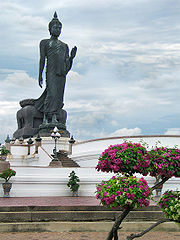
Phutthamonthon (พุทธมณฑล, also often called Buddha Monthon) is a Buddhist park in the Phutthamonthon district, Nakhon Pathom Province of Thailand, west of Bangkok.

It is highlighted by a 15.87 m (52 ft) high Buddha statue, which is considered to be the highest free-standing Buddha statue of the world. The park was created in 1957 (which was the year 2500 in the Thai Buddhist Era) on the basis of an idea of Thailand's prime minister, Phibunsongkhram.

The park covers an area of about 400 hectares, which in traditional Thai units is 2500 rai. Construction started on July 29, 1955, and the park was inaugurated on the Vaisakh Bucha day (May 13) in 1957. After a long pause construction on the park resumed in 1976; notably, the main Buddha statue was built after that time. Already designed in 1955 by art professor Silpa Bhirasri, the statue was cast in 1981. Given the name Phra Si Sakkaya Thotsaphonlayan Prathan Phutthamonthon Suthat by King Bhumibol Adulyadej,which 15.875 m high and located at the centre of the park.

Around the statue are sites memorialising the four main stations in the life of Buddha: his birth symbolized by seven lotus flowers, his Enlightenment under the Bodhi tree, his first sermon and his death. Another important building is the marble viharn, which contains the entire Buddhist canon engraved in 1418 marble stelas.
Source - Wikipedia
胡

Friday, 24 April 2009

Pictures_ Wat Mahathat, Ayutthaya


Famous Buddha head in the Tree Trunk

Wat Mahathat is typical of the Ayutthaya ruins: large crumbling stupas surrounded by low laterite walls and rows of headless Buddhas.


Rows of Headless Buddhas


Buddha Image in the viharn at Wat Mahathat, Ayutthaya

Monday, 23 February 2009

Face - Washing Ceremony

Myanmar Buddhist people have strong and staunch belief that the GREAT IMAGE personified the living Buddha. They must do something in honor of Buddha and they initiate a ritual of washing the face with fragrant scented water and cleaning the teeth of the GREAT IMAGE.

In February 17, 1988, the Ven. Sayadaw Buddhanta Pannya Vamsa of South Htilin monastery, Pitaka Kyaung, commenced his daily routine of washing and cleaning the face of the GREAT IMAGE at dawn.

The washing and cleaning ceremony starts at early 4.30 a.m. every day. The towels are offered by lay devotees and after the ceremony, the towels are given to the worshippers to be honored at their home shrines. Only the male devotees are permitted to apply gold leaf on the IMAGE. For female worshippers, the said kind of donation is carried out by pagoda officials on their behalf.

Wednesday, 18 February 2009

Maha Muni, the most venerated temple - pagoda in Mandalay

The Maha Muni Buddha is a celebrated huge sculpture of Lord Buddha in the Maha Muni Pagoda - called PAYAGYI by the Buddhist devotees with reverence and veneration.

MAHA MUNI is meant THE EXALTED SAGE AND SAINT. This GREAT IMAGE (picture below )was brought from Myohaung in the Rakhine state during the reign of King Bodawpaya in 1784 over difficult terrain of high overhanging mountain ranges and Ayeyarwady River and enshrined in a imposing building in Amarapura.

Though the building that housed the great image caught fire, the image was saved. Originally, IT was made of alloy but now being heavily gilded with gold, increasing day by day; it is estimated to weigh more than one ton of gold. The golden crown of the Maha Muni is studded with several precious stones and gems, rubies, sapphires, emeralds, jade, diamonds, etc. donated by pious devotees.

The Great Image is in a sitting posture
with legs folded under the body in Bhumi Phatha Mudra and resting on a pedestal, 6 ft-10 in high. Its dimensions taken in 1917 are as follows:

1. Height 12 ft-7 in
2. The waist 9 ft-6 in
3. The arms 4 ft-11 in
4. Breadth from shoulder to shoulder6 ft-1 in
5. Breadth at base 9 ft-0 in

Continuous gilding with gold leaves has decidedly changed the said dimensions.

Thursday, 22 January 2009

Buddha Image for Wednesday Night~~Phra Palelai

Wat Thong Khung

Nong Khai

Doi Suthep. Chiang Mai


Thursday, 13 November 2008

Fasting Buddha


Fasting Buddha @ Wat U-Mong temple in Chiang Mai, Thailand

The young prince Siddharatha left his palace in search of enlightenment and practised for six years such severe austerities and intense mental concentration that his beautiful body withered away to skin and bones. Ultimately he attained enlightenment at the age of thirty five and became known as the Buddha "The enlightened one".

Saturday, 8 November 2008

The Trimurti Shrine

Trimurti refers to the Trinity of Hindu Gods consisting of Brahma the creator, Vishnu the sustainer and Siva the destroyer, the three most important gods in Hinduism.The deity is a gold statue of a human body with two heads and four arms. The heads are one on top of the other; the lower head has four faces.

Built in 1989, the Trimurti Shrine is on a raised platform, sheltered by a dome on four pillars with elaborately carved gables at the four sides.
There's an open area around the shrine with a ring of seats for worshippers to sit and reflect.
Crafted in classical Indian sculpture with a Thai touch, the statue is a replica of the original from old Ayutthaya.

Like other shrines in Bangkok, the Trimurti Shrine was built to answer the prayers of people seeking success, prosperity and happiness.

The shrine somehow acquired a reputation of granting happiness in romance, as it's very popular with young Thais who associate the shrine with the god of love.
Legends build upon themselves and as the fame of the shrine grew, so did the flock of faithful. Such is the renown of the shrine that it's sometimes referred to as the Lovers' Shrine.There's an air of peace and serenity around the shrine and the place just has a natural draw for people.

The Trimurti Shrine is along Ratchadamri Road, in front of Isetan Department Store, next to the Ganesha Shrine, at CentralWorld Plaza. The easiest way to reach here is to take the BTS Skytrain. The Sukhumvit Line and Silom Line converge at Thanon Rama 1 (Rama 1 Road) in front of CentralWorld. Alight at either the Siam station or Chit Lom station, then walk to CentralWorld.

Thursday, 25 September 2008

Nang Kwak Mantra


Nang Kwak (นางกวัก) Thai. 'Beckoning lady'. Female statue (Nang) with one or both arms raised and summoning with her hand(s) as if to gesture or to beckon (kwak). She invites happiness and good fortune and is often found displayed in shops to attract good business. Usually portrayed with a large purse full of money.

(simplified version)

Na-Sha-Li-Thi


(Longer Version)


Omm Pu Chao Kaow Keao Mi-Look Sau Khun Diao

Ci wa Nang KwakChaiHin Chai Rak

Yin hen Yin Tak Pa Ku Pai Kar

Teng Meng Man Kar Hua Wen Ketai Sen Tar Nan

Sam Ren Krab Pan, Ren Pian Set-Ti

Sam Pee Ren bian Sam Pau Thong

Phra Suk Teh Ka Khun Diao


胡
 
eckhart tolle