胡
Thursday, 29 November 2007
龙婆本大师
龙婆本大师,生于佛历2466年即公历1923年,大师本于泰国屈通角佛寺向龙婆靓大师学习佛理,学成后便在佛历2491年即公历1948年,改投屈班拍佛寺的龙泡谦大师门下,而且更是龙泡谦大师的最后一名弟子,大师在龙泡谦大师这里学会古代医术、符咒纹身、及各种佛法,大师天资聪敏,尽得其真传后,大师便云游修行,其间机缘巧合,在山中遇上泰国出名的苦行僧人,龙婆胡怕史大师,难得有此机缘,大师便与龙婆胡怕史大师,一起学习交流各种佛理法门,为期约1年,而大师云游苦修共历9年之久。其后大师受到屈通难挡佛寺当了5年住持。于佛历2505年即公历1962年,大师离开屈通难挡佛寺,回到家乡地区,而且成为屈港咳牟佛寺住持,大师的第一期佛牌,便是在屈通咳牟佛寺制造,大师更在屈通咳牟佛寺开始为善信纹符。佛历2517年即公历1974年,大师正式前往屈班拍佛寺上任住持一职,直至现今。在屈班拍佛寺,大师继续为善信纹符及制造佛牌,而其中大多有老虎图像,据称,原来大师在修行期间,老虎都会听大师诵经,大师见老虎代表权力,便在为善信纹符及佛牌上亦常常加上老虎图像,而且佛寺内,到处都可见到大师骑老虎之像,因此大师亦有伏虎罗汉之称号。而最为特别是在每年三月,屈班拍佛寺,都会由大师举行一个集体法会,其间当大师开始念诵经文的时候,一些有大师纹符而定力不够的善信,当听到大师念诵经文时,身上的符咒会吸收经文的力量产生共鸣,更会被符咒力量控制,有些会手舞足动,跟随身上所纹的符印而动,例如纹了老虎而定力不够的善信,便会作出一些像老虎的动作,到最后大师为善信洒佛水后,才会平静下来的。龙婆本大师于2002年6月30日因心脏病于医院中圆寂。
胡
胡

Luang Por Pern
 Luang Phor Pern 12.08.BE2466 - 30.06.BE2545
LP Pern Tithakunoe was born in Thambon Bang Gaew Nakhon Pathom on 12/8/2466.
Shortly after his birth, his parent decided to move to a small village of Baan Tung Kork, in the district of Sorng Pi Norng province of Supannburii. At that time Supanburii was a territory that teemed with Nak Laeng and infamous highwayman. SupannBurii province which have most tiger in thailand called "Tiger Land". Luang Phor Pern who was still a Layman, found it wise to source some magic charm to protect himself. In addition to this, he had always been attracted to Buddhist Magic used by warriors in the historic past and he was seriously interested in all things paranormal.
Shortly after his birth, his parent decided to move to a small village of Baan Tung Kork, in the district of Sorng Pi Norng province of Supannburii. At that time Supanburii was a territory that teemed with Nak Laeng and infamous highwayman. SupannBurii province which have most tiger in thailand called "Tiger Land". Luang Phor Pern who was still a Layman, found it wise to source some magic charm to protect himself. In addition to this, he had always been attracted to Buddhist Magic used by warriors in the historic past and he was seriously interested in all things paranormal.
He became a Lay Disciple of LP Daeng who was in turn a disciple of LP Hnoeng ( Wat Klong Madan), an expert in matters of Socery. He was ordained at the age of 26 by Phra Ajahn Huem, who was also his teacher in Buddha Magic and Sorcery.
After this, LP Pern went "Tudong" in the jungles at Kanchanaburi. He crossed the border into the realm of Burma, through the remotes areas of Saesawoe and Bang Graenggawia; known in the time being the thickest darkest Jungle, full of dangerous animals and unknown fevers.
According to Thai beliefs, there was added dangers of "Naang Mai" ( wicked fairies & tree spirits), Phii Phoeng and Phii Phaa (Jungle ghost) and all sorts of evil spirits. It is said that at the time of his return of pilgrimage, it was protected by a tiger, which accompanied him until orée by the jungle. Since, the tiger became the protective symbol of the Master.
According to Thai beliefs, there was added dangers of "Naang Mai" ( wicked fairies & tree spirits), Phii Phoeng and Phii Phaa (Jungle ghost) and all sorts of evil spirits. It is said that at the time of his return of pilgrimage, it was protected by a tiger, which accompanied him until orée by the jungle. Since, the tiger became the protective symbol of the Master.
He became the abbot of Wat Tung Nang Lork for 5 years and returned to the jungles to practice the ancient ascetic meditation practices. He later became the abott of Wat Koeg Khaemao in Nakorn Pathom. As the Wat was in a very bad state of repair and was very inaccessible, being thickly forested, he developed and repaired the temple by consecrated his very first amulet and through donations received in return for these amulet, he renovated the temple.
He was invited to become abbot of wat bang phra where he became better known for spiritual tattoos or yant expecially the tattoo festival in the month of March.
He is a monk of great personality and great compassion to help folks with his magic. Devotees believed that Luang Phor Pern’s tattoos can stop bullets and blades, prevent road accidents, improve business, induce trances, and calm your mind.
(website for wat Bangpra – http://www.bp-th.org/)
胡
Wednesday, 28 November 2007


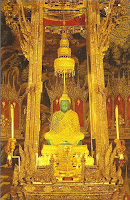
The Emerald Buddha at Wat Phra Kaew
According to popular belief, the Emerald Buddha is ancient and came from Sri Lanka. Art historians, however, generally believe that it was crafted in 14th-century Thailand.
The much-revered Buddha image has traveled extensively over the centuries. The story goes that the Emerald Buddha was once kept covered in plaster in a monument in Chiang Rai, but a damaging lightning storm in 1434 uncovered the treasure.
The king of Chiang Mai tried very hard to procure the statute, but three times the elephant transporting the statute stopped at a crossroads in Lampang. Taking it as a sign from the Buddha, the statue was placed in a specially-built monumental temple in Lampang, where it stayed for 32 years.
The next king of Chiang Mai was more determined, succeeding in bringing the Emerald Buddha to his city. It was housed in a temple there until 1552, when Laotian invaders took it. The statue stayed in Laos for 214 years, until General Chakri (later King Rama I) brought it back to the Thai capital at Thonburi after his successful campaign in Laos.
In 1784, when he moved the capital across the river to Bangkok, King Rama I installed the precious figure in its present shrine, where it has remained as a tangible symbol of the Thai nation. It is feared that removal of the image from Bangkok will signify the end of the Chakri dynasty.
The Emerald Buddha itself is simply the jade statue, but it is adorned with garments made of gold. There are three different sets of gold clothing, which are changed by the King of Thailand in a ceremony at the changing of the seasons - in the 1st Waning of Lunar Months 4, 8 and 12 (around March, July and November). The three sets of gold garments correspond to Thailand's hot season, rainy season, and cool season. The two sets of gold clothing not in use at any given time are kept on display in the nearby Pavilion of Regalia, Royal Decorations and Thai Coins on the grounds of the Grand Palace, where the public may view them.
Wat Phra Kaew ( The emerald Buddha)
Location: Na Phralan, Phra Nakorn ( inside the Grand Palace complex)
Open : 0830-1200 and 1300-1530
Admission : 125baht.
胡
皇储主持玉佛换装仪式
 皇储殿下昨天下午驾临大皇宫玉佛寺,代表皇上陛下赐主持玉佛换装仪式。图为皇储替翡翠玉佛换上冬季黄金装.
玉佛每年会有国王来亲自主持仪式,给玉佛换装。玉佛一共有三套不同的金装.
热季是镶钻的黄金衣服; 雨季是蓝宝石装饰的金衣; 凉季是纯金打造的衣服,上面还加一件琺瑯长袍.
这一切都只是为了烘托一个无价之宝, 那就是这尊由一整块翡翠雕刻而成的玉佛,高66公分,最宽处48.3公分. 祂从被发现到安置于玉佛寺的300多年漫长流浪史,让祂更增加几分神秘传奇色彩.
玉佛首先出现是1464年,清莱的一座佛塔中,泥塑的佛像鼻头石灰脱落,露出内部璀灿的色泽,才被发现原来是一尊玉佛. 这尊稀世珍宝迅速地被清迈城主迎接如城,不料载送玉佛的大象在运送途中居然向南奔(Lampang) 奔去, 城主逐将玉佛供奉于南奔城内的佛寺,长达32年.
另一位城主最后还是将玉佛请回清迈,安置于城内的地隆寺,寮国入侵后,把玉佛迎请到寮国首都永珍,并在寮国供奉长达200余年,直到1784年泰国一世挥军北上,征服永珍,才把玉佛接回曼谷,建立玉佛寺安置,并成为王室专用的佛寺.
胡
般若波罗蜜多心经
 观 自 在 菩 萨, 行 深 般 若 波 罗 蜜 多 时, 照 见 五 蕴 皆 空, 度 一 切 苦 厄。 舍 利 子, 色 不 异 空, 空 不 异 色; 色 即 是 空, 空 即 是 色。 受、 想、 行、 识, 亦 复 如 是。 舍 利 子, 是 诸 法 空 相: 不 生 不 灭, 不 垢 不 净, 不 增 不 减。 是 故 空 中 无 色, 无 受 想 行 识。 无 眼 耳 鼻 舌 身 意, 无 色 声 香 味 触 法。 无 眼 界, 乃 至 无 意 识 界。 无 无 明, 亦 无 无 明 尽; 乃 至 无 老 死, 亦 无 老 死 尽。 无 苦 集 灭 道, 无 智 亦 无 得。 以 无 所 得 故, 菩 提 萨 埵 , 依 般 若 波 罗 蜜 多 故, 心 无 挂 碍。 无 挂 碍 故, 无 有 恐 怖, 远 离 颠 倒 梦 想, 究 竟 涅 槃 。 三 世 诸 佛, 依 般 若 波 罗 蜜 多 故, 得 阿 耨 多 罗 三 藐 三 菩 提。 故 知 般 若 波 罗 蜜 多, 是 大 神 咒, 是 大 明 咒, 是 无 上 咒, 是 无 等 等 咒。 能 除 一 切 苦, 真 实 不 虚。 故 说 般 若 波 罗 蜜 多 咒, 即 说 咒 曰: 揭 谛 揭 谛, 波 罗 揭 谛, 波 罗 僧 揭 谛, 菩 提 萨 婆 诃。
胡
Tuesday, 27 November 2007
周冠罗大师
周冠罗大师出生于佛历2440年2月5日,家中共有5兄弟姊妹,他为长子。在泰王六世时期,他是第一批在泰国大学毕业的学生,毕业后他去了皇宫内当官员,每天负责协助国王的日程和事务安排。至佛历2468年第六世皇圆寂后,他十分伤心的离开了皇宫, 当时他的父母见到大师因六世皇的死而感到十分之伤心,便为他介绍了一位年轻的女教师,但大师对他的父母说,他只想出家成为和尚并在同年的3月23日,六世皇火葬的前一天,他在Wat Dhepsirin佛寺正式出家成为僧侣,为六世皇念经,及后在庙内渡过了他一生的旅程。 其后大师拜了崇笛拍不布崇赞、拍不怀赢干、屈崇文那屈下的主持拍如都史啦刚为师,向他们学习法门。 而大师从来不接受任何善信的任何捐赠,严守僧侣的每一条的戒律,而曾经有一些善信向寺庙内的主持投诉,大师回答说,他的出家只是为了为六世皇加持祝福及向佛佗学习,他每天都在不断的修行,而善信是来自外面的世界,带有外面的问题,他不希望介入。而当主持听 了他的解释后,便没有再向他追问。大师从2468年开始他的出家生活,每天只会进食一些蔬菜及壳类,从不间断每一天的早课和晚课,不论在下雨天、甚至是打仗的其间,大师都从未有离开佛寺;于第二次世界大战时期,Wat Dhepsirin佛寺旁的曼谷火车站受到敌人炸弹猛烈轰炸,甚至波及佛寺,众僧侣为了安全都逃离佛寺,唯独大师继续留在佛寺,为的是坚守着自已在庙内一份的信念。 而大师一生从来都没有制造过任何佛牌,只会参与加持开光,但他有份参与念经的佛牌,都拥有不可思议的力量,而大师为信众洒圣水加持时,都会有强烈的白光散发出来,且曾被人拍照证明过,曾经亲自拜见过大师的人,都称其拥有神奇及能预知未来的力量,其中包括预知自己之死亡;在大师圆寂前一天,大师已预先吩咐其侄儿明天以后都不用为大师准备食物;及至第二天,即佛历2514年1月8日,其74岁仙游的当天,他睡在他自已的蚊子网里,双手放在胸前,念了他人生最后一次尊敬佛佗的经文,走完了大师僧侣的一生。
Luangpor Khoon admitted to hospital
 Renowned monk Luang Phor Khoon Parisuttho was admitted to a local hospital in Nakhon Ratchasima yesterday morning suffering from a high fever and nausea.
The abbot of Wat Ban Rai in Dan Khun Thod district has been treated and diagnosed with mild sepsis. Visitors are barred from seeing the 84-year-old monk, at least for the next three days until doctors can reach a final diagnosis.
Doctors said the monk was pale and had became lethargic, and his lips were still dry as a result of a nervous malfunction, but his fever and vomiting had stopped after he received initial treatment, including intravenous antiseptic medication and a saline solution.
Close aides said the monk met with a large number of visitors during the Loy Krathong festival last Saturday and doctors said his illness could have stemmed from a lack of rest.
Luang Phor Khoon has had an immunity defection after he underwent a bypass operation seven years ago.
He still suffers from palsy stemming from a stroke three years ago, in addition to diabetes and high cholesterol levels.
Published on November 27, 2007 The Nation
胡
Monday, 26 November 2007
Chao Khun Nor's teachings
Personal magnet
Those who have a good heart or sympathy for other people are blessed with their own virtues. Some of these virtues include perseverance, industriousness, strength and benevolence. Since these people are not arrogant, they stand to be loved or receive help from those around them.
The gentle will receive love and help from others. Gentleness is the personal magnet of a virtuous person. If you retain the virtues, they will help you achieve your goals anytime, in the present and the future.
Give what you want
You must remember that if you would like to receive kindness (metta) and sympathy from others, you should extend kindness and sympathy to them, too. Then you'll get kindness and sympathy in return. This is the law of the powerful spirit. If you do this, all of the success you aspire to will be achieved, without a doubt.
A state of elation
Avoid the words "not feeling well". Don't allow what they mean to happen to you. Let it go and get it out. Even before "not feeling well" happens to you, let it go. If you are not careful, it could make its way into your feelings again. Then you must get it out. Don't let the idea of not feeling well remain in your mind, because you'll get used to it. If you do, you will become a weak person, and whenever there are any small mistakes, you will not feel well. This "not feeling well" is the enemy and the devil. It stirs your mind, making the nerves and brain work abnormally. The body will function in an abnormal way. Before we do anything, or while we're doing something, we must feel good after finishing it. Our mind or spirit must be in a state of elation. This will boost the body and the mind. We have to enjoy living.
Peace
The Lord Buddha teaches that peace is real happiness. We may find happiness by watching a play or a movie, socialising with others, being in love and getting married or receiving honours, but these kinds of happiness are marred by other suffering that need to be tackled constantly or alleviated. This is unlike happiness that is gained from peace or serenity, which is an in-depth happiness without any interference from suffering and without any need of further improvement.
This happiness can be realised in a very simple way - with our mind. When we're in a quiet corner, we can also have peace. If we live in a social environment, we can have happiness by separating our mind to search for peace. Although the social environment is troublesome, it can't bother our mind.
When we suffer from physical pain, we can strive for peace of mind, and then the physical pain cannot make us suffer. When the mind is at peace, the body will also be at peace. All suffering will disappear.
A peaceful mind is needed to support a peaceful body, and a peaceful body is needed to support a peaceful mind. Both a peaceful body and a peaceful mind are needed to attain all the success that you wish for.
Be grateful for mistakes
We must remind ourselves that "to do no wrong is to do nothing!" Mistakes are our great teacher. We have to be grateful to ourselves whenever we realise we have done something wrong. And we should feel good when we have met a great teacher, which is the mistake. When we make a mistake, we must remember it well. This is a good example, so that we won't do it again. We can then start again by avoiding carelessness.
Conscience is immortal
We will do no wrong if we have a conscience. The conscience protects our body, our speech and our mind at every moment. If we get it wrong, it means that we do not have a conscience, allowing carelessness to get out of control.
It is the natural way that human beings and animals and other plants fight for their life. Life is fighting. If we can't continue to fight, we're dead. But if we have a full conscience, then when we die, death will only happen to our body. The Lord Buddha and other enlightened monks had a full conscience at every moment. Therefore, they never did anything wrongly. They attained the immortality of dharma, or dharma that would never perish. We can also call this state nirvana.
The three guides
With the power of the trisikkha: sila (precepts), samadhi (insight) and panya (wisdom), we can win over our enemy, which is desire.
We can win over the rudeness, which represents an ugly desire in the lowest form and encroaches over our body, our speech and our mind with sila. We can win over love or hatred or passion, which represents a desire in medium form with samadhi. We can win over understanding, knowing what is right and wrong or the reality of the body, which is the finest desire, with panya. Those who have studied and practised trisikkha thoroughly and completely will transcend all suffering.
Good deeds are their own reward
We must do only good deeds. When we do good deeds but don't receive any blessing, it is still good. If we do bad deeds, we can't become good from fake blessings. Doing bad is like throwing a stone into the water. The stone will sink immediately to the bottom. Nobody can make the stone float. The bad deed will result in disaster and calamity like the stone sinking into the mud under the water.
Good deeds will bring honour, dignity and fame. Other people will respect us. Although our enemies would like to harm us, they can't, because they will suffer their own defeat. Please aim for the good deeds without fear of any obstacle. Let those who have faith in the Three Gems have luck and happiness and achieve what they set out to do.
We only have a few days
Jasmine is known as the most fragrant, the whitest and the purest of all flowers. Life is like acting in a theatre. We should aim at being the main character with the character of the jasmine. Don't be the bad guy. The jasmine will blossom for only a couple of days before it dies. Let us behave ourselves in the best way while we're still alive, like the blossomed jasmine. Do only good deeds.
胡
Chao Khun Nor
 Chao Khun Nor 05.02.BE2440 - 08.01.BE2514
Chao Khun Nor was born on 5th February BE2440. He was the eldest among the 5 children in his family. He graduated from the Chulalongkorn University and became an high ranked officer in the palace duing the time ruled by the King Rama VI of Thailand. As a trusted personal assistant and a favourite subject of the King VI, he was bestowed the title of "Chao Phraya", the highest Thai title of conferred nobleness when he was only 25 years old.
After King Rama VI passed away, Chao Khun Nor was so upset and he decided to enter monkhood. Before he was ordained, he gives away all his riches and land to the poor with nothing left behind. He enter monkhood at Wat Thepsririn on 25.11.BE2468 at the age of 28 and the day before the King was cremated.
After he was ordained, many devotees came to him for fortune telling and seek help. Chao Khun Nor have never accepted any gifts and offerings because he observed strictly the 227 precepts in monkhood and this lead to the unhappiness of the devotees. Chao Khun explained to them that he ordained for the purpose for the King and to study whole-hearted the teaching of Buddha, most importantly the reason why he required concentration on his self cultivation was to fully understand the teaching of Buddha so that he can help the devotees to solve their problem.
Chao Khun Nor meditated from day to night EVERYDAY. He was a vegetarian and he eats one vegetable and cereal meal everyday. From the day he enters monkhood till his death, he never step out of the temple even though during WWII when all the other monks are running for their lives.
Chao Khun Nor has the capability to foresee the future and he can also read anybody mind. He knew what could happen in the near future. Amulet already blessed by other great guru monks from other temples were also brought to be blessed by him.
Every time when Chao Khun consecrate those amulet, there seemed to have some miracles happened. In 22 March BE2512, a reporter took a picture during the consecration process of amulet. The picture turn out showing bright lights emerged from Chao Khun Nor’s brush when he sprinkled water from the brush. The bright light emerged from the brush is unlike normal photo shots taken for other monks. This had happened many thime and was believed that this is the meditative power from Chao Khun Nor, his chanting confirmed to be efficacious.
Chao Khun Nor has predicted his actual day of entering nirvana when he was alive. A few day before he passed away, he told his nephew who took care of him for many years, that he would make an amulet for him. He told his nephew to bring some stone to him to consecrate, but those stone must came from an exact place called "Bang Bo" in the province of Samutprakarn. He gave the reason that the name of the place "Bang Bo" was a good name. The word "Bo" IN THAI mean POND. Chao Khun meant this "Bo" to be pool of gold and silver. He also instruct him to put the stone upon a Bodhi leave shape, made from paper, silver, gold or any material and write down the name of the wearer on the leave. The significance of these holy stone are that Chao Khun Nor never offered to consecrate any amulets before, people made amulet and begged him to consecrate them.
Chao Khun Nor lived a life of excellent austerity and was well known for his meditative powers. He passed away on 8 January BE 2514 at the age of 73 in a beautiful posture with his palms placing together, paying his last respect to the Buddha.
胡
Quotes by Venerable Ajahn Chah.
"If you know you can trust yourself you will feel relaxed and unmoved
by praise and blame. Regardless of what others say, you are content.
Those who do not have a firm foundation in practice
can easily be sucked in and their perceptions are warped as a result.
When you understand this matter you will be truly untroubled.
Nothing that happens is wrong. Everything is Dhamma."
"Even if it takes hundreds or thousands of lifetimes
to get enlightened, so what? However many lifetimes it takes
we just keep practising with a heart at ease, comfortable with our pace.
Once your mind has entered the stream, there’s nothing to fear."
"Making offerings, listening to teachings, practising meditation,
whatever we do we should do for the purpose of cultivating wisdom.
And cultivating wisdom is for the purpose of liberation.
When we are free then we won't suffer, whatever situation we are in."
"When we give, what is it that we are giving away?
The practice of generosity is for letting go of selfishness and deluded self-views.
If we are lost in selfishness it shows we don’t genuinely
care for ourselves, don’t know how to really love ourselves.
But with this practice of giving such attitudes are cleansed,
leaving a heart of compassion towards all beings without exception."
In our practice we maintain a heart that is imbued
with goodwill, with generosity, kindness and helpfulness.
When these qualities are properly maintained
they become the foundation for a pure mind."
胡
Sunday, 25 November 2007
高僧火化尸不毁 急换新袈裟入棺
高僧圆寂后尸体不腐化已有先例,不足为奇;但高僧被火化时,尸体竟没有被焚毁,令人啧啧称奇。
这起怪事发生在泰南仁廊府挽暖区樾挽暖佛寺。该寺高僧拍丘巴博颂威叻呀坤(銮菩銮他嘛哇罗)于10月17日圆寂,享年90岁,其火化仪式则是在11月8日进行。
当日,滂沱大雨下个不停,惟到下午4时,庙方欲进行佛教诵经仪式,大雨即时停下。
这起怪事发生在泰南仁廊府挽暖区樾挽暖佛寺。该寺高僧拍丘巴博颂威叻呀坤(銮菩銮他嘛哇罗)于10月17日圆寂,享年90岁,其火化仪式则是在11月8日进行。
当日,滂沱大雨下个不停,惟到下午4时,庙方欲进行佛教诵经仪式,大雨即时停下。
防夺旧袈裟 剪块分众信
仪式结束后,除了一部分人返回家外,另一部分虔诚信徒仍留在等待火化礼。
当晚9时,收尸老叟拿着装满汽油的加仑桶,把汽油淋在棺木上,更准备好风扇,开启催促火力。
约30分钟过后,炽烈火焰把棺木及吊唁花等物化为灰烬,可是高僧的尸体却丝毫不损,众信啧啧称奇。
因此,众亲信及委员们立即下令终止火化,迅速将高僧尸体换了一套新袈裟及另装入一付新棺木置放于大卧佛的佛堂内。
后来,人潮闻讯赶来,为防抢夺撕高僧袈裟的暴动,庙方最终把高僧的旧袈裟剪成一小块分给众信作为留念,始平息风波。
当晚9时,收尸老叟拿着装满汽油的加仑桶,把汽油淋在棺木上,更准备好风扇,开启催促火力。
约30分钟过后,炽烈火焰把棺木及吊唁花等物化为灰烬,可是高僧的尸体却丝毫不损,众信啧啧称奇。
因此,众亲信及委员们立即下令终止火化,迅速将高僧尸体换了一套新袈裟及另装入一付新棺木置放于大卧佛的佛堂内。
后来,人潮闻讯赶来,为防抢夺撕高僧袈裟的暴动,庙方最终把高僧的旧袈裟剪成一小块分给众信作为留念,始平息风波。
(新加坡)联合晚报 (2007-11-25)
胡
Saturday, 24 November 2007
Tok Raja

Tok Raja of Wat Uttamaram Pasir Mas Kelantan. ( BE2419 - BE2505)
Khron Ratchanaren (known as Tok Raja) was born on Thursday December 1, BE2419 (1876). He was sent to Wat Uttamaram by his parents when he was 12 years old to learn Buddhism and Thai language. He stayed with Archan Lok who was the temple Chief Abbot at that time. He had showed great interest in Buddhism and became a "Dek Jom" under the supervision of monks in the temple. He once told the devotees that even from an early age, he cherished the ambition of joining the monk hood and stay in the temple to learn Buddhism. Tok Raja joined monkhood on Jun 15, BE2438 when he was 21 years old. The ordination took place at Wat Uttamaram and he was then given a Buddhist name known as Punnaksuwanno. After becoming a monk, he stayed at Wat Uttamatam for two phansa before travelling to Southern Thailand to learn Pali language. He stay at Wat huaphom Nai in Songkhla learned "Phrakhatha vertmon" which consist of "Khamphi Mulkachai" and "Khamphi Thammadboth" in Wat Huaporm Nai as well as Vipassana Kammatharn technique in Songkhla for 15 years.
In the year 2449 BE, Tok was appointed Chief Abbot of the Wat for 10 years. He became the Chief Abbot of Wat Mai Suwankhiri for 6 years before been transferred back to Wat Uttamaram and became the Chief Abbot of the Wat in year 2468 BE. He taught Vippassana meditation and ubasok ubasika Buddhaborisat to the kampung folks and Buddhist fundamentals as well as Vertmon Katha to his pupils. In BE2470 He was appointed as Phra Palas Thananukrom. In BE2476 he became Upatchaya, BE2484 he was appointed as Phra Khru Vicarn and BE2488 he became the Chief Abbot of Kelantan State known as Phra VicaranayanmuniTok's role in the deployment of Dharma knowledge and spreading of Buddha's teachings. When Tok came back from Songkhla Thailand, he stressed a lot on knowledge skill. In early year of BE2491, Thai Buddhism has spread out of the country especially to the neighbouring country. Tok has waited for the opportunity to open up such school for long time and has establish the same Naktham school in the year BE2492 and the first school was established in Wat Uttamaram Bangsek itself.
Tok spent his non-meditation hours in research into ancient and forgotten manuscripts which revealed ceremonies and prayers for every occasion. He made searching enquiries into information gleaned from his readings. Tok Raja used the latex from a special tree found in the jungle of Malaysia and Thailand for all his amulets. This special tree can produce a type of gas for protection from animals or human and this gas will made you very itchy and may get rashes when you come into contact with it. The latex is worst, if it got onto your body, your skin will get burnt and swollen. However Tok Raja is not affected by all this acidic chemical and he use his bare hand to collect the latex and then mixed with other holy powders to make his amulets.
He never considered unlikely or as far-fetched the stories he had read or heard of how and where priceless documents had been hidden in times of peril. He explored caves which others fear to enter and seldom found his mission unfruitful.From these ancient writings he copied the prayers and chants which are the weapons he uses in his self-imposed war against Black Magic. He tried the effect of these prayers upon himself when sick, and at all times opportunity offered itself to test his Faith & Power.One day, a novice brought to him a very aged document which he knew was something precious as it has been zealously guarded heirloom. Tok found that the documents described how a sacred tongkat (wand) should be constructed and the ingredients that went into its making. The tongkat was too powerful for the novice who made no use of it.On his death-bed, the novice gifted the tongkat to Tok Raja. Since then, it has never been out of his sight for a fleeting moment. He carried it with him wherever he goes and when asleep, it rests beside him.He has put the tongkat to good use in effecting cures both physical and mental. No ordinary man can touch the tongkat without feeling its Power.He has attained so high a standard of perfection and he was no mere mortal. By a few seconds of association with someone, or at a glance, he can say if the person seeking his help is clean in heart, a genuine sufferer or a fake if he has come to him convinced that only prayer can save life.Tok had never refuse aid and preached Dharma to those fake instead. He certainly was a modern Miracle Worker who convinces you of the unbelievable stories from the recovery of a dying man to saving from been possessed of evil spirit and even non Buddhist experience similar wonders in resolving their problems. Tok built the Kelantan first Naktham school in Wat Uttamaram (2nd School in Malaya after Kedah) and constructed Ubosoth (Both) and Kutis surrounding the temple.
Due to old age, Tok passed away on November 19, BE2505 , 15 days before the conferment of "Chao Khoon" title bestowed to him by the King of Thailand, his Highness King Phumibol Adulyadeth where Tok was invited to be present at the King Palace in Bangkok on December 5, BE2505.
Tok Raja was famous of his Pitha and I hope to get a pic of the amulet my friend have, it's a 2-sided amulet- pitha on one side and Tok Raja of the other side.According to him, it's a very old amulet given to him by someone who is a collector. He have given my husband an amulet and reminded him to wear it whenever he go to meet clients and we can see, It helps!
胡
Friday, 23 November 2007
供佛像和供品
 供佛像有两个意思,第一是“报恩”。 一切众生与我们都有恩,恩德最大的无过于老师,佛菩萨是我们的老师,我们接受佛菩萨教诲,这才真正觉悟,成就我们的法身慧命,所以供养佛菩萨是纪念老师,感恩不忘。第二个意思最重要,“见贤思齐”。佛是凡夫修成的,供养他的形象提醒我向他学习,也要成佛。要学佛的存心立愿,生活工作,处世待人接物,样样向佛学习。
香 : 香表"信",代表戒定真香,见到香,闻到香,知道自己要修戒,定,慧,是修学的目的。
灯 : 象征燃烧自己,照亮别人。每个人要有奉献精神,舍己为人,为社会服务。灯也代表智慧光明。
水 : 佛前供一杯水,要想到我们的心像水一样清净,平等。
花果 : 佛前供花果代表修善因,得善果。提醒我们要深信因果,存好心,说好话,行好事,做好人。
胡
Inspiration Buddhist Story
One bright and cool summer day the Buddha took a walk along the forest path, simply enjoying the beauty of the earth. At a cross road, he saw a man in grief praying earnestly.
The man recognized the Buddha and fell on his knees. He cried, "Lord Buddha, life is indeed bitter and painful! I was once a man with great wealth, living a life of ease and happiness. By trikery and deceit, those I trusted and loved took everything from me. I am now a wretched man with no one to turn to. How many more times must I be reborn into this world of suffering before I can be librated?"
Pointing to the mango tree by the road, the Buddha said, "Do you see that mango tree? You must be reborn as many times as the number of mangoes on that tree before you know the bliss of liberation from the sufferings of this fleeting world."
Seeing that there are at least dozens of mangoes hanging on the tree, the man gasped, "But Lord! I have lived a righteous life in accord with the precepts! Why am I condemned to suffer so much longer?"
The Buddha sighed. "That is the way it must be." And he continued his walk.
He came across another man praying by the road and this man too, fell on his knees and cried, "Lord Buddha, life is indeed bitter and painful. I have lost all those I loved to the king of death. I am now forlorn and lonely. Life is full of anguish. How many more times must I be reborn into this world of suffering before I know the bliss of liberation?"
The Buddha pointed to the field of wild flowers along the road and said, "Before you know the bliss of liberation from the sufferings of this fleeting world, you must be reborn as many times as the number of flowers in that field."
Seeing so many hundreds of flowers in the field, the man cried, "But Lord! I have done many good deeds and have followed you teachings by heart. Why must I endure so much more suffering?"
The Buddha sighed, "That is how it must be." And he continued on his way.
When he came across a tamarind tree, another man fell down on his knees and cried before him, "Oh Lord! Life is full of suffering! During the days I toiled like a slave under the scathing sun; at night I have nothing to sleep on except a pile of grass on the cold, damped earth. Life is nothing but hunger, thirst and loneliness! How many more times must I be reborn into this world of suffering before I know the bliss of liberation?"
The Buddha looked up to the tamarind tree--each branch of it bearing many stems and each stem has dozens of leaves. The Buddha said, "Look at that tamarind tree. Before you know the bliss of liberation from the sufferings of this fleeting world, you must be reborn as many times as the number of leaves on that tamarind tree."
As the man looked up at the tamarind tree and its thousands of leaves, his eyes filled with tears of gratitude and joy. "How merciful!" he said as he prostrated to the ground at the Buddha's feet.
To this day the tamarind's seeds are the symbol of faithfulness and forbearance.
胡
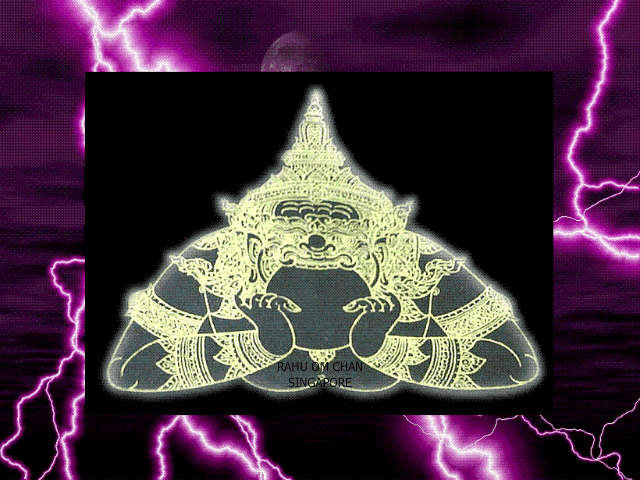
Rahu in India

The famous temple of Naganathar-Girigujambigai in Tirunageswaram, Thanjavur district, houses the equally famous shrine of Rahu Bhagavan and his two consorts.
On February 2, 1986, the molted skin of a 5-foot-long snake was found draped over the Rahu idol. It is still preserved in the temple for darshan.
Those who hope to get married, tie a yellow thread to the vanni tree on the temple premises. People with naga dosha also do pariharam in this Navagraha sthala by donating a stone naga idol and worship here. If a snake enters their house, to ward off its evil effects, people donate brass nagas to the temple and worship it.
Astrologers say that if Rahu is in a 'good position' in one's horoscope, then the man will get a good wife, good servant and acquire great wealth. He will even succeed in politics and get a chance to rule.
praying to Rahu during Rahu kaalam on Sunday can ensure a good life and prosperity. According to belief, a person with Rahu dosham should also pray to Goddess Durgai and Lord Nagaraja.
Generally, auspicious occasions are not celebrated during the Rahu kaalam.
Rahu takes one-and-a-half years to move from one graham to another.
Those afflicted with leprosy, diseases of the intestines, cough and boils can get relief by praying to Rahu.
胡
Thursday, 22 November 2007
Myanmar Astrology - Rahu
There are few countries in the world today in which tradition has such a strong influence on everyday life as it has in Myanmar. Let us observe the path of life a typical Myanmar goes through.Childhood Years, from Birth to Marriage: Seven days after birth, the baby's parents invite friends to a naming ceremony. The youngster is given a name based on astrological calculations, and it need bear no relation to that of the parents.There are Thirty Three alphabets in Myanmar Literature.These alphabets are divided into eight category belonging to eight birthday planets, and the alphabet of each category represents the day of the birth.
It is little strange, because there are eight days a week according to Myanmar Astrology.The reason is that the mid week day, Wednesday is divided into two days; until 6 p.m. it is Wednesday, but after 6.pm. to the midnight it is Rahu's day. The baby's is name is based on his/her birth days, and the astrologer will give the suitable names on the base of his Astrological Calculation of which is to be chosen by the patients.Whatever the method the astrologer's use his calculation, the following alphabet is to be included.
Birthday and Represented Alphabet:
Monday - Ka, kha, Ga, Gha, Nga
Tuesdays - Sa, hsa, za, sha, nya
Saturday - ta, hta, da, dha, na
Thursday - pa, hpa, ba, bha, ma
Wednesday - la, wa
Rahu - ya, ra
Friday - tha, ha
Sunday - A, aha
胡
Buddha's Quotes on Friends..
 An insincere and evil friend is more to be feared than a wild beast; a wild beast may wound your body, but an evil friend will wound your mind
A GOOD friend who points out mistakes and imperfections and rebukes evil is to be respected as if he reveals a secret of hidden treasure.
The rule of friendship means there should be mutual sympathy between them, each supplying what the other lacks and trying to benefit the other, always using friendly and sincere words.
Old friends pass away, new friends appear. It is just like the days. An old day passes, a new day arrives. The important thing is to make it meaningful: a meaningful friend or a meaningful day -Dalai Lama
Don't let a little dispute injure a great friendship - Dalai Lama
Friends are very important to us, we treasure our friends. There might be times when we have disputes and argument, but deep in my heart, those happy memories will always be in my mind.....
胡
Buddha image sukothai

My Sukhothai buddha statue at home
Sukhothai, meaning the ''Dawn of Happiness'' was the first free Thai city founded in 1238.
While there were other Thai Kingdoms (like Lanna, Phayao and Chiang Saen) at the same time, the establishment of the Kingdom of Sukhothai in 1238 is often considered the start of Thai history proper. Sukhothai gained independence from a declining Khmer Empire. Monuments in the city show influence from prior Khmer rule.It is still regarded by Thai historical tradition as the " first Thai Kingdom " , it began life as a chiefdom under the sway of the Khmer empire: the oldest monuments in the city were built in the Khmer style or else show clear Khmer influence.
While there were other Thai Kingdoms (like Lanna, Phayao and Chiang Saen) at the same time, the establishment of the Kingdom of Sukhothai in 1238 is often considered the start of Thai history proper. Sukhothai gained independence from a declining Khmer Empire. Monuments in the city show influence from prior Khmer rule.It is still regarded by Thai historical tradition as the " first Thai Kingdom " , it began life as a chiefdom under the sway of the Khmer empire: the oldest monuments in the city were built in the Khmer style or else show clear Khmer influence.
In 1378, the Ayutthaya King BorommarachaI subdued Sukhothai's frontier city of Chakangrao "Kamphaengphet", and henceforth Sukhothai became a tributary state of Ayutthaya. Sukhothai later attempted to break loose from Ayutthaya but with no real success, until in the 15th century it was incorporated into the Ayutthaya kingdom as a province. Many Buddhist chetiya were built at Sri Satchanalai. After the reign of king Ramkhamhaeng, Sukhothai was ruled successively by other two kings, namely Phraya Le Thai and Phraya Ngua Num Thom. During the time of these two kings the power of Sukhothai declined. Some former colonies of Sukhothai declared its independent. Sukhothai later regained its power during the time of Phraya Li Thai. The reign of king Li Thai are considered as the golden age of Sukhothai arts. Numerous important Buddha images and religious buildings were built not only at Sukhothai, but also at Pitsanulok an Khamphaeng Phet towns. The King also sent Buddhist pilgrims to many towns in order to enlarge the Buddhist followers. After the death of king Li Thai the power of Sukhothai declined again. Finally, Sukhothai became an outpost town under the ruling of the new powerful kingdom centered in the area further to the south, the Ayutthaya kingdom. The Kingdom of Sukhothai had important contacts with Sri Lanka. Thai monks travelled to Sri Lanka for further religious instruction, and Sri Lankan monks settled in Sukhothai. Sukhothai religious art was thus influenced by Sri Lankan art. The Buddha images of the Sukhothai era gained important disdinguishing characteristics from the images during the Khmer and Mon era.A flame appeared on top of the head of the Buddha. The head is covered with fine curled hair. The face is oval, with high curving eyebrows, a hooked nose, a downward gaze, and overall displays a gentle smiling expression.The body of the Buddha images displays broad shoulders and a small waist. Overall it can be said that the Buddha Images do not appear human, but display idealistic or superhuman characteristics.During the Sukhothai era, the four postures of the Buddha (sitting, standing, walking, reclining) were created. Buddha images of the Sukhothai era are subdivided in several groups.
Sitting Buddha images of the Sukhothai period most often display meditation posture, or the gesture of Subduing Mara. Walking Buddhas display the gesture of dispelling fear (Abhaya Mudra), or giving instruction (Vitarka Mudra).
Sitting Buddha images of the Sukhothai period most often display meditation posture, or the gesture of Subduing Mara. Walking Buddhas display the gesture of dispelling fear (Abhaya Mudra), or giving instruction (Vitarka Mudra).
胡
Wednesday, 21 November 2007
Luang Phor Kasem

Luang Phor kasem, Susahn Trailak, Lampang BE 2455-2538.
Born 28/11/2455 in Jangwat Lampang he is the descendant of Lampang's King from the Lanna Period. He became a monk in BE2468 and went to Bangkok to study Pali language. He further his Pali studies in Wat Seelom and Wat Bunyawaht. He ordained at the age of 21 and became a disciple of Pra Krubah Gaen and went Tudong with his teacher in forest and cemeteries. Though he later became abbot of Wat Bunyeun, he continue his learning in Dhamma and Sammahdti practice. He realized that life is uncertain and in BE2492, he left Wat Bunyeun to a cemetery in Lampang. He would sit in front of the burial place and watch the burning of corpse. Whether in hot sun or raining, Luang Por would just sit quietly and watched the corpse being burned to ashes. Luang Por Kasem ever sat in sammahdti for as long as 3 months, without shelter under hot sun or heavy rain. Even his robes were wet by the rain or during cold season, when the cold wind blows, Luang Por Kasem would just sit quietly and not complain and asked for anything. He had let go of everything and steadfast in his practice of dhamma and sammahdti. He ever go without food for 49 days. Since BE2514, Luang Por Kasem only bathed once a year, but there is no stench or foul odor from his body, even his sweat was pouring under the hot sun. More surprisingly, without shelter and mosquito net, Luang Por Kasem never suffered a bite from mosquito at the cemetery. Luang Por Kasem carried nothing with him. His only possession was an alms bowl, his robe which he was wearing and a piece of human bone for him to practice sammahdti. He did not even have any footwear. Luang Por Kasem ever mentioned that he is a forest monk and does not required any possession. He was contented with a piece of robe covering his body. Whatever things that the layman gave to him, Luang Por Kasem would give away to other monks. Luang Por Kasem never used a pillow to sleep, because to him, a pillow is a luxury. Luang Por Kasem would sleep with his body in full prostrate position and would sleep at the same spot where he sat in sammahdti. He was very determined to find the truth of life. He asked for nothing in life though he can enjoy the luxuries in life as he was the descendants of royal blood in Lampang.
Luang Por Kasem died in BE2538 at the age of 83
胡
Subscribe to:
Posts (Atom)