Thursday, 22 January 2009

Buddha Image for Wednesday Night~~Phra Palelai

Wat Thong Khung

Nong Khai

Doi Suthep. Chiang Mai


Wednesday, 21 January 2009

Wat Phra Kaew วัดพระแก้ว

Wat Phra Kaew ~~Temple of the Emerald Buddha, วัดพระแก้ว; official name Wat Phra Sri Rattana Satsadaram, วัดพระศรีรัตนศาสดาราม is regarded as the most sacred wat in Thailand. It is located in the historic center of Bangkok district Phra Nakhon, within the grounds of the Gran Palace.

The construction of the temple started when King Buddha Yodfa Chulaloke (Rama I) moved the capital from Thonburi to Bangkok in 1785. Unlike other temples it does not contain living quarters for monks; rather, it has only the highly decorated holy buildings, statues, and pagodas. The main building is the central ubosoth, which houses the Emerald Buddha. There are three main doors used to enter the temple, however only the King and Queen are allowed to enter through the center door. Even though it is small in size it is the most important icon for Thai people.

Legends hold that the statue originated in India, but it first surfaced in the vassal Kingdom of Cambodia and was given as a gift to the King of Ayuttaya in the 15th century 1434. The image disappeared when Burmese raiders sacked Ayuttaya and the image was feared lost. A century later, the 'Emerald' Buddha reappeared in Chiang Saen, after a rainstorm washed away some of its plaster covering. It was then moved to Chiang Rai, then Chiang Mai, where it was removed by prince Setatiratt to Luang Prabang, when his father died and he ascended the throne of that Siamese vassal state.

In later years it was moved to the Siamese vassal state of Vientiene. During a Haw invasion from the North, Luang Prabang requested Siam's help in repelling the invaders. The King of Vietienne tratoriously attacked the Siamese army from the rear, so the 'Emerald' Buddha returned to Siam when King Taksin fought with Laos and his general Chakri (the later King Rama I) took it from Vientiane, which at that time had been brought to its knees by the Thai Army. It was first taken to Thonburi and in 1784 it was moved to its current location. Wat Preah Keo, in Phnom Penh, is considered by many modern Cambodians as its rightful resting place, whereas, Haw Phra Kaew, in Vientiane, is considered by many Lao people as the Emerald Buddha's rightful place.

The wall surrounding the temple area – from the outside only a plain white wall – is painted with scenes from the Thai version of the Ramayana mythology, the Ramakian. Several statues in the temple area resemble figures from this story, most notably the giants (yak), five-meter high statues. Also originating from the Ramayana are the monkey kings and giants which surround the golden chedis.The Temple also contains a model of Angkor Wat, added by King Nangklao(Rama III), as the Khmer empire of Cambodia and the Thais share cultural and religious roots.
**1 of the 9 MUST VISIT auspicious temple in bangkok, will be visiting next month.

Tuesday, 20 January 2009

Wat Pho วัดโพธิ์ ( First Class 1 in 6, Wat for King Rama I)

Wat Pho , also known as Wat Phra Chetuphon วัดพระเชตุพน or The Temple of the Reclining Buddha in Phra Nakhon district, Bangkok, Thailand, located in the Rattanakosin district directly adjacent to the Grand Palace.

Its official full name is Wat Phra Chetuphon Vimolmangklararm Rajwaramahaviharn (Thai: วัดพระเชตุพนวิมลมังคลาราม ราชวรมหาวิหาร). The temple is also known as the birthplace of traditional Thai massage.

Wat Pho is the one of the largest and oldest wat in Bangkok (with an area of 50 rai, 80,000 square metres), and is home to more than one thousand Buddha images, as well as one of the largest single Buddha images~~ the Reclining Buddha (Phra Buddhasaiyas, Thai พระพุทธไสยาสน์).

Made as part of Rama III's restoration, the Reclining Buddha is forty-six metres long and fifteen metres high, decorated with gold plating on his body and mother of pearl on his eyes and the soles of his feet. The latter display 108 auspicious scenes in Chinese and Indian styles.

The Wat Pho complex consists of two walled compounds bisected by Soi Chetuphon running east-west. The northern walled compound is where the reclining Buddha and massage school are found. The southern walled compound, Tukgawee, is a working Buddhist monastery with monks in residence and a school.

Sunday, 18 January 2009

Wat Arun วัดอรุณ - 1st Class Royal Wat

Wat Arun ( Temple of the Dawn) is in the Bangkok Yai district of Bangkok, Thailand, on the west bank of the Chao Phraya River.

The full name of the temple is Wat Arunratchawararam Ratchaworamahavihara (วัดอรุณราชวรารามราชวรมหาวิหาร). The temple was built in the days of Thailand's ancient capital of Ayutthaya and originally known as Wat Makok (The Olive Temple). In the ensuing era when Thonburi was capital, King Taksin changed the name to Wat Chaeng.The Wat had a brief period as host of the Emerald Buddha, which was moved to Wat Phra Kaew in 1784.The later King Rama II. changed the name to Wat Arunratchatharam. He restored the temple and enlarged the central prang. The work was finished by King Rama III. King Rama IV gave the temple the present name Wat ArunratchawararamWat Arun figures in one of Thailand's most colorful festival, the Royal Tod Kathin. Then His Majesty the King travels down the river in a procession of Royal barges to present new robes to the monks after their three-month lent period.

Location : No. 34, Arun Amarin Road, west side of Chao Phaya RiverKwangWatArun,KhetBangkokYai

Saturday, 17 January 2009

Wat Benchamabophit Dusitvanaram - 1st Class Royal Wat


Wat Benchamabophit Dusitvanaram (วัดเบญจมบพิตรดุสิตวนารามราชวรวิหาร) is a Buddhist temple in the Dusit district of Bangkok, Thailand.

Also known as the marble temple, it is one of Bangkok's most beautiful temples and a major tourist attraction. Construction of the temple began in 1899 at the request of King Chulalongkorn after building his palace nearby. The temple's name literally means the Temple of the fifth King located nearby Dusit Palace. It was designed by Prince Naris, a half-brother of the king, and is built of Italian marble.

Inside the Ordination Hall (Ubosot) is a Sukhothai-style Buddha statue named Phra Buddhajinaraja, cast in 1920 after the original located in Wat Mahathat in Phitsanulok. The ashes of King Chulalongkorn are buried beneath the statue. In the gallery surrounding the ordination hall are 52 buddha statues, collected by Prince Damrong Rajanubhab for his king.Each one is different in style and pose, with highlights including the Buddha in walking posture statue, and subduing Mara posture statue.

Behind the cloister is a large Bodhi Tree, bought as a gift for King Rama V from Bod Gaya, the place of Buddha's enlightenment. There is also a 'Sala Nam' (water pavilion) and, in between the monks and people area, several bridges in a variety of styles.

Open: 08:00 - 17:00
Where: 69 Rama V Road, Dusit

Friday, 16 January 2009

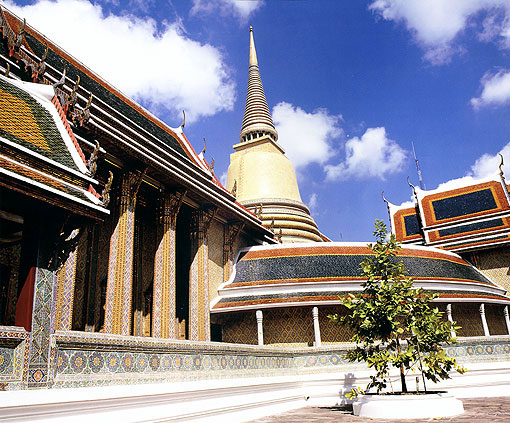
Wat Ratchabophit First Class - Wat for King Rama V


Built in 1869, Wat Ratchabophit was the first temple to be commissioned by King Rama V, who had it built to commemorate his Queen and concubines.
Located in Rattanakosin not far from the Grand Palace, it has distinct gothic elements that distinguish it from other temples in the area. Both the 'wiharn' (prayer hall) and 'ubosot' (ordination hall), for example, have typically Thai exteriors, decorated in hand-painted glazed benjarong ceramics and elaborate gold gilded door and window frames, but European style interiors similar to that of a gothic cathedral.
The ubosot contains a well known gold-gilded Buddha image in the meditation posture, Phra Buddha Ankhiros, and rests on a base in which the ashes of Rama VII, who later inherited the temple, are kept. Instead of the typical eight sema, or boundary, stones are eight stone pillars surmounted with a carving of the Buddhist wheel of law.
An impressive chedi modelled after the famous Phra Pathom Chedi in Nakhon Pathom province (the highest Chedi in the world), contains relics of Lord Buddha, while the enclosure around it contains many Buddha images in varying postures. There is also a royal cemetery with monuments containing the ashes of the Queen, concubines, sons and daughters of King Rama V, and various other member of the Royal Family.
Open: 09:00 - 18:00
Where: 2 Fuang Nakhon Road, Phra Nakhon

Thursday, 15 January 2009

Wat Rakhang (Second Class Royal Wat)


Wat Rakhangkhositraram Woramahavihara , an ancient temple located in Thonburi next to the Chao Phraya River, Wat Rakhang was originally built in the Ayutthaya period. It earned its name - meaning temple bell - during the reign of King Rama I, when a bell was found in the temple compound.

Later, King Rama II had this moved to Wat Phra Kaew (Temple of the Emerald Buddha), sending five new ones in its place. These can be found in the pretty Hor Rakhang, or bell tower, which is built in the four-gable style of Ayutthaya and early Rattanokosin periods and located in the corner of the temple compound.

Not far from this is an elegant Ho Trai, or library, considered an outstanding example of Thai architecture. Once the residence of King Rama I before his ascendance to the throne, its three adjoining buildings today function as a small museum, housing beautiful scriptures stored in lacquer and guilt cabinets. An elaborately decorated Ubosot, or ordination hall, features murals by Phra Wanwadwichit, a well-known artist of the King Rama VI era.

Open: 05:00 - 21:00

Where: 250 Arun Amorin Road, Sirirai, Bangkok Noi

Wednesday, 14 January 2009

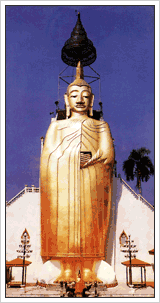
Wat Intharavihan วัดอินทรวิหาร- Wat Luang Pho To

Wat Intharavihara ( Wat In ) is located on Visut Kasat Road, near Bang Khun Phrom Intersection opposite the Bank of Thailand .

It was built at the beginning of the Ayutthaya period and was originally called Wat Rai Phrik.

It was renovated and renamed Wat Intharam when King Rama I provided land in Bang khun Phrom Sub-district for the settlement of prisoners of war from Vientiane.

Chao In, an uncle of Chao Noi Khiew Khom, one of the King's chief wives, renovated the temple and invited Chao Khun Phra Aranyik, a monk who had also come from Vientiane, to preside as an abbot. Chao Inthawong , the son of Somdej Phra Boworn Rajchao Mahasakdipholasep, was responsible for a second renovation. Chao Khun Phra Aranyik was an expert in meditation and had once been the instructor of Somdej Phra Buddhacharn ( To ) of Wat Rakhangkhositaram, who initiated the construction of Luang Pho To, a large standing Buddha image.

The construction of the image had reached only to the navel when Somdej Phra Buddhacharn died. It was completed in the reign of King Rama VII. Luang Pho To is a statue of the Buddha holding an alms bowl. When the statue was completed, the temple held a three-day celebration on 4-6 March, 1928, and this festival has been held annually ever since.

King Rama VI renamed the temple Wat Intharavihan because the name was the same as Wat Intharam ( Wat Bangyirua Tai ) in Thonburi. People generally refer to the temple as Wat In, Wat In Bang Khun Phrom, or Wat Luang Pho To.

Open: 08:30 - 20:00
Where: 114 Visut Kasat Road


Monday, 12 January 2009

Wat Hua Lamphong วัดหัวลำโพง

Wat Hua Lamphong is nice Buddhist temple located on Rama 4, just beyond the entrance to Silom. The temple is one of the newer Wats in Bangkok and therefore rarely visited by tourists. The temple complex is nicely incorporated in modern buildings around.


Wat Hua Lampong was extensively remodeled in honor of His Majesty the King's 50 anniversary on the throne. The royal seal of the Kanchanapisek Year (as it was called) is used extensively throughout the temple's elaborate decorations. The seal features two elephants flanking a multi-tiered umbrella.
The temple is actually quite large, and if you wander around you will find some interesting older buildings.

Wat Hua Lampong faces Rama IV Road a short distance from the Montien Hotel. If taking the Skytrain, alight at the Saladaeng Station, walk through Taniya Alley, cross Suriwong Road, Rama IV will be on your right. Turn left on Rama IV and walk down about one block.

http://www.wathualampong.com/

Sunday, 11 January 2009

Saturday, 10 January 2009

命运 = 机会

你的命运就是你的机会。灾难是机会,失败是机会,苦痛是机会,困难是机会,逆境是机会,危险也是机会~~是生命给你一次改变的机会!

命运若安排让你受伤,是为了让你变坚强。
命运若安排让你受骗,是为了让你变聪明。
命运若安排敌人给你,是为了让你超越自己。
命运若安排你倒下,是为了让你站得更稳。
命运若安排让你迷路,是为了让你找到新路。
命运若安排让你迷失,是为了让你更加觉醒。

所以每个厄运背后,其实都隐藏着祝福。生命中任何一个变动,都可以是一种机会,困境也是一种机会。 如果你挺得住,你就去做,这就是一个机会。
不要一直说你做不到,不可能,改写人生~~~靠自己!

Friday, 9 January 2009

Wat Pa Lelai วัดป่าเลไลยก์วรวิหาร

Wat Pa Lelai Worawihan is located on the banks of Tha Chi River.It is generally called "Wat Pa" by the villagers. The temple has the royal insignia of King Rama V, which shows that it is a royal temple.

According to historical records, before succeeding to the throne, King Rama V was a monk and it was during that time that he was responsible for founding Wat Pa Lelai Worawihan. After he became the king, King Rama V had the temple restored to its former glory.


The Vihara houses a 23.46 metersBuddha image named "Luang Pho To" in the attitude of leading a jungle life. The image, highly revered by the people, was formerly in the attitude of giving the first preaching sermon but was changed to the present attitude when it was renovated. You can see the seated Buddha image accepting offerings from an elephant and monkey, which is a typical art form of U Thong Suphannaphum era. In addition to the Luang Pho To, the wihan also houses 36 Buddha relics.


Every year there are two worshipping fairs falling on the 5th to the 9th waxing moon days of the 5th and the 12th lunar months repectively.

Thursday, 8 January 2009

Wat Phai Rong Wua

Phra Phutta Khodom, the largest bronze Buddha image in the world, is the first piece of work of Luang Pho Khom known to both Thai and foreign tourists.

It is often called by the villagers as Wat Luang Pho Khom, located by the side of Klong Phraya Banlue in the Bang Ta Ten Sub-District. This temple was built in 1926. Luang Pho Khom has been invited from Wat Bang Sam to become the abbot and he has built everything that becomes the present Wat Phai Rong Wua.

It houses the largest metal cast Buddha image of the world called Phra Phutthakhodom, which has a lap width of 10 metres and a height of 26 metres. There are various sites concerning Buddhism, such as, the Three Season Palace of Prince Sitthattha, places of gaining enlightenment, giving the first preaching sermon, Nivarna (passing away stage) and the hell being community.

The monastery is reached by Highway No. 321 to Amphoe Song Phi Nong with right turn to Wat Phai Rong Wua or take a boat trip from Tha Chang Landing, Bangkok, every Sunday at 07:00 hours.

Most impressive, there is a terrifying representation of the Buddhist conception of hell. Some of the depictions are pretty gruesome and the Thais are taking this to teach the children to be afraid of sins.

Tuesday, 6 January 2009

Lucky / Unlucky day based on Horoscope

CAPRICORN (December 23-January 22)
Lucky Days - Wednesdays and Thursdays
Unlucky Days - Sundays and Mondays

AQUARIUS (January 23-February 22)
Lucky Days - Wednesdays and Fridays
Unlucky Days - Mondays and Saturdays

PISCES (February 23-March 22)
Lucky Days - Sundays and Wednesdays
Unlucky Days - Fridays and Saturdays

ARIES (March 23-April 22)
Lucky Days - Wednesdays and Thursdays
Unlucky Days - Fridays and Saturdays.

TAURUS (April 23-May 22)
Lucky Days - Tuesdays and Fridays
Unlucky Days - Saturdays and Tuesdays.

GEMINI (May 23-June 22)
Lucky Days - Saturdays and Sundays
Unlucky Days - Thursdays and Fridays

CANCER (June 23-July 22)
Lucky days - Tuesdays and Wednesdays
Unlucky Days - Mondays and Thursdays

LEO (July 23-August 22)
Lucky Days - Mondays and Wednesdays
Unlucky Days - Fridays and Saturdays

VIGRO (August 23-September 22)
Lucky Days - Sundays and Thursdays
Unlucky Days - Wednesdays and Fridays

LIBRA (September 23-October 22)
-

SCORPIO (October 23-November 22)
Lucky Days - Wednesdays and Fridays
Unlucky Days - Sundays and Tuesdays

SAGITTARIUS (November 23-December 22)
Lucky Days - Saturdays and Sundays
Unlucky Days - Wednesdays and Fridays.

Source - Bangkok Post

Monday, 5 January 2009

2009 年什么生肖犯太岁?

2009年之太岁为己丑,姓潘名佑。属牛,对生肖属羊、牛、狗、马犯太岁相冲相刑相害,多有不利!

依据传统理论认为,属相为“羊、牛、狗、马”的人为犯太岁生肖,冲犯太岁者表示流年运程可能会受到一定的影响,会有不少麻烦,甚至会有凶灾,可能会有官非纠缠,仕途阻滞、投资失利、情绪波动、人事不和及感情离合等影响,严重者或会有意外血光之灾等情况出现,即古语说:“太岁当头坐,无福便有祸,无喜必有祸。”

犯太岁的年份常常被认为是一个不吉利的年份。所以也要提醒自己,在这一年小心谨慎,遵纪守法,多做善事,注意冷暖,避免触犯太岁神,以免给自己带来疾病和灾祸。

很多庙宇都会在新年期间让人们去祭拜太岁,所以那些犯了太岁的人,记得在那个时候到庙里走走。尽管如此,犯太岁并非世界末日,日子还是要过的,只要不去“犯法”,不做坏事,多积点德,做善事,凡是小心,今年做事低调一点,切忌太过出锋头而招惹是非,那么在困难的日子都会过去的。

Sunday, 4 January 2009

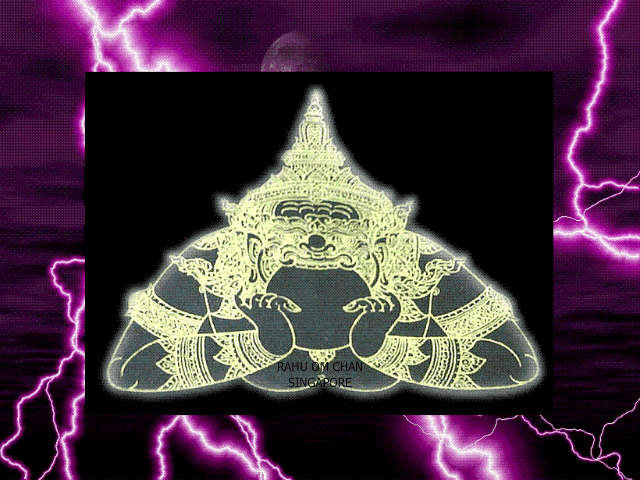
Making Merit - Rahu

A group of dancer who dance trandition thai dance and sing for Rahu

Friday, 2 January 2009

Rahu Statues in Bangkok

Wat Waramattayahanthasararam (วัดวรามาตยภัณฑสาราราม)
Wat Phasi (วัดภาษี)
胡


Thursday, 1 January 2009

Rahu Statues in Ayutthaya

Wat Thasung Thaksinaram (วัดท่าซุงทักษิณาราม)


Wat Klang Pak Kran (วัดกลางปากกราน)

胡

Wednesday, 31 December 2008

Rahu Statues in Lopburi

Wat Khung Tha Lao(วัดคุ้งท่าเลา )
Wat Nong Tharai Chao (วัดหนองทรายชาว)
胡


Saturday, 27 December 2008

Wat Bang Nom Kho


Wat Bang Nom Kho (วัดบางนมโค) is a Buddhist temple in Sena district, Ayutthaya Province, Thailand.

The temple was made famous by one of Thailand's Gaeji Ajarn high monks, Luang Pho Phan, who was renowned for his blowing of the sacred Diamond Armour Yantra, (or Yant, onto the forehead of his disciples. According to legend, many of these disciples, after death, were found to have an impression of the Yant mysteriously embedded into their skull. The Yant was allegedly revealed to Luang Pho Phan in a dream, which led him to its discovery on a metal template hidden within a Chedi.


Luang Pho Phan was also reputed to have received the ability to make powder based amulets of Buddha images sitting on animals from a Chee Ba Khaw, (a spirit that appeared as a firefly). These amulets are extremely sought after and expensive due to their reputed powers.


Credits : Wikipedia & www.watbangnomkho.com (map)

Wat Srisathong, Nakhon Pathom

Thursday, 25 December 2008

December

December should be a month full of Joy and Happiness. But I wouldn't say so for my family and someone I know. We lost our loved ones on the 26th December.

Chinese believed that as an elders, we are not allow to pray, to cry and to do anything for the dead. It's sad~~ really heart breaking and it's like a mission impossible because we are only human and we really missed them .

I wonder some times if he is able to receive the merit we have done for him and I wonder what can I do for him? The only thing i guess i can do for him is to write those mantras for him and pray that all will be well for him in the other world. Dilemma we can be, believing that if we keep on clinging on them ( thinking of them), calling out their names and cried for them, it will slow down their " reincarnation", we know we have to let go, but we just couldn't help it and loses control of ourselves.

We're told that time heals all wounds. That's not entirely true, of course. Time does have the ability to make that acute, searing pain of loss less intense, to make our red-hot emotions less painful. But our feelings of loss and emptiness may never completely go away....

人们常说,人生最痛苦的三件事莫过去少年丧父,中年丧偶,老年丧子。 再辛苦难熬的人生没有比失去自己的至爱更痛苦的事情了。珍惜眼前人!

Tuesday, 23 December 2008

Jataka - Buddha's Former Birth - Pt 2

The Sama Jataka -Sama is shot by an arrow in his side by King Piliyakka.
Care for the elderly
The future Buddha was born as a youg man named Sama, who cared lovingly for his forest-dwelling ascetic parent, who were aged and blind. One day, while fetching water from a pool, Sama was accidentally shot and killed by the arrow of a king who was out hunting in the forest. However, Sama's merit was so great that he came back to life, and even his parent's eyesight was restored.
The Sama Jataka

The Grateful Parrot

The future Buddha was born as Mahasuka, a parrot who lived in a fig tree whose fruit fed him all year long. The God Saka decided to test him., and caused the tree to wither away. The parrot perched on the stump, unperturbed. Saka asked the parrot why he did not fly away. The parrot replied that he could not desert an old friend who had given him so much. On hearing these words, Saka offered him a boon. The parrot asked for his tree to live again, and it sprang back to life.

The Mahasuka Jataka

The Four Friends Jataka

A story in a Buddhist sutra tells of four animal friends. One day they decided to work out who was the eldest and thus the wisest. To determine their ages, they recalled their first memories of a nearby tree. The elephant remembered it as tall as himself, the monkey as a small tree, and the hare as a sapling. However, the bird remembered it as a seed, which he planted himself. In accordance with this, the animals set themselves in order, with the wisest highest, to show respect and harmony. The future Buddha was the bird and the other animals were attendants and disciples.

Monday, 22 December 2008

Jataka - Buddha's Former Birth - Pt 1

The Quiet Serpent
The future Buddha was born as Bhuridatta, a serpent divinity. He was captured and forced to perform for public entertainment. Despite these and other ignominies and torments of captivity, Bhuridatta remained free of anger, and ultimately regained his freedom.
The Bhuridatta Jataka

The Patient Prince
The Buddha-to-be was born as Prince Candakumara, whose nobility and patience were so great that an official at his father's court grew to hate him. Finally, the official convinced the king to offer his son as sacrifice. The prince faced his death calmly, but at the last moment he was saved by his mother, the queen. her prayers were answered by the god Indra, who interrupted the ceremony.
The Candakumara Jataka

Lifting the Chariot
When he was just a month old, the future Buddha, Prince Temiya, realized that as a ruler he would have to punish his subjects, and so he decided to remain silent and unmoving to avoid hurting other living beings. For 16 years he was tormented by trials to break his resolve. Finally, he was condemned to death. In the chariot that was taking him to his execution, Temiya finally moved: he got out of the chariot and raised it above his head with one hand, in a single action demonstrating his power and merit.
The Temiya JatakaTemiya confirms his strenght by lifting a chariot.

Sunday, 21 December 2008

The Parable of Pilgrims

Two Monks on pilgrimage came to a river bank. there they saw a girl dressed in fine clothes and at a loss to know how to proceed, for the river was high and she did not want her clothes spoilt.

Without further ado, one of the monks took her on his back, carried her across and put her down on dry ground. Then the monks continued on their way. After a while the other monk suddenly burst out :" Surely it is not right to touch a woman. It is against the commandments to have close contact with woman. How can you go against the rules for monk?"... and so on in a steady stream.

The monk who had carried the girl walked along silently, but finally he remarked:" I set her down the river, But you are still carrying her."

Saturday, 20 December 2008

The Paramitas ~ The Perfections

The Paramitas, or perfections, are the skills for living that lead to freedom and happiness. Cultivating them is fundamental to practice. Each paramita is demonstrated by the Buddha in one of his past lives, which are retold in tales known as the Jatakas.

In the Theravada Tradition -

The First Paramita ~Dana in Pali, the paramita of giving, applies to both material and non-material things: service of all kinds, helping others, teaching the Dharma and most importantly, always giving ourselves wholeheartedly to what we are doing right now.
The Second Paramita~Sila (morality) means behaving well at all times, living according to ethical rules or precepts, restraint of the senses and passions, good manners, self discipline, courtesy, consideration and politeness. Sila is also used as a general term for the daily practice of sustained awareness and mindful actions.
The Third Paramita~The Buddha himself admitted that before he was enlightened his heart did not delight in the thought of giving up worldly pleasures. Eventually he realized it was because he had not yet experienced life without them. The practice of renunciation (nekkhama) reduces the pull that sensual experience has on us, leading to relief, freedom and genuine joy.
The Fourth Paramita~The paramita of wisdom ( panna in Pali) means seeing the true nature of things, no longer contaminated by personal bias. With wisdom we can then live in accordance with things as they are, and realize inner peace and the truth.
The Fifth Paramita~Energy (Viriya) encourages us to abandon laziness and procrastination. Fear of not getting what we want can make us unwilling to wholeheartedly give ourselves to life's challenges. Viriya counterects this fearful " I won't" and transforms the heart.
The Sixth Paramita~Patience (Khanti) is considered the means for overcoming anger, ill-will and hatred, maintaining inner peace and tranquillity, and tolerating the intolerable. Patience is one of the most written-about practices in all Buddhism: it calms the passions and, in doing so, diminishes our illusory sense of "I", "me" and "mine" and makes us flexible, tolerant and warm.
The Seventh Paramita~Truthfulness (Sacca) means both honesty with other people and truthfulness with oneself - being honest about what our hearts really long for and courageously pursuing this with the whole of ourselves. if we practise inconsistently, or simply because we desire praise, it will never produce real result.
The Eighth Paramita~To attain any goal we need determination. Resolution (adhitthana) is sometimes called the four determinations: for discernment, for truth, for relinquishment and for calm. This paramita is also concerned with perseverance, the commitment to keep going forward in order to reach freedom and happiness.
The Ninth Paramita~Loving kindness (metta) means "good will" in all our action. If in all circumstances we behave with our hearts uncomplicated by our own desires, sedning out good wishes and love to all being, our actions will be kind and helpful in the deepest sense.
The Tenth Paramita~Equanimity (upekkha) is not at all the same as indifference. it refers to imperturbability, ans is one of the divine states, or brahma viharas. It is also considered to be one of the step toward enlightenment. It is only when the "I" is truly vanquished that there is no fear, and all action then arises from that state of equanimity, fully aware and fully present and thus completely in keeping with the situation.

Meditation~Translated as dhyana in Sanskrit or jhaha in Pali, meditation is a paramita of the Mahayana (Northern) tradition. Meditation simply means to cultivate and develop calm and peaceful awareness, concentration and insight. Eventually, sincere and dedicated practice can lead to the ultimate goal of enlightenment.

Friday, 19 December 2008

Wat Xieng Thong, Laos


Wat Xieng Thong , Temple of the Golden City is a Buddhist temple (wat) in Luang Phrabang, Laos.
It was built in 1560 by King Setthathirath. It was under royal patronage during the Kingdom of Laos. There are many legends about the place where the Nam Khan enters the Mekong.
It is believed to be the site where the two hermits, who founded Luang Prabang, placed the boundary stone for the new settlement. Another story tells about a betel merchant with the name of Chanthapanit who built a palace on this site, making himself the first king of the new capital. It has been said that he was the first founder of Wat Xieng Thong.
The union of the Nam Khan with the Mekong is also said to be the home of two nagas (water spirits in the form of large snakes), the guardians of the river. A shrine to the nagas existed at the site until recently.Wat Xieng Thong was the only monastery in Luang Prabang to escape the 1887 fire at the time of the sacking of Luang Prabang. It has been restored twice - in 1928 and then again between 1952 and 1960 by King Sisavangvong (1904-1959).
Address : Ban Xieng Thong, Muang Luang Prabang, Khoueng Luang Prabang, LaosOpening Hour : 8am-5pm daily

Thursday, 18 December 2008

Xieng Kuan (Buddha Park), Vientiane, Laos


Buddha Park, also known as Xieng Khuan (as well as other variations of the spelling) is a sculpture park located 25 km southeast from Vientiane, Laos in a meadow by the Mekong River. It may be referred to as Wat Xieng Khuan (วัดเซียงควน) although the park is not a temple (Wat). The name Xieng Khuan means Spirit City. The park contains over 200 Hindu and Buddhist statues.

The park was built in 1958 by Luang Pu (Venerable Grandfather) Bunleua Sulilat. Luang Pu Bunleua Sulilat was a priest-shaman who integrated Hinduism and Buddhism and later fled from Laos to Thailand after the revolution in 1975. There, he built another sculpture park, Sala Keoku in Nong Khai.

The statues are made of cement and are ornate, and sometimes bizarre, in design. The statues appear to be centuries old, though they are not. There are numerous sculptures of Buddha and characters of Hindu lore. There are also sculptures of humans, gods, animals, and demons. One notable sculpture resembles a giant pumpkin. It has three stories representing three levels - Hell, Earth and Heaven. Visitors can enter through an opening which is a mouth of a 10 ft tall demon head and climb staircases from hell to heaven. Each story contains sculptures depicting the level. At the top, there is a vantage point where the entire park is visible. Another sculpture, an enormous 40 m high reclining Buddha, is also a park attraction.

Admission to the Buddha Park is 5,000 Kip. There's another 2,000 Kip fee for a camera.
You can get to the Buddha Park by tuk-tuk. Most of the drivers around town soliciting tourists can take you there. Expect to pay around 700 Baht.

春府寺庙大佛遭泼强酸

【本报讯】不久前因供奉前总理塔信等政治人物头像,而遭到民盟警告闹得沸沸扬扬的春武里瓦挽拉蒙寺庙,7日再次发生怪案。

寺庙内正在建缮的1尊大佛,被泼洒强酸,导致佛像受损,预估经济损失约10万铢。

这尊佛像座落在瓦挽拉蒙佛寺正在建设的佛堂之内,投资建造费达到130万铢。可是该佛像却在日前被不法分子泼洒强酸,导致佛像的肩部、左臂等部位大面积被腐蚀,粗略统计经济损失约为10万铢。

瓦挽拉蒙寺庙的方丈表示,该尊大佛受到附近的居民敬仰,寺庙方还在本月5日举行大型诵经法会恭祝皇上圣体安康。
据悉,春武里瓦挽拉蒙寺庙曾在不久前,因在佛塔上塑造前总理塔信等政治人物的头像,招致民主联盟的不满,民盟不仅派人在寺外示威,而且还通过多个渠道给寺庙方面施加压力,最后寺庙方已将塔信等人的头像拆除,才平息了民盟的怒气。

宗教信仰为什么要和政治挂钩呢?如果要发泄心中的不满,也不应该把气出在佛像身上.

本文引用地址:http://www.udnbkk.com/article/2008/1209/article_46147.html

Wednesday, 17 December 2008

Rahu in Pattaya

There is an article on this temple, unfortunately it's in thai.
Source - http://www.pattayadailynews.com/thai/shownews.php?IDNEWS=0000006790
胡


Tuesday, 16 December 2008

Monks use snake’s blood to exorcise ‘possessed’ playground

Demon spirits’ close Kamala school
MORE than 700 hundred students at a Kamala school have been sent home after 29 students at the school were ‘possessed’ by demons. Children aged between four and 17 started convulsing uncontrollably, while others sat frozen to their seats, or burst into loud screaming.

The prestigious H.M. the Kings Rachaprachanakroh Foundation school, which caters mainly for Muslim children, was closed for a week while nine Bhuddist and one Chinese monk exorcised the school grounds, spreading snakes’ blood and pigs’ blood around the playing area to drive off the ‘spirits’.

A Muslim ceremony was also performed to persuade the spirits to leave the school. The school’s assistant headmaster, Suda Wonnuha, said the younger children were terrified by the older students irrational behaviour.“We had to cancel all classes for a week,” she said. Kongsak Khoburi, an educational assistant at the school said the ‘crazy behaviour’ started on November 19 when a Year 4 boy ‘displayed worrying behaviour in class’.“He was sitting frozen to his seat, and then he suddenly started screaming,” he said. The boy was taken to the school’s infirmary, but teachers were at first skeptical and thought the students were ‘playing games’. But when disciplinary action didn’t shake the usually boisterous 16-year-old, they realised it was something more sinister.

As the day wore on, the strange behaviour spread to other parts of the school. Groups of primary school girls began dancing ritualistically and chanting in class. Their teachers were unable to control them. By the next morning, students of all ages were doing weird things, and by the Friday, they were uncontrollable. Mr Konsak said there was pandemonium and wild outbursts by children in the playground.The following Monday, the headmaster closed the school for a week.Mr Konsak played down claims that the ‘demons’ were unhappy when a sacred tree near the school was cut down. A spirit house under the tree was destroyed when the tree was cut down to make way for a building development. Mr Konsak said, in Buddist-Thai culture, it is believed that during sampawesi, or when the soul changes condition, it can become open and allow spirits to enter.“Some people believe the spirits have no home and nowhere to go, so they enter the bodies of humans and communicate through them,” he said.

A handful of children playing in the deserted school grounds seemed blissfully unaware of anything untoward occurring. Two girls happily pushed each other around in a make-shift sled, while ten-year-old Panya sat next to Mr Konsak reading his English books. Mr Konsak doesn’t believe his students were possessed by spirits.“I think the children were bored, and were acting this way as some sort of practical joke,” he said.“They have convinced some of their classmates to act this way, and it has escalated from there,” he said.“It has turned into a large scale problem for staff. “But we should understand that a lot of these children come from extremely traumatized backgrounds and many lost family in the tsunami. “Some of them have very different emotional needs to normal children, and many of them come from very poor backgrounds."“They depend on the school for food and housing, and more than 60 students live on campus.”“Most of them returned home when the school was closed, but some stayed, either because they have no family or they have problems at home.”

Source- Phuket Post (2008-12-15 11:22:49)
by Fraser Morton

Monday, 15 December 2008

solar eclipses in 2009


On Wednesday, 2009 July 22, a total eclipse of the Sun is visible from within a narrow corridor that traverses half of Earth. The path of the Moon's umbral shadow begins in India and crosses through Nepal, Bangladesh, Bhutan, Myanmar and China. After leaving mainland Asia, the path crosses Japan's Ryukyu Islands and curves southeast through the Pacific Ocean where the maximum duration of totality reaches 6 min 39 s. A partial eclipse is seen within the much broader path of the Moon's penumbral shadow, which includes most of eastern Asia, Indonesia, and the Pacific Ocean.

So Rahu's in Action again! I guess there will be a big event in Wat Srisathong on that day!

胡
 
eckhart tolle