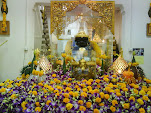
清迈府美丹县森玛哈蓬镇的吞銮寺庙,其间存放著一具高僧的遗体,该遗体保存至今已经将近20年,但仍未腐烂。
吞銮寺庙曾有1名为芭吞玛猜的高僧,芭吞玛猜高僧於1987年12月5日去世,享年73岁6个月。芭吞玛猜高僧去世后,寺庙内众僧人为其举行盛大的念经仪式,接著将芭吞玛猜高僧遗体存放於玻璃柜中。一个月过后,将芭吞玛猜高僧遗体取出,用水清洗遗体并使用凡士林擦拭全身,接著道3个月、6个月和1年时期,均使用同样的方法处理遗体。
如今芭吞玛猜高僧的遗体已经存放将近20年而未腐烂,遗体由最初的黄白色渐渐转变成褐色,最后变成黑色,且遗体也渐渐变硬,硬度甚至类似石头,乍看上去有些像古埃及的木乃伊。吞銮寺庙表示,今年的12月5日正好是芭吞玛猜高僧的20周年忌日,寺庙内将会为其举办盛大的诵经仪式。
本文引用地址:http://www.udnbkk.com/article/2007/1203/article_27318.html
Friday, 7 December 2007

The Thai Buddha Image - Chiang Saen-Lanna Art
 Chiang Saen-Lanna Art refers to object found in Northern Thailand dating between 11th, 13th or 10 centuries AD. The Buddha images from this period can be categorized into 2 distinct phrases.
- Former Phase - With similar characteristic to the Pala Indian style, Buddha images typically featured a lotus bud or orb shaped finial and large hair curls ( without hair band), a plump torso and prominent chest.
The face is round with a gently smiling expression, high curving eyebrows, a hooked nose, narrow lip and a knobbed chin. A short mantle with a zigzag "Centipedes Fang" design is usually positioned above the breast, Figure would usually be posed in the Subuing Mara posture and rhe Buddha would be seated cross legged, showing the soles of both feet. - Later Phase : Later influences from Sukhothai introduced an extended lotus shaped or flame shaped finial, fine hair curls and a thin hair band. The torso and chest sometimes resembled those of the former phase, but the face was more oval ( some works still featured the round shape) The mantle usually extended down the navel. The posture was also modified to a seated position with the sole of only one foot visible and the base upon which the figure was seated was undecorated. Buddha image draped in royal attire and appearing in different postures were also initiated, often featuring more decorative element on the base.
It was during this time that the creation of Buddha images in crystal and precious stone became very popular.
胡
The Thai Buddha Image - Lopburi Art
 Lopburi art is widely found in the central, east and the Northeast of Thailand. It can be dated around 11th to 13th centuries AD.
The culture was centred in the city of Lopuri and was much influenced by Khmer art and culture as it spread through Northeast Thailand. Because of this, Lopburi art is similar to the Khmer art of Cambodia.
Buddha image at that time are characterized by a cranial protuberance in the form of 3 tiered lotus petals. The hair band is featured and the hair is sometimes straight like human hair. (occasionally curled). The head is decorated with a diadem or a face frame. Facial features include a broad, slightly smiling face, thick lips, broad chin and earlobes that extend down to the shoulder.
The buddha would be shown wearing a robe drape diagonally with a straight edged mantle placed over the left shoulder and extending to the navel. The image would be posed upon a distinctive lotus petal base, featuring a uniguq border design around the lotus petal edges.
Naga Protected Buddha. The final was formed in the shape of a lotus bud or an orb and the Buddha’s robe would feature a distinct curvature at the waist. Image were curved in the meditation posture seated with folded legs and the Naga heads forming a protective taper above the buddha’s head. The Naga in Royal attire. The facial expression is rather stern.
胡
Thursday, 6 December 2007
友情 - Friendship
忽然非常想要写关于友情,最近太多事情发生了,所以特别有感触。
人们常说,人类最纯净的友情只存在於孩提时代,说这话的人都有些无奈和痛心。因为他们说,随著岁月流转,友情越来越依附于事功,越来越仰赖实用和交换原则。这似乎很对。可惜的是,前提本身却错了。
我们在一生的不同阶段会有不同的朋友,岁月在替你做著筛选和替补。也许其中有一些是真实的朋友,而有一些或许是你的某种错觉,仅仅是错觉而已,这与欺骗和利用无关。
友情如果仅仅出於一时的需要,那也只能是短命的友情。或者说,它还不具备友情的真正意义。这样的朋友亦只是一种错觉。
「一个不是我们有所求的朋友,才是真正的朋友。」但是彻底想来,要做到这点,是何其难!友情产生的本质便是因为孤独,我们常常陷入虚幻的友情旋涡,好在还有时间——它可是一面最清醒的镜子。 时间会很自然而然地告诉你谁是你真正的朋友——可是答案总是太残酷。也只有这个时候你会看到人们丑陋的一面。 当我们得宠掌权时,有谁不是对我们恭恭敬敬,满口的好话,一旦退下职务,那些人竟然可以把我们当透明人。。唉。。再次证明人类是很现实的。。他们真的是悲哀的一群!
The rule of friendship means there should be mutual sympathy between them, each supplying what the other lacks and trying to benefit the other, always using friendly and sincere words and not scheming on one another.
There is nothing more dreadful than the habit of doubt. Doubt separates people. It is a poison that disintegrates friendships and breaks up pleasant relations. Doubt is a thorn that irritates and hurts; it is a sword that kills.
Sometime we get closer doing things together to make the event a successful one, but that is also the time when we faced misunderstanding and miscommunication. It’s a test for everyone, there bounds to be someone who is making use of us to get rid of people they dislike, if we are not careful, or not having a clear mind, then we are actually stepping into his trap.
Think before we do anything!
"When you get into a tight place and everything goes against you, till it seems as though you could not hold on a minute longer, never give up then, for that is just the place and time that the tide will turn."
The Thai Buddha Image - Srivijaya Art
 The Srivijaya Kingdom is believed to have thrived in Sumatra between the 8th and 13th centuries A.D. At this time, Srivijaya art was influenced not just by the indian art forms through trade but also Dvaravati,javanese and khmer art. Buddha images from this period are mostly related to Mahayana Buddhism; however, religious object including those of Theravada Buddhism and Hinduism have also been discovered.
Votive tablets found from this period were made from unbaked clay, which is easily broken. Therefore their purpose was not to prolong Buddhism into the future as with metal or clay tablets. They were created for the spititual benefit of the deceased. After cremation the bones or relics of the Buddhist were mixed with clay and made into tablets depicting the Buddha or Bodhisattva. Because the bones had been cremated once, they do not require a second firing.
胡
The Thai Buddha Image - Dvaravati Art
 Dvaravati ( land of Buddhism) refers to the kingdom situated in the Chao Phraua river basin between the 7th and 11th centuries AD. Important archaeological objects of Dvaravati art comprise Buddhism related sculptures representing 2 distinct sect known as Theravada and Mahayana.Dvaravati Art can be sub categorized into 3 groups according to the craftmanship.
- Heavily influenced by Indian art, image have no aureole and faces are similar to Indian sculptures. Position seated with leg loosely folded or standing in the leaning pose. Hand gestures were limited to the right hand,while left hand would be shown holding the end of the robe.
- Influenced by local styles, the aureole appears in a lotus bud shape or an orb over the cranial protuberance with large hair curl. The eyebrows form a continuous "crow wings" curve, the eyes protrude while the nose is flat and the lips thick. The seated posture was in the Amaravati style with loosely folded legs. Sculptures with a diagonally draped robe would normally feature a short mantle placed over the left shoulder. The standing Buddha are mainly positioned in a straight standing pose performing the preaching posture. The robe hung to mid shin level with a symmetrical trimming.
- During the final period, Khmer influence are markedly visible. The Buddha was carved with a square face and a cleft chin. The straight adged mantle typically extended all the way to the navel. Image normally shown seated with legs fully folded, resting on a roughly carved lotus base.
胡
Development of Buddha Images in Thailand
 Development of Buddha Images in Thailand -
Dvaravati Art
Srivijaya Art
Lopburi Art
Chiang Saen-Lanna Art
Sukhothai Art
U Thong Art
Ayutthaya Art
Rattanakosin Art
胡
Wednesday, 5 December 2007
阿占哆
话说,有一天阿占哆在宿舍午睡,正要入眠之际,惊觉有人走进来,他用眼角瞄了一眼,见是小偷进来偷东西,便假装睡觉,不理他,尽管让他偷. 偷了好些东西,正要离开时,小偷看见阿占哆睡觉的地方上面的架子上有一个非常精致的盒子,心想要得到它,又怕惊醒睡在下面的阿占哆,于是伸手踮脚都触不到的他,正想那椅子来站高一点时,突然阿占哆站起身,伸手拿起了那盒子,并交到他手上,小偷大吃一惊,见阿占哆无恶意,便开口问他为何要把盒子给他.阿占哆说" 因为你没有钱,生活辛苦,才会来偷东西, 而我拥有此盒,就有责任每天看顾着它.现在你需要时让你拿去了,我就不用看顾它了"
这件事让我们得到了一个启示 - - - 生不带来 , 死不带去. 我们又何苦为了身外物太执著呢?
Tuesday, 4 December 2007
佛说。。。。。
是非天天有,不听自然无,是非天天有,不听还是有,是非天天有,看你怎么办?人活在这个世界就一定会有烦恼, 因为 这个世间只有圆滑, 没有圆满的. 如果我能时时告诉自己"别人永远对,我永远错,这样子比较没烦恼" 但有可能吗???
佛说" 人之所以痛苦,在于追求错误的东西" 如果你能每天呐喊二十一遍「我用不着为这一点小事而烦恼」,你会发现,你心里有一种不可思议的力量,试试看,很管用的!
不要一直不满人家,你应该一直检讨自己才对。不满人家,是苦了你自己.
心中装满着自己的看法与想法的人,永远听不见别人的心声. 不要在你的智慧中夹杂着傲慢。不要使你的谦虚心缺乏智慧. 不要因为众生的愚疑,而带来了自己的烦恼。不要因为众生的无知,而痛苦了你自己.
忌妒别人,不会给自己增加任何的好处。忌妒别人,也不可能减少别人的成就.
佛说: 眼睛不要老是睁得那么大,我且问你,百年以后,那一样是你的!
要了解一个人,只需要看他的出发点与目的地是否相同,就可以知道他是否真心的.
不洗澡的人,硬擦香水是不会香的。名声与尊贵,是来自于真才实学的。有德自然香!
当你明天开始生活的时候,有人跟你争执,你就让他赢,这个赢跟输,都只是文字的观念罢了。当你让对方赢,你并没有损失什么。所谓的赢,他有赢到什么?得到什么?所谓的输,你又输到什么?失去什么?
佛陀从不勉强别人去做他不喜欢的事情,佛陀只是告诉众生,何者是善?何者是恶?善恶还是要自己去选择,生命还是要自己去掌握。
胡


Wat Rong Khun- Chiang Rai

The white color is chosen to represent the Lord Buddha’s immaculation.
White glass means the wisdom of the Lord Buddha that shines out all over the earth and the universe. The bridge replaces walking across reincarnation to Bhudhabhumi. Before going up to the small half-circle bridge which means human’s earth and the bigger one with the fangs is the evil’s mouth or Rahu (the demon who swallows the sun and the moon) that means inner defilements representing hell or suffering. Whoever shall see the Lord Buddha in Bhudhabhumi shall have to leave their desires and cravings into the mouth of the evil so as to clear and clean up their mind. After that, they shall walk up along the bridge surrounded by 16 Omgun Asura, 8 for each side which implies for 16 defilements. Upon reaching the middle of the bridge which means Mount Meru where deities reside. Down below is the pond which means Sidantara Ocean with 6 tiers of heaven represented by 16 celestial lotuses around the temple. Four biggest lotuses are located beside the temple at the way up which means the 4 Ariyachao Archway consisting of Phra Sodabhan, Phra Sakitakamee, Phra Nagamee and Phra Arahant whom we should pay respect before getting up the half-circle staircase. The staircase contains 3 steps, each implies for Anijjung (impermanent), Tukhang (suffering) and Anatta (non-self) and leading to the land of 4 immaterial Brahma represented by 4 celestial lotuses and 4 gates. The last gate is a triangle glass means emptiness (extrication), then stepping over the doorsill to Bhudhabhumi. Designed to be viewed in moonlight, if you can manage to get there when the moon is out it’s worth the effort – very incredible indeed. This temple is certainly worth a visit.
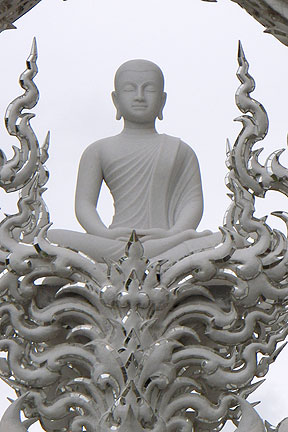

Wat Rong Khun is a modern temple built since 1998 by famous thai artist " Master Chalermchai Kositpipat" , he desires to build a temple as a heaven – a touchable paradise on earth for human. Chalermchai expects it will take another 90 years to complete, making it the Buddhist temple equivalent of the Sagrada Familia church in Barcelona, Spain!
It seems that the creator and his followers put all of their energies into creating this imaginative temple. Unlike many temples, Wat Rong Khun refuses to accept donations of more than 10,000 baht and the donors cannot have their names recorded on the buildings.
Wat Rong Khun is located at Tambon Pa-Or Donchai, Muang, Chiang Rai 57000.
胡
Quotes by THE BUDDHA
 Good men and bad men differ radically.
Bad men never appreciate kindness shown them, but wise men appreciate and are grateful. Wise men try to express their appreciation and gratitude by some return of kindness, not only to their benefactor, but to everyone else.
Believe nothing, no matter where you read it, or who said it, no matter if I have said it, unless it agrees with your own reason and your own common sense.
It is a man's own mind, not his enemy or foe, that lures him to evil ways.
The Ariyan Eightfold Path, that is to say: Right view, right aim, right speech, right action, right living, right effort, right mindfulness, right contemplation.
胡
Monday, 3 December 2007
Wat Mahathat Bangkok

Wat Mahatat, in Nakhon Si Thammarat, is one of the most highly revered temples in the south, a destination for pilgrims coming from all over the country. It is said to house a fragment of bone from the historical Buddha. The top of the chedi is said to be 700 (or 1,000) kilograms of gold.
Wat Mahathat Yuwarajarangsarit Rajaworamahavihara (Thai: วัดมหาธาตุยุวราชรังสฤษฎิ์ราชวรมหาวิหาร) is a Buddhist temple in Bangkok, Thailand. It is one of the 6 royal temples of the highest class (Thai: พระอารามหลวง ชั้นเอก ชนิดราชวรมหาวิหาร).
Built during Ayutthaya period, the temple was then known as Wat Salak. Soon after Bangkok was established as the capital of Siam, the temple became strategically situated in between the newly-built Grand Palace and Front Palace (residence of the vice-king). As a result, the temple was used for royal ceremonies and funerals.
 Throughout the past two centuries, the temple has been renovated and elevated in status by many Thai kings and royalties. It became the Wat Mahathat of Bangkok in 1803 and was given its current name in 1996.
Mahachulalongkornrajavidyalaya University, Thailand's oldest higher education institute for Buddhist monks, is located within the temple
Location: Phra That Road ( near Sanam Luang Park, between the Grand Palace and National Museum)
Open: 0900-1700
胡
Sunday, 2 December 2007
四面佛经咒
Om Mahapom Mataywa Namami Eitipiso Pagawato Puto
嗡 玛哈蓬 玛铁哇 呐玛密 依第必苏 巴加哇当 菩哆
Etipiso Phrapom Mataywa Nacitang Pagawato
依第必苏 柏蓬 玛铁哇 呐及当 巴加哇哆
Eitipiso Taywana Sukato Sawaha Sewahong
依第必苏 铁哇呐 苏加都 沙哇哈 沙哇鸿
***Chant each side once. 每一面念一次
胡
Saturday, 1 December 2007
Emerald Buddha 玉佛经咒
Putat Maha Mani Ratana Patimakara Pucemi
菩达 玛哈 玛尼 拉达那 巴滴玛伽郎 甫切米
Eitayna Sacawacena Mahatayco Cewa Mahapanyoca
依爹那 沙加哇切那 玛哈爹祖 且哇 玛哈班哟查
Mahapoko Camahayaso Capawatumay
玛哈菩柯 查玛哈呀苏 查巴湾都米
Nipana Sapancayo Homtu (3x)
尼巴那 沙巴查哟 鸿都
胡
Friday, 30 November 2007
Wat Srisathong

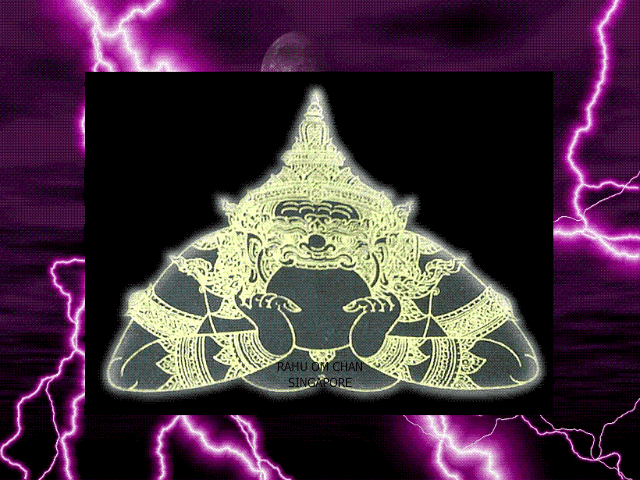
 Wat Srisa Thong is most popular with Rahu followers because it has a giant statue of Rahu, the biggest in Thailand. Some Thai people believe that bad luck always comes with an eclipse, so major changes and big losses are inevitable. Visits to Wat Srisa Thong then become more popular before such event. The temple is located at Nakhon Pathom, 50 kilometers (30 miles) west of Bangkok.
胡
Black is the color of Rahu, the God of Darkness.
 Worshippers offer Rahu eight black items, among them black chicken, black jelly, black liquor, black rice and black pudding.
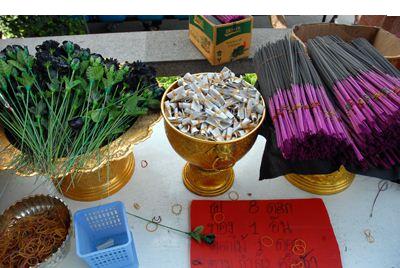 They offer black flowers, black joss sticks, black candles .
The symbol of Rahu was the number 8, a powerful figure believed to be the origin of all earthly things.
胡
Rahu - Wat Trimit
 Phra Rahu the god of fate, it is believed that paying respect to this god will protect you from bad luck.
Wat Traimit ( The Golden Buddha)
Location: Traimit Road ( West of Hua Lampong Station)
Open : 0900-1700
胡
Thursday, 29 November 2007
Offerings to Buddha
As i wrote on my previous blog on offerings, the following are the English version as per requested.
- Offer a cup of fresh water every morning.If our hands become dirty, we wash them with water. Water has the power to clean. The teaching ofthe Buddha has the same kind of power to make our minds clean. To offer a cup of water means topraise the Buddha with water, which has the same kind of power, and to quench the Buddha’s thirst.
- Offer incense every morning. Offering incense means to offer the fragrance of the incense to the Buddhas, and also to purge us with its fragance. It is said that offering incense symbolize the compassion of the Buddha. Its fragance spread all over equally no matter what kind of barrier is.
- Offering light signifies the stability and clarity of patience, the beauty which dispels all ignorance. It is also excellent to offer the butterlamps, candles or light because this act of offering this light symbolizes burning away our mental afflictions of desire, aggression, greed, jealousy, pride and so forth. The other part of the symbolism is that it is a way to burn away our illness."
- Offering flowers means to offer beauty and to ornament the Buddha.
胡

Subscribe to:
Posts (Atom)