With four things women win power in this world, this world is in their grasp. What four? Concerning this, a woman is capable at her work, she manages the servants properly, she is loved by her husband and she guards his wealth.
And how is a woman capable at her work? Whatever her husband's home industries, whether in wool or cotton, she is deft and tireless, gifted with an inquiring turn of mind into ways and means and able to arrange and carry out the job.
And how does she manage the servants properly? Whether there be servants, messengers or workers in her husband's household, she knows the work of each and what has been done, she knows what has not been done, she knows the strengths and weaknesses of the sick, she divides the food, both hard and soft, according to their share.
And how is she loved by her husband? Whatever her husband considers unlovely, she would never do, not even to save her life.And how does she guard her husband's wealth? Whatever money, grain, silver or gold he brings home, she secures, watches and guards; never does she steal, misuse or waste it.
Friday, 25 January 2008

Thursday, 24 January 2008
Ti Tsang P'usa: Ksitigarbha Bodhisattva
 Ti Tsang P'usa is an extremely popular Bodhisattva among the Chinese and Japanese Buddhists. 'Ti Tsang', meaning 'Earth-Store' is a direct translation of the Bodhisattva's name KSITIGARBHA in Sanskrit. Among the countless Bodhisattvas in the universe, he and three others have firmly captured the hearts of the Mahayanists.
These four main P'usas or Bodhisattvas are depicted in the Chinese Buddhist Pantheon and they represent four basic great qualities:
- KUAN SHIH YIN(观士音) as Great Compassion
- WEN SHU (文殊) as Great Wisdom
- PU HSIEN (普贤) as Great Love and Perfect Activity
- TI TSANG(地藏) as Great Vow to help and to deliver all beings.
Ti Tsang P'usa has often been mistaken by uninformed Buddhists to be Mogallana who was a disciple of Sakyamuni Buddha, because he too had a similar experience of descending to the Hell Realm to seek and save his mother. The stories may sound similar but they happened at different times and adopted quite different methods to save their mothers. Many others also tend to mistake Ti Tsang as Hsuan Tsang, the famous Tripitaka master of the Tang Dynasty who made the harzadous journey to the West to seek the Buddhist scriptures. This is mainly due to the Sangha robe and the five-leave crown which both are seen to wear. Ti Tsang P'usa is again taken by many to be "Yen-Lo-Wang" or Yama, the "Over-Lord of Hell." It must be mentioned that Ti Tsang is a Bodhisattva and not a mere King of the Fifth Hell. He does not judge the dead but seeks to save them from their suffering.
Ti Tsang may be represented in sitting or standing posture. He always has a kind and benevolent look and carries either, or both, his symbols of the Cintamani or "Wish-fulfilling Jewel' and the "Ringed-Staff", which is also called the Khakkhara. This ringed staff is often carried by Buddhist monks in their travels so that the sounds caused by the jingling rings can warn small animals and insects of their approach lest they be trod upon and killed. It is also sometimes called the alarm-staff. In the much treasured picture of Ti Tsang P'usa, which is found in many Buddhist homes and temples, he is seen seated upon a lotus throne. His hands holds the precious flaming pearl which has vast magical powers beyond description. He wears the robe of a Northern Buddhist monk and on his head is the "five-leave crown, where the representation of a Dhyani-Buddha can be seen on each of the leaves.Ti Tsang's compassion is not practised exclusively for the benefit of the beings of the hell realm, he also gives blessings to those of the world who seek his help and he is a comforter of the poor, oppressed, sick, hungry, and those who are troubled by spirits and nightmares. Those who have firm faith in him can easily receive his protection.
With faith one needs to recite any of these simple prayers:
"NAMO TI TSANG WANG P'USA' or"NAMO KSITIGARBHA BODHISATTVA YA".
The birthday of Ti Tsang P'usa falls on the 30th day of the 7th moon of the Chinese lunar calendar. All over the world Buddhist temples offer prayers to Ti Tsang P'usa during the 7th lunar month for the benefit of the dead. Ti Tsang's popularity among the Chinese and Japanese Buddhists is second only to Kuan Shih Yin P'usa as he takes upon himself the fearful and difficult task of bringing relief and consolation to the suffering beings of hell.
(source: http://www.buddhanet.net/)
胡
Wednesday, 23 January 2008
Buddha's word on Wisdom & Self control
- Thoughts of greed
- hatred
- harming.
- Thoughts of giving up
- love
- helping
These three types of thought give vision, seeing and knowledge, they increase wisdom, are associated with harmony, and conduce to Nirvana.
Look not to faults of others nor to their omissions and commissions.
But rather look to your own acts, to what you have done and left undone.
When one looks down on another's faults and is always full of envy, one's defilements continually grow; far is one from their destruction.
If only you would do what you teach others then being yourself controlled, you could control others well. Truly, self-control is difficult. You yourself must watch yourself. You yourself must examine yourself, and so self-guarded and mindful.
胡
Tuesday, 22 January 2008
Zeeba (Tibetan legend)
 Zeeba or Zipak (Tibetan)
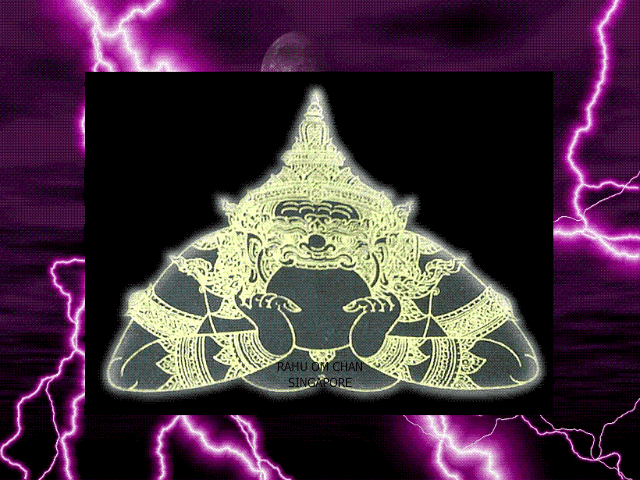
(First glance at the picture, we thought it's Rahu but after reading the story we realised it's not, but for sharing purpose, I've decided to write out. )
The Zipak originates in a Shaivite legend from the Shandha Purana. Shiva created a demon called Jalandhara from the blaze of his third eye. Jalandhara assumed great power and desired an incestuous relationship with Parvati, the consort of Shiva and Jalandhara’s adoptive mother. Jalandhara persuaded Rahu, one of his demonic friends, to demand Parvati’s favor. When Shiva got wind of this, he was understandably outraged, so his third eye blazed again. Thereby creating the Zeeba, who made a beeline to devour Rahu. Rahu decided that Zeeba was going to eat him bones and all and begged Shiva for mercy;whereupon, Shiva offered forgiveness and called off Zeeba. Because Zeeba had not had anything to eat since coming into the world and had been deprived of his only prey, he turned on himself and devoured his own body until only the head and hands remained. Shiva was very pleased with his handiwork and invited Zeeba to remain as the guardian to his door. Since then, he has become a reminder of the consequences of gluttony and greed and also stands as a guardian of practitioners. Zeeba’s finger point to his missing body to show what can happen when someone is overcome by avarice.
胡
Sunday, 20 January 2008
Sharing - Wisdom
- Wisdom is the light by day and Right mindfulness is the protection by night. If a man lives a pure life nothing can destroy him; If he has conquered greed nothing can limit his freedom.
- One is to cultivate the seven factors of enlightenment: mindfulness, investigation into phenomena, energy, bliss, tranquility, concentration, and equanimity. [Buddha, Maha-parinibbana Sutta 9]
- The thought manifests as the word; The word manifests as the deed; The deed develops into habit; And habit hardens into character. So watch the thought and its ways with care, And let it spring from love Born out of concern for all beings.
胡
Saturday, 19 January 2008

Friday, 18 January 2008
Rahu
 Rahu swallowing the sun. (Image taken from Bali Sekala Niskala Vol. 1, Fred B. Eiseman, Jr., page 66.)
 Rahu swallowing the moon. (Image taken from Island of Bali, Miguel Covarrubias, page 299.)
胡
Wednesday, 16 January 2008

Tuesday, 15 January 2008
Fengshui Tips
This year, 2008 the 5 Yellow star and the 3 Killings are both located in the south hence this may be a challenging year if the main entrance to your living space is in this direction.
Here are some general tips:
Here are some general tips:
- Tai Sui (God of the year or Grand Duke Jupiter) occupies N2 direction (352.5° to 7.5° N). Do not challenge him by facing him when you’re seated. Instead, sit with him behind you to gain his support.
- The 5 Yellow enjoys peace and quiet, if your main door is located in the south, you should try using another door. If this is not feasible, place a big golden bowl of water in the south to please him.
- The 3 Killings are also in the south this year and contrary to the Tai Sui, you must always face them. For 2008, you’ll be in tune with the Tai Sui and 3 Killings if you sit facing south, provided south is one of your auspicious direction.
- Wu (Horse) is in direct conflict with Zi (Rat) because they are directly opposite each other as shown in the compass below. Please remember that you should keep the south direction quiet and peaceful, with minimm activities and noise. Do not undertake renovation, digging, construction or demoltion work in all the above mentioned sectors without the advice from your Feng Shui Consultants.
- Star # 2 is located in the NW, if you'd spend a lot of time here or if this is your bedroom, don't forget to place a Hu Lu for good health... get it activated as well.
- Star # 3 is in the west. This star represents conflicts, disputes, etc. when it's untimely, but it can also bring us abundance of wealth if timely.
- Star # 7 commonly known as Robbery star, occupies SW in 2008. When timely, it will bestow financial gain on us.
- Spend as much time as possible in the East and SE with your family in 2008, when timely, it will bring us happiness, success, and good fortune.
The above serve as a general guide, hopefully it will be useful.
Monday, 14 January 2008
Words from the Buddha - Right Companion
If the one who does no wrong
Follows one who is evil,
He himself will be suspected of evil
And his reputation will decline.
According to the friends one makes,
According to who one follows,
So does one become.
Like one's associates one becomes.
Follower and following,
Toucher and touched alike,
An arrow smeared with poison
Infects those arrows that are not poisoned,
So that all are fouled.
The upright person not wishing to be soiled
Should not keep company with the fool.
If one strings a piece of putrid fish
On a blade of kusa grass,
The grass will smell putrid too;
The same with one who follows the fool.
If one wraps frankincense
In an ordinary kind of leaf,
The leaf will soon smell sweet too;
The same with one who follows the wise.
Remembering the example of the leaf wrapping
And understanding the results,
One should seek companionship with the wise,
Never with the fool.
Sunday, 13 January 2008
Words from the Buddha- Winning Respect
One who is wise and disciplined,
Kindly always and intelligent,
Humble and free from pride -
One like this will win respect.
Rising early and scorning laziness,
Remaining calm in time of strife,
Faultless in conduct and clever in actions -
One like this will win respect.
Being able to make friends and keep them,
Welcoming others and sharing with them,
A guide, philosopher and friend -
One like this will win respect.
Being generous and kindly in speech,
Doing a good turn for others
And treating all alike -
One like this will win respect.
Saturday, 12 January 2008
Daily word of the Buddha
Greed is to be slightly blamed but it is slow to change. Hatred is to be greatly blamed but it is quick to change. Delusion is to be greatly blamed and it is slow to change.
Wisdom is purified by virtue, and virtue is purified by wisdom. Where one is, so is the other. The virtuous person has wisdom, and the wise person has virtue. The combination of virtue and wisdom is called the highest thing in the world.
The past should not be followed after,And the future not desired.What is past is dead and gone,And the future is yet to come.
But whoever gains insight into thingsPresently arisen in the here and now,Knowing them, unmoved, unshaken -Let him cultivate that insight.
胡
Friday, 11 January 2008
Thai Amulet
One of the most unique and beautiful things you will experience in Thailand, are the amulet
that is made by the monks in certain Wats (Buddhist temples) to commemorate special events,festivals, or an anniversary.
For centuries, the monks have been crafting these little treasures. They come in all shapes and sizes, but generally, each Wat makes its own particular shape and size. Each amulet is infused with prayers, secret ingredients, and a little magic. They are said to endow their wearer with special powers, even up to the point of making the owner indestructable, and able to strike mortal terror into the heart of his enemies. Others are made to attract love, success, or happiness.
Possibly the oldest Thai amulets whose origins are traceable are the amulets from the Haripunchai period. Today this area is known as Lampoon province. Around 1,200 - 1,400 years ago there was a strong Mon/Burmese influence here and this area was its own distinct kingdom.
The first Thai amulets where made and blessed by devout monks and given to warriors and fighters to enhance and strengthen their ability to fight the enemies of Thailand. Many times the Thai amulets were worn as buttons or as talismans. This power then and today was acquired through a faith in the power of the Buddha and as protection against their enemies to be beaten, injured or killed in battle. Although the names of the kingdoms have changed and we have a host of new monks, the power and the belief in magical attributes of these Thai amulets remains very strong.
The collecting of these images is serious business in thailand. Great care is used to determine the age and authenticity of each piece. The most famous is the "Benjapakee" or "The Grand 5 Set".
The motif images of Thai Buddhist amulets were usually the Buddha, it was until the past century when images of Arahants (disciples of Buddha whom had achieved Nibbana), famous monks and Devas gained much more popularity. In fact, the Buddha had forbidden the worship of his images in attempt to achieve enlightenment, but rather achieve enlightenment through practising the Dhamma. The worship of Buddha's images may also lead to the wrong practise of worshipping idols instead of practising and understanding the Dhamma. No images of the Buddha were made during the life of the Buddha, and after the Buddha's passing away, Buddhist paid respect to the Buddha's relics, Stupas and to his footprints.
Thai Buddhist amulets are made by monks from since the last century. As mentioned earlier, the majority Thai Buddhist amulets depicts the image of the Buddha, however images of Arahants, popular monks and Devas had also gained popularity in recent decades, especially the images of popular holy monks. These images often bear words from Buddhist scriptures written or inscribed in old Khymer language scripts and contemporary Thai language scripts. The name of the particular monk and temple making and commissioning the amulet are oftenly also included on the amulet, along with the date it was made and issued. Yantra scripts and other Buddhist symbols such as images of Stupas, Bodhi leave, etc, are also oftenly included on the amulet.New period of Thai Buddhist images are made for a few purposes other than for Stupa storage, some common purposes are; to rise funds for the purposes of temple building or repair, fund rising for building hospitals, orphanages, etc.
胡
Wednesday, 9 January 2008
Website
I came across a website for Rev Luang Pu Hong, unfortunately, it was in Thai... I tried using a translator to read, not easy, but I'm really happy that someone actually came up with this idea. The web was nicely done up with pictures showing ceremonies conducted at the temple, biology of Luang Pu and many other more info.
If you would like to find out more about Luang Pu Hong and most importanly, if you can read thai, this is the website for you.
http://www.luangpuhong.com/
Thai Buddha for each day of week (part 2)
 Thursday ( Jupiter ): Pharutsabodi (Brihaspati) is the heavenly seer who carries a slate and rides a deer. He corresponds to Jupiter, tutor of the gods. Thursday, his day, is dedicated to teachers.
 Friday ( Venus ): Sukra, the god who presides over Friday, rides a bull. He is considered one of the heavenly seers as well as a tutor of the gods. He is the diety of wealth and fine art.
 Saturday ( Saturn ): Phra Sao (Sani), equivalent to Saturn, with bow and trident in his hands, is considered the god of difficulty. The people who are born under the influence of Saturn are believed to fall easily into grief, despair, and difficulties. He is seated on his vehicle, a tiger.
胡
Tuesday, 8 January 2008
Thai Buddha for each day of week (Part 1)
 Sunday ( Sun ): Phra Athit (also Aditaya or Suriya), the Sun, the god of light, is seated on his chariot of seven skyhorses driven by his rider, Phra Arun.
 Monday ( Moon ): Phra Chan (or Chandra), the Moon, is a male deity who rides a chariot drawn by ten horses. His nature is suave and gentle.
 Tuesday ( Mars ): Phra Angkhan (Angaraka) rides a water buffalo. He is Mars, the god of war, hard-work and conflict.
 Wednesday ( Mercury ): Buddha is an Indian equivalent of Mercury and Woden. He rides an elephant. He is the deity of wisdom, communication and books.
Monday, 7 January 2008
Merit-making helps spirit rest
The ceremony helps the deceased to rest in peace.
Without dhamma or Buddhist chanting by monks, the spirit, with an unconscious mind, might be lost in an unknown destiny between the worlds of the deceased and the living.When their karma - activities that bring upon oneself inevitable results, good or bad, either in this life or in a reincarnation - causes them to be born again, as only enlightened persons will not be born anew, they might suffer a sad fate.
For deceased royal personages, the ceremony must be held with elegance to honour those returning home in Buddhist heaven. In terms of deva-raja (god-king), which is based on Brahmin and Buddhist beliefs, royals, especially the king, are incarnations of god or angels in Buddhist heaven, coming to earth to take care of the people.
Although Thais nowadays do not believe in deva-raja, they feel it's more polite to say that their beloved royal personages have returned to their home in heaven.
In general, merit-making for the deceased begins on the first day of the funeral. The deceased will be laid on a bed with head turned to the west. The most respected or eldest person in the family will comb the body's hair halfway from front-to-back and halfway from back-to-front.After that, relatives and friends will sprinkle holy water on the right hand of the deceased.
At a later time, the deceased will be put into a coffin decorated with flowers and a photo of the deceased. When the monks finish preaching the fourth cycle of Phra Abhidhamma, a collection of analytical treatises based on lists of categories drawn from the teachings in the Buddhist discourses, close relatives will offer robes and necessities to the monks and the monks will pray for the deceased.
The merit-making ceremony might continue for three, five, seven or 100 days, depending on what the relatives agree to.
In the royal merit-making ceremony, honorary ornaments will be put in the front and to the side of a coffin including a golden urn decorated with golden flowers, golden and silver flower bushes and royal honorary necessities.
For the Princess Mother's funeral in 1995, His Majesty the King invited monks from nine royal Buddhist temples - Phra Chetupon, Saket, Maha That, Suthat, Chakrwat Rajawas, Rakang, Prayurawongsawat, Anongkaram and Rajasitharam - to preach Phra Abhidhamma at Dusit Maha Prasat Throne Hall for 100 days. After that, members of royal families, top government officials and other senior figures held the merit-making ceremony until February 29, 1996 - nine days before the royal cremation on March 10.
During that time, the special royal merit-making ceremony took place every Tuesday, the day the Princess Mother passed away.
*source : nationmultimedia.com
僧王法諭新年賀詞
僧王法谕新年前赐一首诗,以赐福全民,其大意为:新年来临,尘世烦燥而纷乱,是世俗长期积累的后果,可惜泰国有佛道这么久,佛祖道法无边,超越一切是非,世人应虔心向佛,遵循仁慈之道,摒弃恶行,一心向善,净化心灵,则佛祖必会以德阴庇,国泰民安。
此外,僧王法谕还赐新年祝语,希望佛教善信持续守戒律,修身养性,以实现自身幸福和国家和谐,并祈祷一切神圣力量保佑大家全年吉祥。
本文引用地址:http://www.udnbkk.com/article/2008/0102/article_28921.html
Sunday, 6 January 2008
Lp Waen
There’s a story about a pilot of the Royal Thai Air Force, who, on a practice flight over Mae Pang mountain, saw a monk sitting in meditation upon a cloud, and he had to practice much skill in swerving away to avoid hitting the apparition.
Having grounded the plane, the pilot with his flight map in hand went scouting on the mountain, and there he recognized Luang Pu Waen as the monk he had seen in the clouds.
The news of Luang Pu Waen’s power of levitation and flying spread quickly – it was broadcast on the radio and splashed in the newspapers. And public's demand for his medallions soared.
Friday, 4 January 2008
You have a choice
When people talk or read about suicide, there are various reactions to it. Some may just shook their heads and say, " What a stupid thing to do. .." whereas some just feel a sense of remorse thinking how a life could’ve been saved if someone had just listened.
A life is wasted just to end their suffering or for some, other people’s sufferings. Sufferings that people often say that it could be solved. They always say that after the person has taken his life. They alway say " we’re here to help…"" blah blah blah..
By the time, it’s too late.
Living in regret after they’ve killed themselves will not rewind time.
You think if the person is alive and well, people around them will really come forward to help? Chances are .. VERY unlikely. Becos the problem to one person ( who is normal) may seem trivial but to one ( who is severely depressed), it may be deemed dead serious. Hence they will brush aside like many others will. To you, it may be ridiculous but to them,.. it’s not.
When there is a call for help, please don’t ignore it becos it is something preventable. Like I said before, blaming yourself afterwards won’t bring him/her back.
If you choose to ignore or rejest that call.. inevitably you will feel responsible for his/her death becos you were the last person he/she thought of, whom he/she felt reliant on and thought could possibly help him.. but unfortunately.. didn’t. And that is the saddest part.
Remembering them after their death is painful but relatively pointless becos they won’t know anyway.
As anyone who has been close to someone that has committed suicide knows, there is no other pain like that felt after the incident.
And for people who is thinking of committing suicide __ You have a choice. Live or die. Every breath is a choice. Every minute is a choice. To be or not to be.
Subscribe to:
Posts (Atom)