Sunday, 16 December 2007

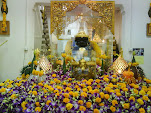
Luang Poo Waen

Luang Pu Waen BE2431 - 02.07.BE2528

Luang Pu Waen was born in BE2431 at Loei province, northeast Thailand. At the age of 13, he became a novice monk at Wat Poh Chai and studied Dhamma and Pali, showing exceptional ability even at young age. He went Tudong with his Teacher, Ajahn Wuan, travelling to Ubon province where he remained to learn Dhamma from Ajahn Sing. During his Tudong, he met many disciples of Ajahn Man telling him how good he was, hence Luang Pu Waen wished to meet Ah Jahn Man and become his disciples. In BE2462 Luang Pu Waen finally met Ah Jahn Man at Bahn Kor forest, Udon Thani province and became his disciple. Both he and Ah Jahn Dteu went Tudong again.
During the period in Tudong, he endured many difficulties such as ghost, wild animals and many other danger but he was never afraid. He spent most of his monkhood as a forest monk, travelling from one province to another on foot, going as far as Laos, Cambodia, Burma and even Vietnam.

At BE 2470 Ajahn Man officially accepted him as his disciple and he studied Dhamma at Wat Jedi Luang.
He went Tudong in chiangmai and stayed at Wat Huainumrin for 10 years. During the stay, he spent most of the time in forest and only return to the temple during the Khao Pansa. In BE2505, Ajahn Noo, the abbot of Wat Doi Mae pang ask him to stay at the Wat as he treated Luang Pu Waen as a teacher. He became the abbot of Wat Doi Mae Pang after Ajahn Noo passed away and he too, living the life as a forest monk all the time in a small hut away from the temple. He was very skillful in Sammahti and Dhamma.

The most unique nature of Luang Poo Waen, was that he did not like crowded places and loved to live alone in the forests
Chao Khun Nor ever mentioned"There is a Phra Arahang, but he lives far away, in the forest hill."

Luang Pu Waen passed away peacefully on 2nd July BE2528.

胡

Saturday, 15 December 2007

Tai Sui

The Tai Sui 太岁 are stars directly opposite of Jupiter. They influence the Chinese zodiac, and are also a theory in Taoism and Feng Shui.
In the Chinese zodiac, there are sixty heavenly generals who assist the Jade Emperor in taking charge of the well-being of the Mortal World. Each of them takes turn to be in charge for a year. Due to most of them having a military background, they are normally known as the Military Generals, or as the Cycle Gods. Each of their features and weapons signifies the well-being of that year. For example, if the Tai Sui of the year is one who holds a pen, it signifies political unrest for that particular year. On the other hand, if the Tai Sui of the year holds a spear or sword it signifies the need to work hard and excel for that year.
In Taoism, those who offended, or by their sign conflict with the Tai Sui of the year are advised to go through a prayer session with a Taoist Priest to ask for blessing in obtaining Peace and Good Fortune throughout the year. Talismans thought to protect again Tai Sui are sold in many areas.


The Taoist calendar is organized into a series of twelve "earthly branches" which rotate according to the five elements. The result is a sixty year cycle (in Chinese, the first year in the cycle is the "jia" year, while the last year in the cycle is the "zi" year). Taoists believe that the Heveanly heirarchy, under the leadership of the Jade Emperor, has assigned sixty Heavenly Generals, each with their own characteristics, temperments, abilities, etc., to rule the years of the Jiazi Cycle. People tend to take on the personalities of the Taoist Deity governing the year of their birth. The Deity also takes a special interest in the lives and affairs of those born under his reign. He functions in that respect as a type of "Guardian Angel." The Heavenly Generals are frequently asked to intercede on behalf of their "God-children" in matters dealing with higher ranking Taoist Deities. A normal person, for instance, rarely calls upon the Jade Emperor, but might frequently ask his or her Heavenly General to do so on their behalf.

In Feng Shui, the area of the house corresponding with the position of that year's Tai Sui is to be left undisturbed or misfortune will befall the residence.

Next year's (2008) Tai Sui General will be General Zou Dang.
Those whose chinese Zodiac sign - Rat , Rabbit, Horse and Goat are advise to pray to the Taisui.


2008 太岁

太岁是掌管一年凡间事务的天神,由六十位天界大将军轮流值年,即中国的六十花甲。要知太岁的来历典故必须从太岁的上司斗姆元君说来了。斗即北斗星群,姆即众生得圣子,补裨造化,统绐乾坤。一年春天,紫光夫人在后园九华曲池沐浴,忽然池中现出一宝座,紫光夫人登于宝座之上,得宝座灵气修练得道,经七日七夜,紫光夫人化生金莲九苞,莲苞开花放射光芒,化成九座大宝楼阁,大宝楼阁混凝直射上天界,形成众星群即斗姆生九子。斗姆九子即勾陈、北极、北斗中国三大星座,当中有六颗星即为六十大将军掌管人间每年事务,即为六十太岁了。

由于众星座中有不同位置,而这些位置古人亦以天干地支代表,而地支:“子、丑、寅、卯、辰、巳、午、未、申、酉、戍、亥”即各星星座位置,亦即每年生肖。有刑、冲、破、害,故每年太岁与各人生肖便有机会出现刑冲破害的效应,而出现所谓的犯太岁了。

人的出生生肖与太岁有着刑冲破害的不利关系,因恐冒犯太岁,故便有拜太岁的风俗传统,其生肖与太岁刑冲破害其实是来自算命的程序,亦即天星十二宫位的关系。而十二生肖的刑冲破害亦有其不同的力量及影响,现简介如下:

  • 刑~~ 即满的意思,即生肖五行过旺,旺极而衰的现象,刑亦残缺及转衰之象。

  • 冲~~ 即冲着而来的意思,有相战的味道,是四种之中最猛烈碰撞的一种。

  • 破~~ 即有散乱及移动之象,破不及冲及刑的碰撞猛烈,是较为轻微的一种冒犯。

  • 害~~ 即与另一个生肖不能相合,命理称为破合,即强行分开。
2008年戊子属鼠,对生肖属马、鼠、兔、羊犯太岁相冲相刑相害,多有不利!

鼠-犯刑 馬-犯沖 兔-犯破 羊-犯害

如某人出生在哪一年,那么当年值班之神就是某人的本年神(本命太岁)。六十甲子神都各有名号。如甲子年出生的人,他的本命神就是甲子太岁金辨大将军。相传礼拜本命神,就可获其护佑,百恶皆伏,所行大吉。

佛说

如果一个人没有苦难的感受,就不容易对他人给予同情。你要学救苦救难的精神,就得先受苦受难。一般人在遇到对方的权势大,财富大,气力大,在无可奈何的情形之下而忍,这算什么忍耐呢?真正的忍是,就算他欺负了你,对不住你,但他什么都不及你,你有足够的力量对付他,而你却能容忍他,认为他的本性和我一样,只是一时糊涂,或在恶劣的环境中受到熏染罢了,你不必与他计较,能在这样的情况及心境之下容忍那才是真正的忍耐。   

如果我们放眼从累生历劫去看,那么一切的众生,谁不曾做过我的父母、兄弟姊妹、亲戚眷属?谁不曾做过我的仇敌冤家?如果说有恩,个个与我有恩;如果说有冤,个个与我有冤。这样子我们还有什么恩怨亲疏之别呢?再就智慧愚笨来说,人人有聪明的时候,也有愚痴的时候,聪明的人可能变愚痴,愚痴的人也可能变聪明。最坏的人,也曾做过许多好事,而且不会永远坏;好人也曾做过许多坏事,将来也不一定会好。如此我们反覆思索,所谓的冤亲、贤愚,这许多差别的概念,自然就会渐渐淡了。这绝对不是混沌,也不是不知好坏,而是要将我们无始以来的偏私差别之见,以一视同仁的平等观念罢了!

世界原本就不是属于你,因此你用不着抛弃,要抛弃的是一切的执著。万物皆为我所用,但非我所属当你用烦恼心来面对事物时,你会觉得一切都是业障,世界也会变得丑陋可恨。

Phra Phuttasihing - Phra Sihing


The Phra Singh Buddha has been a significant Buddha image of the Thai lanna people for many years. However there is uncertainty as to how the image came to Lanna. A copy of the Pala school image in high relief may have been brought back to Chiang Mai in 1455, along with the plans of the Mahabodhi temple, which formed the basis for Wat Jet Yod. The Lanna sculptors who were of the Sukhothai school would then have made copies as bronze images in the round. Thus the "lion" style images of Lanna combine the flowing grace and posture of the Sukhothai school with features of the Pala school of India.
Another theory suggests that can original Phra Sihing image came from Sri Lanka via Nakhorn Sri Thammarat, where a similar "lion" style image is kept. In 1661 King Narai had the Phra Sihing taken to Ayutthaya, but Lanna soldiers fighting with the Burmese are said to have recovered it at the sack of Ayutthaya in 1767. The existence of yet another old "lion" style image at the National Museum in Bangkok suggests Lanna craftsmen made several copies. One thing is certain, at least, and that is the image in the Viharn Lai Kham is a replica, for the "original" is located in the Chiang Mai National Museum.
Lanna images were not only of the lion style, however. King Tilokarat also ordered images made reproducing other schools such as that of Sukhothai and U-Thong. These mixed style images were produced throughout Lanna.

On the day of the Songkran Festival , the Phra Singh Buddha is espectfully mounted on the royal carriage , and travels in a procession around the city of Chiang Mai, so that Chiang Mai people can pay homage in a traditional manner to the image.

During the Songkran festival Chiang Mai people will process the Buddha image around the town for traditional bathing.


Friday, 14 December 2007

Wat Thai Watthanaram – Mae Sot district.

It is a Tai Yai Mahayan Temple, built in 1867. It contains one of the most beautiful Buddha, Phra Phuttha Maha Muni, which is a Mandalay-style image, built for Tai Yai people who cannot visit the original image in Burma. The image is located in a Burmese palace-style building. Behind the meeting hall is a hugh white reclining Buddha image.

Thursday, 13 December 2007

Phra Phutthasothon-Wat Sothon


Wat Sothornwararamworaviharn or Wat Hong is the oldest temple in Chachoengsao Province.
The temple is located within the town Chachoengsao on the banks of the Bang Pakong River'

Built in late Ayutthaya Period, with its original name of Wat Hong, it is the location of Phra Phutthasothon or Luang Pho Sothon, the important Buddha image in the attitude of meditation with a width of 1.65 meters and a height of 1.48 meters high.

According to the legend, this Buddha image had been floated along the river, before being placed here at this temple. The original image was a beautiful Buddha image, but later on cement was placed on the image to prevent from burglary. Worshippers from all walks of life come to pay respect to this most reputed image by pasting gold leaves on the image.


Many Thais pay respect to Phra Phutthasothon which is one of the moset revered in the country. There is a legend that Phra Phutthasothon is one of the three brothers that fled from the ravages of war during the Ayutthaya period. They just got up one day and jumped into the river. One of them ended up at Samut Songkram. Another ended up in Samut Prakan. The third arrived in Chachoengsao. In each case, the Buddha images only came to shore when the local villagers paid proper respect. Efforts to retrieve it were unsuccessful until a villager had a small shrine erected on the site and performed a ceremony welcoming the image to the community.


There are a total of 3 celebration in a year -

  • Around April to celebrate the occasion of lifting Luang Pho Sothorn from the river. Open theatres are provided all through these three days and three nights.

  • Around November to commemorate the occasion of subsiding of smallpox in 1890 as it was believed that due to the help of Luang Pho Sothon. Performed on the eve is the chanting of sermons whereby magical power is instilled in Luang Pho votive tablets. A procession of a Luang Pho Sothon reproduction is held both on land and the water. Red Cross Festival is held at the same time at Somdet Phra Srinagarindra Park.

  • Around February (Chinese New Year Festival). This lasts 5 days 5 nights. A large crowd of people from every direction come to the temple to pay respect to Luang Pho.

WAT PA LELAI

Wat Pa Lelai stands just south of Wat Chimphli on Koh Kret. It is now a deserted monastery and te only remaining structure is an Ayutthaya-style congregation hall. In front of the hall a Buddha image with a monkey and an elephant represents the generally entitled Phra Phuttha Palelai image ( Rahu). This episode in Buddha gestures means that His needs were taken care of even by the members of the animal kingdom.


This is a good image for those born on Wednesday evening.

Wednesday, 12 December 2007

Introduction of Rahu in Japanese

ラーフ ラーフ(Rāhu)は、インド神話に登場する、4本の腕と1本の尾をもつアスラの名。あるいはインドの天文学におけるナヴァ・グラハという9つの惑星(九曜)の1つ羅睺(インド占星術参照)。神話によると、乳海攪拌のあと、神々とアスラは不死の霊薬アムリタをめぐって争い、アムリタは神々の手にわたった。神々は集まってアムリタを飲んだが、その中にラーフというアスラが神に化けてアムリタを口にした。それを太陽と月が発見し、ヴィシュヌ神に知らせた。ヴィシュヌ神は円盤(チャクラム)を投げてラーフの首を切断したが、ラーフの首は不死になってしまった。そして天に昇り、告口したことを怨んで太陽と月を飲み込んで日蝕や月蝕を起こす悪星になったという。一方、ラーフの体も天に昇ってケートゥという凶兆の星になったとされる。

**Note: for the reading pleasure of my dear friend from Japan

Introduction of Rahu in French

Râhu est le démon de l'éclipse, l'un des Navagrahâ.À l'origine il était doté d'un corps comme tous les asura. À l'issue du Barattage de la mer de lait, il déroba l'amrita - la liqueur d'immortalité - mais fut dénoncé par le Soleil et par la Lune. Avant qu'il n'eut fini de boire la liqueur, sa tête fut tranchée par Indra, demeurant seule immortelle. Il erre depuis dans l'espace et pour se venger du Soleil et de la Lune, tente de les dévorer. Mais comme il n'a plus de corps, ceux-ci s'échappent. C'est une éclipse.

**Note: For the reading pleasure of my dear Friend from Paris.

Sharings

The pessimist sees difficulty in every opportunity. The optimist sees the opportunity in every difficulty.

A positive attitude may not solve all your problems, but it will annoy enough people to make it worthwhile.

When you step into a turnaround situation, you can safely assume four things: morale is low, fear is high, the good people are halfway out the door, and the slackers are hiding.

One of the hardest tasks of leadership is understanding that you are not what you are, but what you're perceived to be by others.

Do what you feel in your heart to be right -- for you'll be criticized anyway. You'll be damned if you do, and damned if you don't.

People, even more than things, have to be restored, renewed, revived, reclaimed, and redeemed; Never throw out anyone!

Tuesday, 11 December 2007

Temple Location - Bangkok

Wat Arun ( Temple of Dawn)
Location: Wat Arun is located on the west side of Chao Praya River ( opp Tha Thien Pier)
Open: 0800-1730

Wat Pho ( Temple of Reclining Buddha)
Location: Maharat Road . Close to the river ( about a half mile south of the Grand Palace)
Open: 0800-1700
Admission: 20baht

Wat Saket ( Temple of the Golden Mount)
Location: Between Boriphat Road and Lan Luang Road
Open: 0800-2100

Wat Benchamabophit ( The Marble Temple)
Location: 69 Rama V Road, Dusit
Open : 0800-1700

Wat Bowonniwetwihan
Location: 248 Phrasumen Road, phra Nakkon, Rattanakosin
Open: 0800-1700

Wat Chanasongkram
Location: Chakrapong Road, near Khao San Rd, Banglamphu
Open: 0600-1800

Wat Intharawihan
Location: 114 Wisut Kasat Road, Banglamphu
Open: 0830-2000

Wat Rachanatdaram Worawihan
Location: 2 Machachai Road, phra Nakhon
Open: 0900-2000

Wat Rakhang
Location: 250 Arun Amorin Road, Sirirai, Bangkok Nou

Mae Nak Shrine
Location: Wat Maha But, On Nut, Sukhumvit 77
How to get there: Take the BTS to On Nut Station, Maha But Temple is located about 900 metres down Sukhumvit Soi 77, the temple is at the end of Soi 7.

Erawan Shrine ( Than Tao Mahaprom)
How to get there : BTS - Ploenchit

Sunday, 9 December 2007

Pictures of Rahu

Taken on 2/12/07

Taken on 7.12.2007

The Thai Buddha Image - Rattanakosin Art

The current era, which is known as the Rattanakosin period began when King Rama I established Bangkok as the capital of Thailand in the 10th century. The period can be categorized into 2 distinct phases.
  • Phase 1 : In the early Rattanakosin period ( from the rule of King Rama I to King Rama II), characteristics from different periods were revived, particularly from the Ayutthaya era. As many as 1200 Buddha images were moved from temple in the north for restoration work. Because of this principal Buddha images in many important temple in Bangkok and Thonburi belong to older periods, mostly from Sukhothai ( though U thong & Ayutthaya styles can also be found). There was more emphasis on adornments than on the Buddha’s expression.
    Features became more humanlike through the integration of influences from the Ayutthaya and Sukhothai periods. The aureole came to resemble an elongated flame, The cranial protuberance, the fine hair curls, long ears and the robes were retained. The robes, however, are distinguish-able from the former Ayutthaya style by the decorative floral motifs.

  • Phase 2: From the reign of King Rama IV onwards, a greater exposure to western styles began to have some influence on Buddha images. Image appeared more humanlike omitting the cranial protuberance, the pleated robe and rhe cross legged meditation posture. However, during the reigns of King Rama V and VI, the style was further changed to follow the Indian Gandhara style.
    This style retained the more human appearance but re-established some of the Buddha’s traditional characteristics, such as the flame aureole, the cranial protuberance, the curled hair, the long ears and the robes.


胡

The Thai Buddha Image - Ayutthaya Art

The Ayutthaya period began when King Ramathibodi I ( King U thong ) established Ayutthaya as a capital city in the 10th century A.D at the hands of the Burmese.


The Buddha mages from this period are characterised by the distinctive hair frame and 2 small lines carved above the upper lip and the eyes, a feature that was survived into the current Rattanakosin period. Buddha image at thatera falls into 3 distinct categories.

  • Early Ayutthaya Period: Influenced by Lopburi art, Buddha images carved out of stone were highly prized.
  • Middle Ayutthaya Period : By this time, Sukhothai characteristics had largely been adopted. The construction of large Buddha images became very popular and materials varied from gilded bronze to bronze plated and even brick and stucco. Postures included, seated reclining and standing.

  • Late Ayutthaya Period: In the later period the creation of bronze Buddha images in royal attire became very popular. 2 distinct styles gradually evolved; a Buddha in profusely adorned Emperor’s attire and a more moderate (though still regal) version that featured a crown or diadem with flanges covering both ears. The base also became more decorative for the seated Buddha images. A lion legged base was developed and the frontal decorative banner or ‘Pha Thip’ at the base was filled with elaborate designs and ornamentation.

胡

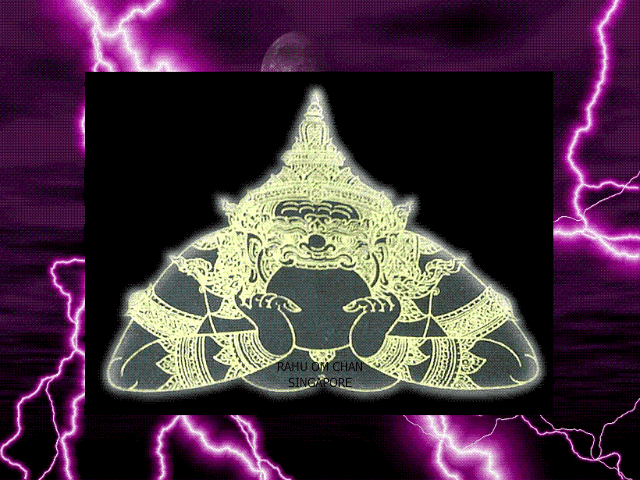
Picture of Rahu


Source : www. 大头.com.sg

Saturday, 8 December 2007

眾神猴之王 - 哈奴曼故事


哈奴曼(Hanuman),印度史诗《罗摩衍那》的神猴,风神和母猴所生之子,拥有四张脸和八只手. 哈奴曼出身于虎年三月的星期二, 他的头发是钻石,牙齿是水晶.他打哈欠时,口中会神奇的生出星星,月亮和太阳.

他聪明非凡,力能排山倒海,善于腾云驾雾,变幻形象和大多次救助罗摩王子,是智慧和力量的化身。他解救了阿逾陀国王子罗摩(Rama)之妻悉多(Sita),与罗刹恶魔罗波那(Ravana)大战. 它手中的虎头如意金棍,为天地冥三界锄妖铲魔、扬善去恶立下赫赫战功.

THE RAMAKIEN

Pic of Hanuman
In Thailand, the Ramayana has become the national epic, in the form of the Ramakian.
The Thai version, called the "Ramakian," appears to be a combination of several versions.The Ramayana epic first, several hundred years ago, was told on the Indian subcontinent but has since spread from there as far away as Indonesia. It is the legend of the hero Rama and the beautiful princess Sita, and of the fight between gods and demons and good and evil.
The Ramakien story goes as follows:
Once upon a time there was a giant king (called Tosakan) on the island of Lanka who won a battle against the god Indra and then sought to achieve the rule of the whole world. The gods knew that only a mortal man would be able to stop the invulnerable giant and sent the god Vishnu down to earth.
Vishnu is reincarnated as Prince Rama (Phra Ram), son of the mighty King Tosarot of
Ayuthaya. Rama and his faithful brother and friend Lakshman (Phra Lak) become famous heroes and Rama is appointed by his father as successor to the throne of Ayuthaya. When Rama manages to win beautiful and chaste Princess Sita as his wife, their happiness seems complete. However, an envious concubine of King Tosarot convinces him to favor her son and to disinherit Prince Rama. Rama, Sita, and the faithful Lakshman are expelled from the royal palace and have to flee into the jungle where they spend the next fourteen years hidden in a hermitage.
Even in the seclusion of their forest retreat, however, Sita's beauty does not go unnoticed, and the evil giant King Tosakan decides to lure her way from Rama. He disguises himself as a lovely deer and carries Sita off to Lanka where she is forced to live in his palace. Rama and Lakshman, of course, try to find her and enlist the help of the monkey king Subrik and his white general,Hanuman.
Hanuman, by flying through the air to Lanka, finally discovers poor Sita. Supported by Hanuman and an army of monkeys, Rama and his brother reach the coast in front of Lanka and Hanuman builds with his body a causeway to the island . And the battle starts. When it turns out that Rama and his followers are going to be victorious, however, the evil giant Tosakan manages to sneak out of the palace and takes lovely Sita with him. Again, it is Hanuman who helps: he finds the giant and becomes his confidant. Tosakan trusts him so much that he reveals to Hanuman the secret of his invulnerability. That allows Prince Rama to successfully fight (in an exhausting seven day battle) and finally kill the giant and to win Sita back - although in the beginning he does not believe in Sita`s faithfulness and she must undergo a trial of fire to prove her chastity.
All of them now return to Ayuthaya, where the unlawful king, the son of the envious concubine, resigns and Rama again becomes king. Everybody could be happy now, but Rama is still in doubt about Sita, who is expecting a child. He expels her from the palace and orders his brother Lakshman to have her killed. Lakshman, however, does not obey and brings Sita instead back to the hermit in the jungle where she and Rama spent fourteen years during Rama's exile. There she gives birth to a son and the hermit, a powerful magician, forms a twin brother of the child and teaches both arts and mystics. Rama hears about the children, and finally recognizes his son.
After a final battle with the remaining rebel giants, Rama's mission is fulfilled and he returns to heaven.

The Thai Buddha Image - U Thong Art

The art of U Thong originated in the Central region of Thailand between the 12th and 15th Centuries A.D. The style was developed was influences from different areas. U Thong Art falls into 3 distinct types.
  • Type 1 : This first and rarely encountered type presents a mixture of Dvaravati and Khmer influences. Distinguishable features are the lotus bud aureole, the hair frame, a Khmer styled square face and the long robe with the edge cut in a straight line. The base tended to be plain with an inward set V shaped hollow.

  • Type 2: Bearing a stronger resemblance to Khmer and Lopuri style art, Buddha images of the second type typically feature fine hair curls and a hair band. Occasionally the hair was tied into a topknot or transformed into a cone shaped cranial protuberance. A rather stern expression shown on a square face was similar to that of Lopuri style and the chin had a human like cleft. The mantle, smaller than the Lopuri style was sut into a straight edge. The Buddha is usually created in the Subduing Mara Posture. The lap is narrow and the shins are ridged ( called the "sharp shinned" design). The base is con-cave with no decoration.

  • Type 3: Although strongly influenced by art from Sukhothai, some U Thong characteristics were retained as seen in the hair band & the base with the inverted V shaped hollow. This style probably originated between the 14th and 15th centuries A.D


胡

Friday, 7 December 2007

The Thai Buddha Image - Sukhothai Art

In the 14th century A.D, King Sri Indrathit declared Sukhothai’s liberation from the Khmer and adopted a form of Buddhism based on the Sri lanka School. During this time, Sukhothai Art developed a radically different appearance to Mon and Khmer styles.
The difference can be seen in the "Walking Buddha" an original creation of the Sukhothai School. The inspiration which developed the idea of idealistic and superhuman characteristic and expressed the power of compassion and serenity. Such developement have made Sukhothai Art worthy of high praise as a truly unique and beautiful style. It was also during this period that the "four postured" group of Buddha images were created. The 4 poses consisted of, walking, standing, sitting and reclining. Sukhothai images can be classified into four distinct groups.

  • The major Group: Distinguished Sukhothai features include a flame aureole, whorls of fine curled hair, an oval facem high curving eyebrows, downward gazing eyes, booked nose and a gentle smiling expression. The torso included broad shoulders and a small waist. Robes were hung diagonally across the body and were completed with a zigzag edged mantle that extended down to the navel, seated in the Subduing Mara posture on a plain base.

  • The Kamphaengbet Group: The characteristics are generally similar to the major group apart from a broader upper face and a pointed chin.

  • The Phra Putthachinaraj group: In this group, thought to have originated during the reign of King Lithai, the aureole is flame shaped, the torso is rather plump, the face rounded and all fingers ( excluding the thumb) on each hand were of equal length.

  • The Heterogeneous Group or Wat Ta Kuwan Group: First discovered at Wat Ta Kuan in Sukhothai. The facial features are similar to images from the early Chiang Saen – Lanna period. This style is thought to have been created during the early 14th century A.D.

胡

 
eckhart tolle