Friday, 18 January 2008

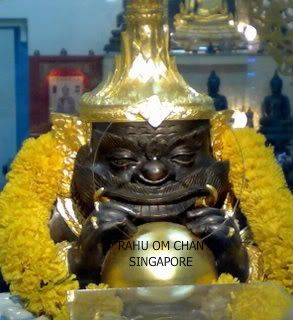
Rahu

Rahu swallowing the sun. (Image taken from Bali Sekala Niskala Vol. 1, Fred B. Eiseman, Jr., page 66.)
Rahu swallowing the moon. (Image taken from Island of Bali, Miguel Covarrubias, page 299.)

Wednesday, 16 January 2008

Tuesday, 15 January 2008

Fengshui Tips

This year, 2008 the 5 Yellow star and the 3 Killings are both located in the south hence this may be a challenging year if the main entrance to your living space is in this direction.

Here are some general tips:
  1. Tai Sui (God of the year or Grand Duke Jupiter) occupies N2 direction (352.5° to 7.5° N). Do not challenge him by facing him when you’re seated. Instead, sit with him behind you to gain his support.
  2. The 5 Yellow enjoys peace and quiet, if your main door is located in the south, you should try using another door. If this is not feasible, place a big golden bowl of water in the south to please him.
  3. The 3 Killings are also in the south this year and contrary to the Tai Sui, you must always face them. For 2008, you’ll be in tune with the Tai Sui and 3 Killings if you sit facing south, provided south is one of your auspicious direction.
  4. Wu (Horse) is in direct conflict with Zi (Rat) because they are directly opposite each other as shown in the compass below. Please remember that you should keep the south direction quiet and peaceful, with minimm activities and noise. Do not undertake renovation, digging, construction or demoltion work in all the above mentioned sectors without the advice from your Feng Shui Consultants.
  5. Star # 2 is located in the NW, if you'd spend a lot of time here or if this is your bedroom, don't forget to place a Hu Lu for good health... get it activated as well.
  6. Star # 3 is in the west. This star represents conflicts, disputes, etc. when it's untimely, but it can also bring us abundance of wealth if timely.
  7. Star # 7 commonly known as Robbery star, occupies SW in 2008. When timely, it will bestow financial gain on us.
  8. Spend as much time as possible in the East and SE with your family in 2008, when timely, it will bring us happiness, success, and good fortune.

The above serve as a general guide, hopefully it will be useful.

Monday, 14 January 2008

Words from the Buddha - Right Companion

If the one who does no wrong
Follows one who is evil,
He himself will be suspected of evil
And his reputation will decline.

According to the friends one makes,
According to who one follows,
So does one become.
Like one's associates one becomes.

Follower and following,
Toucher and touched alike,
An arrow smeared with poison
Infects those arrows that are not poisoned,
So that all are fouled.

The upright person not wishing to be soiled
Should not keep company with the fool.
If one strings a piece of putrid fish

On a blade of kusa grass,
The grass will smell putrid too;
The same with one who follows the fool.

If one wraps frankincense
In an ordinary kind of leaf,
The leaf will soon smell sweet too;
The same with one who follows the wise.

Remembering the example of the leaf wrapping
And understanding the results,
One should seek companionship with the wise,
Never with the fool.

Sunday, 13 January 2008

Words from the Buddha- Winning Respect

One who is wise and disciplined,
Kindly always and intelligent,
Humble and free from pride -
One like this will win respect.
Rising early and scorning laziness,
Remaining calm in time of strife,
Faultless in conduct and clever in actions -
One like this will win respect.
Being able to make friends and keep them,
Welcoming others and sharing with them,
A guide, philosopher and friend -
One like this will win respect.
Being generous and kindly in speech,
Doing a good turn for others
And treating all alike -
One like this will win respect.

Saturday, 12 January 2008

Daily word of the Buddha

Greed is to be slightly blamed but it is slow to change. Hatred is to be greatly blamed but it is quick to change. Delusion is to be greatly blamed and it is slow to change.

Wisdom is purified by virtue, and virtue is purified by wisdom. Where one is, so is the other. The virtuous person has wisdom, and the wise person has virtue. The combination of virtue and wisdom is called the highest thing in the world.

The past should not be followed after,And the future not desired.What is past is dead and gone,And the future is yet to come.
But whoever gains insight into thingsPresently arisen in the here and now,Knowing them, unmoved, unshaken -Let him cultivate that insight.


Friday, 11 January 2008

Thai Amulet

One of the most unique and beautiful things you will experience in Thailand, are the amulet
that is made by the monks in certain Wats (Buddhist temples) to commemorate special events,festivals, or an anniversary.

For centuries, the monks have been crafting these little treasures. They come in all shapes and sizes, but generally, each Wat makes its own particular shape and size. Each amulet is infused with prayers, secret ingredients, and a little magic. They are said to endow their wearer with special powers, even up to the point of making the owner indestructable, and able to strike mortal terror into the heart of his enemies. Others are made to attract love, success, or happiness.
Possibly the oldest Thai amulets whose origins are traceable are the amulets from the Haripunchai period. Today this area is known as Lampoon province. Around 1,200 - 1,400 years ago there was a strong Mon/Burmese influence here and this area was its own distinct kingdom.
The first Thai amulets where made and blessed by devout monks and given to warriors and fighters to enhance and strengthen their ability to fight the enemies of Thailand. Many times the Thai amulets were worn as buttons or as talismans. This power then and today was acquired through a faith in the power of the Buddha and as protection against their enemies to be beaten, injured or killed in battle. Although the names of the kingdoms have changed and we have a host of new monks, the power and the belief in magical attributes of these Thai amulets remains very strong.


The collecting of these images is serious business in thailand. Great care is used to determine the age and authenticity of each piece. The most famous is the "Benjapakee" or "The Grand 5 Set".

The motif images of Thai Buddhist amulets were usually the Buddha, it was until the past century when images of Arahants (disciples of Buddha whom had achieved Nibbana), famous monks and Devas gained much more popularity. In fact, the Buddha had forbidden the worship of his images in attempt to achieve enlightenment, but rather achieve enlightenment through practising the Dhamma. The worship of Buddha's images may also lead to the wrong practise of worshipping idols instead of practising and understanding the Dhamma. No images of the Buddha were made during the life of the Buddha, and after the Buddha's passing away, Buddhist paid respect to the Buddha's relics, Stupas and to his footprints.

Thai Buddhist amulets are made by monks from since the last century. As mentioned earlier, the majority Thai Buddhist amulets depicts the image of the Buddha, however images of Arahants, popular monks and Devas had also gained popularity in recent decades, especially the images of popular holy monks. These images often bear words from Buddhist scriptures written or inscribed in old Khymer language scripts and contemporary Thai language scripts. The name of the particular monk and temple making and commissioning the amulet are oftenly also included on the amulet, along with the date it was made and issued. Yantra scripts and other Buddhist symbols such as images of Stupas, Bodhi leave, etc, are also oftenly included on the amulet.New period of Thai Buddhist images are made for a few purposes other than for Stupa storage, some common purposes are; to rise funds for the purposes of temple building or repair, fund rising for building hospitals, orphanages, etc.

Wednesday, 9 January 2008

Website

I came across a website for Rev Luang Pu Hong, unfortunately, it was in Thai... I tried using a translator to read, not easy, but I'm really happy that someone actually came up with this idea. The web was nicely done up with pictures showing ceremonies conducted at the temple, biology of Luang Pu and many other more info.

If you would like to find out more about Luang Pu Hong and most importanly, if you can read thai, this is the website for you.

http://www.luangpuhong.com/

Thai Buddha for each day of week (part 2)

Thursday ( Jupiter ): Pharutsabodi (Brihaspati) is the heavenly seer who carries a slate and rides a deer. He corresponds to Jupiter, tutor of the gods. Thursday, his day, is dedicated to teachers.
Friday ( Venus ): Sukra, the god who presides over Friday, rides a bull. He is considered one of the heavenly seers as well as a tutor of the gods. He is the diety of wealth and fine art.
Saturday ( Saturn ): Phra Sao (Sani), equivalent to Saturn, with bow and trident in his hands, is considered the god of difficulty. The people who are born under the influence of Saturn are believed to fall easily into grief, despair, and difficulties. He is seated on his vehicle, a tiger.


Tuesday, 8 January 2008

Thai Buddha for each day of week (Part 1)

Sunday ( Sun ): Phra Athit (also Aditaya or Suriya), the Sun, the god of light, is seated on his chariot of seven skyhorses driven by his rider, Phra Arun.
Monday ( Moon ): Phra Chan (or Chandra), the Moon, is a male deity who rides a chariot drawn by ten horses. His nature is suave and gentle.
Tuesday ( Mars ): Phra Angkhan (Angaraka) rides a water buffalo. He is Mars, the god of war, hard-work and conflict.
Wednesday ( Mercury ): Buddha is an Indian equivalent of Mercury and Woden. He rides an elephant. He is the deity of wisdom, communication and books.


Monday, 7 January 2008

Merit-making helps spirit rest

The ceremony helps the deceased to rest in peace.

Without dhamma or Buddhist chanting by monks, the spirit, with an unconscious mind, might be lost in an unknown destiny between the worlds of the deceased and the living.When their karma - activities that bring upon oneself inevitable results, good or bad, either in this life or in a reincarnation - causes them to be born again, as only enlightened persons will not be born anew, they might suffer a sad fate.

For deceased royal personages, the ceremony must be held with elegance to honour those returning home in Buddhist heaven. In terms of deva-raja (god-king), which is based on Brahmin and Buddhist beliefs, royals, especially the king, are incarnations of god or angels in Buddhist heaven, coming to earth to take care of the people.
Although Thais nowadays do not believe in deva-raja, they feel it's more polite to say that their beloved royal personages have returned to their home in heaven.

In general, merit-making for the deceased begins on the first day of the funeral. The deceased will be laid on a bed with head turned to the west. The most respected or eldest person in the family will comb the body's hair halfway from front-to-back and halfway from back-to-front.After that, relatives and friends will sprinkle holy water on the right hand of the deceased.
At a later time, the deceased will be put into a coffin decorated with flowers and a photo of the deceased. When the monks finish preaching the fourth cycle of Phra Abhidhamma, a collection of analytical treatises based on lists of categories drawn from the teachings in the Buddhist discourses, close relatives will offer robes and necessities to the monks and the monks will pray for the deceased.
The merit-making ceremony might continue for three, five, seven or 100 days, depending on what the relatives agree to.
In the royal merit-making ceremony, honorary ornaments will be put in the front and to the side of a coffin including a golden urn decorated with golden flowers, golden and silver flower bushes and royal honorary necessities.
For the Princess Mother's funeral in 1995, His Majesty the King invited monks from nine royal Buddhist temples - Phra Chetupon, Saket, Maha That, Suthat, Chakrwat Rajawas, Rakang, Prayurawongsawat, Anongkaram and Rajasitharam - to preach Phra Abhidhamma at Dusit Maha Prasat Throne Hall for 100 days. After that, members of royal families, top government officials and other senior figures held the merit-making ceremony until February 29, 1996 - nine days before the royal cremation on March 10.
During that time, the special royal merit-making ceremony took place every Tuesday, the day the Princess Mother passed away.

*source : nationmultimedia.com

僧王法諭新年賀詞

僧王法谕新年前赐一首诗,以赐福全民,其大意为:新年来临,尘世烦燥而纷乱,是世俗长期积累的后果,可惜泰国有佛道这么久,佛祖道法无边,超越一切是非,世人应虔心向佛,遵循仁慈之道,摒弃恶行,一心向善,净化心灵,则佛祖必会以德阴庇,国泰民安。

此外,僧王法谕还赐新年祝语,希望佛教善信持续守戒律,修身养性,以实现自身幸福和国家和谐,并祈祷一切神圣力量保佑大家全年吉祥。


本文引用地址:http://www.udnbkk.com/article/2008/0102/article_28921.html

Sunday, 6 January 2008

Lp Waen

There’s a story about a pilot of the Royal Thai Air Force, who, on a practice flight over Mae Pang mountain, saw a monk sitting in meditation upon a cloud, and he had to practice much skill in swerving away to avoid hitting the apparition.

Having grounded the plane, the pilot with his flight map in hand went scouting on the mountain, and there he recognized Luang Pu Waen as the monk he had seen in the clouds.

The news of Luang Pu Waen’s power of levitation and flying spread quickly – it was broadcast on the radio and splashed in the newspapers. And public's demand for his medallions soared.

Friday, 4 January 2008

You have a choice

When people talk or read about suicide, there are various reactions to it. Some may just shook their heads and say, " What a stupid thing to do. .." whereas some just feel a sense of remorse thinking how a life could’ve been saved if someone had just listened.

A life is wasted just to end their suffering or for some, other people’s sufferings. Sufferings that people often say that it could be solved. They always say that after the person has taken his life. They alway say " we’re here to help…"" blah blah blah..
By the time, it’s too late.
Living in regret after they’ve killed themselves will not rewind time.
You think if the person is alive and well, people around them will really come forward to help? Chances are .. VERY unlikely. Becos the problem to one person ( who is normal) may seem trivial but to one ( who is severely depressed), it may be deemed dead serious. Hence they will brush aside like many others will. To you, it may be ridiculous but to them,.. it’s not.

When there is a call for help, please don’t ignore it becos it is something preventable. Like I said before, blaming yourself afterwards won’t bring him/her back.

If you choose to ignore or rejest that call.. inevitably you will feel responsible for his/her death becos you were the last person he/she thought of, whom he/she felt reliant on and thought could possibly help him.. but unfortunately.. didn’t. And that is the saddest part.
Remembering them after their death is painful but relatively pointless becos they won’t know anyway.
As anyone who has been close to someone that has committed suicide knows, there is no other pain like that felt after the incident.
And for people who is thinking of committing suicide __ You have a choice. Live or die. Every breath is a choice. Every minute is a choice. To be or not to be.

Thursday, 3 January 2008

出家仪式变枪战 1死12伤

安纳乍能府2群青年30日在华达攀县参加剃度法会时,双方因发生争执打起群架。期间有1名青年,疑不熟炸弹的用法,令到自己被炸死,并连累身边的朋友,导致另12人受伤。

警方获报县内2群青年在叻那哇尼镇打群架,且有枪械及炸弹等武器,因此派人前去调查。警方发现有1人死亡,12人受伤后,已将所有伤者送交县内2所医院急救。警方稍后证实,该因不熟炸弹用法,反被炸死的17岁青年塔威萨,其腹部及胸部均被炸弹碎片打中,合共7处伤口。此外,另有3名伤势较重的伤者,分别是隆蓬(15岁)、信提速(15岁)及乃典(57岁),当中以乃典最为严重,需入住心切治疗病房接受观察。

该名肇事民居的65岁屋主颂女士称,当日由於42岁儿子阿隆剃度出家,因此聘请专人前来表演庆祝。不料突有2群自外地前来观赏活动的青年发生争执,且持酒瓶打群架。期间2群青年曾离开现场,但在10分钟过后,双方竟持手枪及炸弹回来,但塔威萨手持的炸弹突然爆炸,导致造成伤亡。

邬汶府边境警察第22小队透露,经检查炸弹的碎片,证实该颗炸弹并没有保险钳,推测塔威萨因不熟爆炸的用法,炸死自己,且连累身边的朋友受伤。


本文引用地址:http://www.udnbkk.com/article/2007/1231/article_28856.html

曼谷市長迎請神聖佛像 供民眾膜拜

曼谷市長阿披叻30日主持迎請神聖佛像到皇家田廣場供奉儀式,供廣大民眾在新年期間前往膜拜祈福。阿披叻強調,今晚在中央世界廣場和皇家田廣場將舉辦的新年倒數計時活動,安全工作已全面就緒。 阿披叻市長昨天和曼谷市政府官員一同主持迎請神聖佛像到皇家田廣場中央供奉儀式,以讓廣大佛教善信前來膜拜祈福。阿披叻市長為佛像安座舉行點燭,意味著曼谷市慶祝新年活動正式拉開序幕。佛像將供奉在皇家田廣場直到2008年1月1日。每天早上6時45分將為181名僧人進行齋僧。而皇家田廣場舉行的新年倒計時慶祝活動,將以彩燈和音樂為主,並突出曼谷王朝的文化特色。

本文引用地址:http://www.udnbkk.com/article/2007/1231/article_28896.html

HRH Princess Galyani Vadhana passes away

Her Royal Highness Princess Galyani Vadhana passed away at Siriraj Hospital, announced the Royal Household Bureau. She was 84.The Princess' condition worsened on Tuesday night and she passed away at 2.54 am on Wednesday January 3, 2007.
The Princess had been received treatment for cancer at the hospital for months. Well-wishers had flocked to the hospital since the news spread that she was admitted.
The Princess is the elder sister of two kings of the Chakri Dynasty - King Rama Ananda and the present King Bhumibol Adulyadej.
The royal funeral will take place at the Dusit Mahaprasart Throne inside the Grand Palace. Public who wants to pay respect to the late Princess should head to Sala Saha Thai Samakom inside the grand palace from 1pm to 4pm today.
The mourning period has started from today until the 100th day of her departure, according to the Bureau.
Shortly after the news of her death was announced, people in black dress rushed to the hospital to pay respect to the Princess portrait.
At the time of the announcement, all members of the Royal Family were still on the 16th floor of the hospital a huge crowd was waiting to have an audience with His Majesty the King.
The hospital decorated inside the Chalerm Prakiart Building with black and white clothes to mourn the departure of the Princess.

Source: http://www.nationmultimedia.com/

皇姐昨驾薨 享年84岁

泰国甘拉雅妮瓦她娜皇姐殿下昨天(2日)凌晨2时54分,在曼谷驾薨,享年84岁。
遗体已从诗里叻医院移至大皇宫披曼叻达雅皇殿入殓,进行长达100天的吊唁。国务院则通令全国政府部门向皇姐殿下致哀15天。受全民爱戴的甘拉雅妮瓦她娜皇姐殿下,从去年6月15日起,因胃肠癌症复发住进曼谷诗里叻医院接受治疗。宫务处昨天凌晨5时发布公告指出,由於病情不断恶化,皇姐殿下於昨天凌晨2时54分驾薨,享年84岁。

皇上谕示全体皇室成员按照传统的皇家葬礼和仪式,让皇姐殿下遗体在大皇宫入殓,并举哀100天,公家单位降半旗,公务员著黑色服装15天。同时赐准民众到大皇宫向皇姐殿下致哀。数千名泰国人昨天在诗里叻医院外摆放致哀的花束及花圈。甘拉雅妮瓦她娜皇姐殿下的遗体於昨天下午3时被移往大皇宫入殓,并从昨天下午起举行为期100天的皇家吊吊仪式。皇上及各位皇室成员均驾临。

泰国通讯社指出,甘拉雅妮瓦她娜皇姐殿下不仅是泰皇蒲美蓬的长姐,也是上1任泰皇的姐姐,她见证了两位泰皇在20世纪的成就,也见证了泰国在20世纪的进步与成长。甘拉雅妮瓦她娜皇姐殿下於1923年5月6日出生在英国伦敦,并在英国接受教育,对艺术、语言及历史极有兴趣,也曾经在朱拉隆功大学与法政大学教授法文、法国文学与历史课程。

本文引用地址:http://www.udnbkk.com/article/2008/0103/article_28947.html

Tuesday, 1 January 2008


HAPPY NEW YEAR!

May This New Year -

Bloom with Happiness & make your heart Replete with Joy


泰国佛牌的由来

相传古时泰国有一位督信佛教的高官,在家里供奉了一尊佛像,每天早晚均会诵经。有一天,泰国某地区出现旱灾,泰皇得悉此事便派遣高官前往灾区视察,於是,高官便回家准备前往灾区。

由於他是一位虔诚的佛教徒,希望带同那尊佛像前去灾区,好让他能早晚诵经祈福,同时藉著佛像,希望能保佑灾区,但可惜佛像太大,未能一同带往。当晚,高官做了一个奇怪的梦,梦见佛像叫他可用寺庙的泥土,按他的模样制作一个牌佩戴在身上,一同前去灾区,这样便能得到他的保护,使他平安、顺利,他醒后便按梦中指示制作牌佩戴身上。

到了灾区后,他依然每晚诵经祈福,不久,灾区的情况便好转起来及后,高官因年时已高,便向泰皇告老还乡,并将身上佩戴的佛牌奉献给泰皇,希望此佛牌能带给全国国泰民安。
其后,高官在乡间寺庙里当上僧侣修行,在修行期间,还制作佛牌,给善信奉请,希望他们也能得到佛祖的庇佑,带来好运,至此,佛牌便在民间流传开去。

时至今日,制造佛牌的材料已不单是寺庙的泥土,有些更是用一些得道高僧的骨灰、衣物、舍利子、花粉、佛门圣物等制造,而佛牌的像相、种类繁多,善信可按不同需要奉请适合的佛牌。
 
eckhart tolle