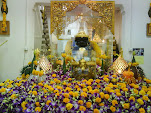
"Before you say anything, ask yourself whether it's necessary or not. If it's not, don't say it. This is the first step in training the mind -- if you can't have any control over your mouth, how can you expect to have any control over your mind?"
Showing posts with label Enlightenment. Show all posts
Showing posts with label Enlightenment. Show all posts
Saturday, 18 July 2009

Thursday, 16 July 2009
Meaningful Quotes from Ajarn Chah
"If your mind is happy, then you are happy anywhere you go. When wisdom awakens within you, you will see Truth wherever you look. Truth's all there is. It's like when you've learned how to read -- you can then read anywhere you go."
"People who suffer will accordingly gain wisdom. If we don't suffer, we don't contemplate. If we don't contemplate, no wisdom is born. Without wisdom, we don't know. Not knowing, we can't get free of suffering -- that's just the way it is. Therefore, we must train and endure in our practice. When we then reflect on the world, we won't be afraid like before. It isn't that the Buddha was enlightened outside of the world, but within the world itself."
"Remember you don't meditate to 'get anything', but to get 'rid' of things. We do it, not with desire, but with letting go. If you 'want' anything, you won't find it."
"Everything is uncertain. Don't cling to anything."
Friday, 15 May 2009
Letting Go - Dhamma teaching of Phrarajbhavanavisudh
When we begin to meditate, before we can bring our mind to a standstill position, we must train our minds to stop thinking of all tasks and worries, such as business, school, family and so forth.
We must clear our minds and leave these thoughts behind. Imagine that you are alone in this world and have never experienced any of those things before. We need to practice letting go of our thoughts gradually. It could be very difficult at the beginning, but we'll be able to do it through a consistent effort. Because meditation is the practice of emptying the mind of all distracting thought, it is the way to purify and keep the stillness of one's mind in order to attain Dhammakaya in oneself.
Thus, we must let go all the worries which obstruct meditation. We must practice letting them go and empty our minds of all thoughts. This will benefit us when we are to leave this world. Everyone will die, sooner or later. We cannot choose the time and place of our death. The moment of dying is important because we can not transform to the realm of happiness if our minds are worried about the house, family, properties, work, or business. These issues will bring us unhappiness and lead us to the realm of suffering.
It is crucial for us to learn and practice letting go and how to empty/free/clear our minds of all worrying. Nobody else can help us when we are to leave this world. The others can only watch us dying; we need to help ourselves. All people, materials, families, and work can not help us at all. We need to let go of them. Indeed, they belong to us only temporarily during our life time.
When we were born, we brought nothing with us but we begin to accumulate things as we grow up. If we consider our lives carefully, we see that they are temporary belongings. We should not count on them as permanent. They are only possessions that accommodate our living. We should think of it this way during meditation. In our daily lives, we have to work to support our living and deal with many problems and obstacles that enter our mind. When we do that, we forget these truths about life. If we remind ourselves of these truths, we will be cheerful and detached from all worldly things. Thus, the result of this feeling will help our mind to focus quickly and steadily. It will be easier for us to attain dhammakaya, where true happiness awaits everyone, in ourselves.
Source - Dhamma Foundation
胡
Thursday, 14 May 2009
Respectfulness- Dhamma teaching of Phramongkolthepmuni
After attaining enlightment, every Buddha accepts the customary practice of only respecting the Dhamma, or the Truth of life.
Every Buddhist believes and respects the Dhamma. Often it takes many lifetimes before a person to understand and come to respect the Dhamma. When a person loves and respects the Dhamma, he or she will develop more self-control and compassion towards others than the one who doesn't respect the Dhamma. That is, when one reaches the level of seeing the Dhamma sphere in one's own body, one will show a greater sense of compassion towards others. The people receiving the kindness and compassion are more likely to accept it and return the same kind of love and compassion towards others.
When one gives good to others, they will always receive good in return, it may be in the near future or the distance future, but good is always returned to the giver. This can also be interpreted as a person having power over another. In the Buddhist sense, power over another should not be looked at in a negative manner as one person having physical control over another, it should be looked at as a spiritual control, where goodness to others returns goodness to oneself.
The Dhamma Sphere is at the seventh base or the center of the body, in every sentient being. On the contrary, when one's mind wanders from the Dhamma Sphere, one can also become less fortunate. As one's mind wanders from the center, we begin thinking about worldly affairs that are less pure, our balance starts to shift and we become weak. We are no longer as productive or efficient because we have surrendered some of our purity to worldly desires.
From Luang Pu Wat Paknam's meditation experience, he assured that every sentient being has the Dhamma substance in a spherical shape at the center of one's body. A person will become more energetic and prosperous if the Dhamma Sphere is bright and clear, indicating pureness of the mind. It manifests that one's mind is pure and clear because it doesn't attach itself to worldly things or desires. By keeping your mind clear and pure and it is much easier to successfully complete any task at hand.
According to the Buddha, to respect the Dhamma, is to rest your mind at the center of your body until your mind comes to a complete stand still. The seventh base or the center of the body is the location of Dhammakaya, the body of enlightenment, that gives us the needed wisdom to understand the Truth of life.Naturally, a person's mind always wanders away from the seventh base and this results in thoughts about worldly materials. For example, as you read this message, your mind may be wandering around to different places such as home, entertainment, work place, school, or any other worldly place. As one's mind begins to wander it must be brought back by shifting your thoughts to the Dhamma Sphere located at the center of the body, or the seventh base. People with wisdom understand the importance of maintaining one's mind at the center of the body. In this manner of maintaining purity one is showing respect to the Buddha by accepting and practicing the teachings of the Dhamma.
Source - Dhamma Foundation
When we were children, our need for food, clothes, love, and a proper environment to learn in were provided by our parents. We were dependent on them for our physical and emotional needs. As we matured we returned love and respect to our parents, which they gave so freely to us. If we are adopted by others, we learned to respect and love them as if they were our biological father and mother. As we travel through life we are often confronted with obstacles and problems, and we think of the advice or guidance our parents can provide for us. Our parents provided our needs and we continue to love and respect them. We respect our parents because of their concern and love for us. When we started school, our parents provided the necessary tuition and fees to support our education. After we graduated, planned for marriage, and began our own family, again, our parents continued to support us.
Children show love towards their parents to ensure and satisfy the child's material and emotional needs. A child's love to a parent is love without wisdom, because it is a love that does not lead one to the Truth of life or the Dhamma. The love that children have towards their parents is different from the love that Buddhists show toward the Dhamma. As a Buddhist adult, one learns to respect others.
For example, a husband and wife respect each other resulting in a household filled with peace and happiness. Regardless of the difficulties or obstacles they are confronted with they continue to support and love each other. If a couple is unwilling to respect and help one another, their marriage would probably consist of many arguments that ultimately lead to divorce.
In conclusion, friendships and alliances can still be established and maintained through respect. Mankind can achieve a far greater sense of happiness when humanity learns to respect each other, regardless of differences in skin color, religious beliefs, or nationality.
Every Buddhist believes and respects the Dhamma. Often it takes many lifetimes before a person to understand and come to respect the Dhamma. When a person loves and respects the Dhamma, he or she will develop more self-control and compassion towards others than the one who doesn't respect the Dhamma. That is, when one reaches the level of seeing the Dhamma sphere in one's own body, one will show a greater sense of compassion towards others. The people receiving the kindness and compassion are more likely to accept it and return the same kind of love and compassion towards others.
When one gives good to others, they will always receive good in return, it may be in the near future or the distance future, but good is always returned to the giver. This can also be interpreted as a person having power over another. In the Buddhist sense, power over another should not be looked at in a negative manner as one person having physical control over another, it should be looked at as a spiritual control, where goodness to others returns goodness to oneself.
The Dhamma Sphere is at the seventh base or the center of the body, in every sentient being. On the contrary, when one's mind wanders from the Dhamma Sphere, one can also become less fortunate. As one's mind wanders from the center, we begin thinking about worldly affairs that are less pure, our balance starts to shift and we become weak. We are no longer as productive or efficient because we have surrendered some of our purity to worldly desires.
From Luang Pu Wat Paknam's meditation experience, he assured that every sentient being has the Dhamma substance in a spherical shape at the center of one's body. A person will become more energetic and prosperous if the Dhamma Sphere is bright and clear, indicating pureness of the mind. It manifests that one's mind is pure and clear because it doesn't attach itself to worldly things or desires. By keeping your mind clear and pure and it is much easier to successfully complete any task at hand.
According to the Buddha, to respect the Dhamma, is to rest your mind at the center of your body until your mind comes to a complete stand still. The seventh base or the center of the body is the location of Dhammakaya, the body of enlightenment, that gives us the needed wisdom to understand the Truth of life.Naturally, a person's mind always wanders away from the seventh base and this results in thoughts about worldly materials. For example, as you read this message, your mind may be wandering around to different places such as home, entertainment, work place, school, or any other worldly place. As one's mind begins to wander it must be brought back by shifting your thoughts to the Dhamma Sphere located at the center of the body, or the seventh base. People with wisdom understand the importance of maintaining one's mind at the center of the body. In this manner of maintaining purity one is showing respect to the Buddha by accepting and practicing the teachings of the Dhamma.
Source - Dhamma Foundation
胡
Wednesday, 13 May 2009
Giving - Dhamma teaching of Phramongkolthepmuni
Giving had not been an aspect of Buddhism only.
Even before Buddha's time, giving existed.For husbands and wives to stay together, giving is a critical element of the relationship. They have to give happiness, clothing, and other things. They have to share. Otherwise, they couldn't stay together. Giving is absolutely essential. Giving is very important for the success of givers.
Knowing this, whatever occupation one has, one should not overlook giving.
In the family, the husband must give to the wife and vice versa. When a child is born, the mother has to feed milk to the child. Even milk is considered as the parents' money. It is a byproduct of their money. The mother eats. The food is transformed into milk for her child. As the child grows, the parents have to find the food for the child; to find the toys for the child's play. Giving is critical. Whatever the child needs, the parents will find and give to the child. If the parents do not give to the child, the child will die.
It is because of the parents' giving that children live. Knowing this, we should give continuously. If someone is angry with us, we should find a way to make that person understand us by giving good words and some gifts. To one who criticizes his own parents, we should give first and share our thoughts later. When he receives what we have to give, increasingly this will lead him to believe in, and have faith in us.
The foundation of Buddhism is giving. Giving is crucially important because everyone lives by giving and being given to.
According to records (Buddhist Canons), giving a meal symbolizes giving these five things to the receivers : -Life, Freshness of complexity and health Happiness, Power of these three qualities : physical, intellectual, spiritual Wisdom
These five qualities everyone wants.
It is not only giving, but also three other actions that will help us live happily in society.
The other three actions are :
Use good words : When we have many friends, we have to speak gentle words. We have to have good manners. We must not bother others with our words. This is very important.
Help others : We should help others. Do not care only for ourselves. When we have children, we have to allow them to study until they can work and support themselves.
Do not disturb other people :Wherever we go, we will not bother people with our actions, words, or thoughts. Moreover, we should adjust ourselves to their lives/living and make them as comfortable with us as if we were their family.
The world will be peaceful if we do these four things :give, use good words, help others, and not disturb people.
If we don't do these four things, parents will not receive respect from or be respected by their children. The wise considered this carefully and agreed on this philosophy.
Source - Dhamma Foundation
胡
Sunday, 21 December 2008
The Parable of Pilgrims
Two Monks on pilgrimage came to a river bank. there they saw a girl dressed in fine clothes and at a loss to know how to proceed, for the river was high and she did not want her clothes spoilt.
Without further ado, one of the monks took her on his back, carried her across and put her down on dry ground. Then the monks continued on their way. After a while the other monk suddenly burst out :" Surely it is not right to touch a woman. It is against the commandments to have close contact with woman. How can you go against the rules for monk?"... and so on in a steady stream.
The monk who had carried the girl walked along silently, but finally he remarked:" I set her down the river, But you are still carrying her."
Saturday, 20 December 2008
The Paramitas ~ The Perfections
The Paramitas, or perfections, are the skills for living that lead to freedom and happiness. Cultivating them is fundamental to practice. Each paramita is demonstrated by the Buddha in one of his past lives, which are retold in tales known as the Jatakas.
In the Theravada Tradition -
The First Paramita ~Dana in Pali, the paramita of giving, applies to both material and non-material things: service of all kinds, helping others, teaching the Dharma and most importantly, always giving ourselves wholeheartedly to what we are doing right now.
The Second Paramita~Sila (morality) means behaving well at all times, living according to ethical rules or precepts, restraint of the senses and passions, good manners, self discipline, courtesy, consideration and politeness. Sila is also used as a general term for the daily practice of sustained awareness and mindful actions.
The Third Paramita~The Buddha himself admitted that before he was enlightened his heart did not delight in the thought of giving up worldly pleasures. Eventually he realized it was because he had not yet experienced life without them. The practice of renunciation (nekkhama) reduces the pull that sensual experience has on us, leading to relief, freedom and genuine joy.
The Fourth Paramita~The paramita of wisdom ( panna in Pali) means seeing the true nature of things, no longer contaminated by personal bias. With wisdom we can then live in accordance with things as they are, and realize inner peace and the truth.
The Fifth Paramita~Energy (Viriya) encourages us to abandon laziness and procrastination. Fear of not getting what we want can make us unwilling to wholeheartedly give ourselves to life's challenges. Viriya counterects this fearful " I won't" and transforms the heart.
The Sixth Paramita~Patience (Khanti) is considered the means for overcoming anger, ill-will and hatred, maintaining inner peace and tranquillity, and tolerating the intolerable. Patience is one of the most written-about practices in all Buddhism: it calms the passions and, in doing so, diminishes our illusory sense of "I", "me" and "mine" and makes us flexible, tolerant and warm.
The Seventh Paramita~Truthfulness (Sacca) means both honesty with other people and truthfulness with oneself - being honest about what our hearts really long for and courageously pursuing this with the whole of ourselves. if we practise inconsistently, or simply because we desire praise, it will never produce real result.
The Eighth Paramita~To attain any goal we need determination. Resolution (adhitthana) is sometimes called the four determinations: for discernment, for truth, for relinquishment and for calm. This paramita is also concerned with perseverance, the commitment to keep going forward in order to reach freedom and happiness.
The Ninth Paramita~Loving kindness (metta) means "good will" in all our action. If in all circumstances we behave with our hearts uncomplicated by our own desires, sedning out good wishes and love to all being, our actions will be kind and helpful in the deepest sense.
The Tenth Paramita~Equanimity (upekkha) is not at all the same as indifference. it refers to imperturbability, ans is one of the divine states, or brahma viharas. It is also considered to be one of the step toward enlightenment. It is only when the "I" is truly vanquished that there is no fear, and all action then arises from that state of equanimity, fully aware and fully present and thus completely in keeping with the situation.
Meditation~Translated as dhyana in Sanskrit or jhaha in Pali, meditation is a paramita of the Mahayana (Northern) tradition. Meditation simply means to cultivate and develop calm and peaceful awareness, concentration and insight. Eventually, sincere and dedicated practice can lead to the ultimate goal of enlightenment.
Saturday, 22 March 2008
HELL / JUSTICE
Going through hell
is not going to hell forever.
We only pass through.
Terrible as it might be,
it is only part of the long learning process;
the long detour taken
on the way to Enlightenment.
Your personal hell is not a personal punishment;
it is an urgent wake-up call.
It is spiritual training -
which is only as tough as it is necessary for you,
in the name of your personal karma.
Karma will deliver justice, yes,
eventually, with or without you.
But sometimes, justice can be delivered through you.
Have confidence in karmic justice then,
and have the right sense of justice -
For delivering justice with Compassion and Wisdom
is the way of the Bodhisattva.
胡
Friday, 14 March 2008
CHANGE
 People are always changing -
how can anyone be yours to have and hold forever?
We can only love in the moment.
We can only seize the moment.
But do not be misled…
this moment is also not for you to have and hold forever.
It slips right through your hands
like sand falling through clasped hands.
If the passing is going to happen whether you like it or not,
why not learn to enjoy it?
Enjoy change,
learn to be one with change.
Enjoy love in the moment.
胡
Wednesday, 27 February 2008
MIND GARDEN

Two people wait for a late bus.
One is frustrated,
while the other takes it easy...
Thus, the source of frustration cannot be the bus.
Is there an evil bus-driver out there to be angry at?
The seed of anger lies within.
The "late buses of life" are only conditions which
ripen our anger.
In the end, it is you who cause your state of mind.
The causes of (un)happiness are within your mind.
Take care of your mind then.
It is a garden -
you decide what seeds to plant and nurture.
胡
Monday, 25 February 2008
Help Yourself
 When you really feel the need to seek refuge, we must always keep in our minds that the Buddha can't help us without us helping ourselves first.
The phenomenon of merely praying for help is rampant, especially with students during the examination periods, without realising this simple and subtle truth-we are our best help, only if we try.
It is dangerous not to realise that, for then, not only is the problem left unsolved, we might start to shift the blame to those we expect help to come from.
The Bodhisattvas are always around but we should realise that it is best that we be our own Bodhisattvas-is that not the truest meaning of self-reliance in Buddhism?
The Buddha did not become a Buddha by prayer!
Source: www.thedailyenlightenment.com
胡
Thursday, 21 February 2008
Spiritual Burnout
There are times when we feel spiritually low and burnout. While it is popular belief that this might mean it is time to "take a break" from any tedious spiritual training, I personally see that for a mature enough spiritual practitioner, there is no better time to really put his spirituality to the test. As the saying goes, "When you hit rock bottom, the only way is up." I mean, how can anyone who is serious about seeking liberation actually "take a break" from this goal? Of course this is a lot easier said than done. But what is truly worth doing will always require much effort; Enlightenment isn't going to come easy.
Imagine the Buddha as a Bodhisattva in His previous lives taking breaks from perfecting Himself! Is that not absurd? Being spiritually burnout is a sign that one has not been looking after his spirituality while he might think he had been doing so all along. There is no such thing as "too much" spiritual practice. Spiritual practice anyway, is to be integrated into everyday life. It is simply everyday living with a spiritual touch.
Great effort is needed not only to say, being able to meditate long and steady, it also means meeting totally down to earth responsibilities like being a better son and friend etc. Spirituality is not up in the heavens, it is here on earth where you stand right now. The next time you burnout, remember that your spirituality was probably never properly kindled in the first place! A good flame burns on unflickering and bright.
Source: www.thedailyenlightenment.com
胡
Tuesday, 12 February 2008
Bad Mood
Don't think you have a valid excuse for "bad" behaviour when you are moody (in a bad mood).
Don't think you can just say something offensive, followed by, "Sorry, I didn't mean that. I'm in a bad mood today." You can't just walk away like that. Do you expect others to understand that and forgive you-again and again when you do it again and again?
We can control our moods- we are our master.
Master your Mind
or
beMastered by Mind.
Not a single angry word slipped out of the Buddha's lips even when the party He was talking to cursed and swore at Him. Nope-no moody blues for He who is ever mindful and is a master of His mind. Don't want any excuse from you again!
Source: www.thedailyenlightenment.com
胡
Saturday, 9 February 2008
FORGIVENESS
 A friend realised something rather amusing yet enlightening.
He became a more forgiving person when he realised that he had been letting himself off again and again, readily forgiving himself for his own misdeeds to others big and small, while being easily unforgiving and grudge-bearing towards others for their little mistakes. He realised how fat his ego was. It was as if he alone had all the right in the world to be wrong and forgiven, while the rest of the world should do him no slight wrong.
Being a forgiving person is part of the path of practice towards Enlightenment. Forgiveness liberates both pain and guilt. It unties knots of tensed negative karma, stops ill seeds from growing into greater hatred. Being unforgiving is nurturing our sense of hatred - which is no less than one of the three poisons that keep us swirling in Samsara's vicious cycles.
However, forgiving another does not mean we allow the same wrong to be repeated. We have to realise that while it could be our negative karma that we are wronged, we should put in the effort to prevent the person who did us wrong from doing more harm, creating more negative karma for himself. By being complacent, we could well be creating more negative karma for ourselves! Remember - forgiveness is "for giving". It is a gift of reassurance - it sets both parties' hearts and minds at peace.
Source: http://www.thedailyenlightenment.com/
胡
Thursday, 7 February 2008
SEE THE BUDDHA
 Some friends have visions or dreams of the Buddha,
where He is all magnificent,
smiling, beckoning…
But what would you do if you see the Buddha in person?
After bowing, paying respect?
Do you just gaze on in a daze of amazement?
Do you just bask in His glory?
Truth is, if you do not ask for the Dharma,
you are not a true Buddhist, not a Truth-seeker;
you are merely a Buddha worshipper.
胡
Wednesday, 6 February 2008
The 6 Senses
See with your Eyes every Sight.
Hear with your Ears every Sound.
Smell with your Nose every Smell.
Taste with your Tongue every Taste.
Feel with your Body every Feeling.
Think with your Mind every Thought.
Function pure untainted by Greed or Hatred.
Penetrate deep and mindfully into your experiences.
Relish every sensation.
But do not become attached.
Your six senses-
Be forever liberated by learning best you can from them, or be forever trapped by indulging worst you can in them.Source: http://www.thedailyenlightenment.com/
胡
Tuesday, 5 February 2008
EYE

One should not consider the faults of others,
nor their doing or not doing of good or bad deeds.
One should consider only
whether one has done or not done good or bad deeds.
-Dhammapada
The eye that sees
does not see
the eye that sees.
The eye that sees
others' faults and blindspots,
in this sense,
is too at fault.
It is too,
a personal blindspot.
胡
Saturday, 2 February 2008
Embrace Your Karma
In the film "Little Buddha", there is the opening scene where a monk tells the story of a priest who sacrificed goats for offerings.
One day, he encountered a goat that laughed. The priest asked him in shock, "Why are you laughing? You are going to be killed!" The goat replied that he had been a goat for five hundred lives, and that in his next birth, he will be human again.
Then the goat cried. And the priest asked, "Why are you in tears?" The goat replied, "Five hundred lives ago, I was a priest like you, killing goats for offerings!" Of course, karma does not always operate so simplistically.
Whenever there is suffering in our lives, we should be happy that we are clearing our "previous karmic debts". We should be grateful and joyful, rather than sad and grumpy. It is much better to clear our negative karma as humans than as beings in the lower realms - as we get to accept the effects of our karma graciously and mindfully. This is important because it can lead us to better comprehend the law of karma, and to transcend it ultimately in liberation.
Source: www.TheDailyEnlightenment.com
胡
Wednesday, 30 January 2008
THE GIFT OF TRUTH

The gift of food is useful only till hunger returns.
The gift of clothes is useful only till they are torn.
The gift of a house is useful only till it is dilapidated.
The gift of medicine only delays sickness and death.
But the gift of the Dharma protects a person
throughout his rebirths -
it even helps him break free from rebirth altogether.
If you spend most of your life,
lying to yourself and others,
your life is basically a lie,
self-deception -
not a true life,
not truly living.
It is the sustenance of delusion,
that only propels you into greater delusion.
But the moment you snap out of it,
you seek the Truth,
you become true to yourself
and your whole life turns around.
The Truth is always there -
you only need to turn around.
胡
Subscribe to:
Posts (Atom)