Showing posts with label Temple. Show all posts

Wednesday, 20 July 2016

清邁24小時 Pikanet Chiangmai

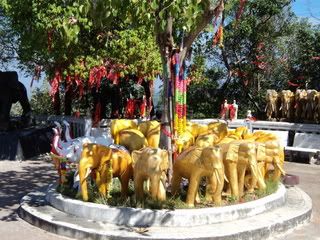
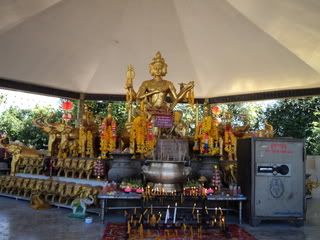
清邁最近開了一間新的象神廟,裡面有很多婆羅門教的天神及一些泰國神佛供信眾參拜,24小時開放。


地點在清邁巴士總站旁的空地上,香火鼎盛:多款的象神、四面神丶拉壺天神、愛神和一些泰國佛教神像等都有供奉在內,每個神像下有中文經文,大家跟著指示去念經就能祈福。
這裡有師傅幫大家做法事,有專業的工作人員指導你拜什麼神用什麼祭品,而祭品價錢也不算太貴。
此外在旁邊亦有小舖出售相關的紀念品、佛像、佛牌,價錢方面有平有貴,光顧與否宜視乎個人需要而衡量。


Sunday, 15 December 2013

Thai temple in bordeaux France

Finally after almost one year, after many visit to churches and cathedral and even Lourdes, we managed to find a Thai Buddhist Temple♥♥! Imagine the excitement knowing that there is one which is pretty near us, about 45 min drives! 
Wat Bouddha Bordeaux,  a little temple in a residential area. We got it right using the help of GPS. Press bell and a young guy came to open the door and direct us to the main Hall. A small little area with a nice English speaking thai monk from the Southern Thailand, pattani. He is a friendly monk who had just been here for almost a year before he came from Germany and he spent 11 years in USA to promote the meditation and setting up of temple.
We had a good chat and he share not only his knowledge in Buddhism, views of current situation of Thailand, his experience in foreign countries and also he taught us basic meditation! 
 
MEDITATION SYSTEM
Dhammakaya meditation in the tradition taught at Wat Pak Nam. The system is said to be an efficient way to purify the mind. One begins by bringing the attention to a point in the center of the body. A crystal ball or Buddha image is visualized as a //nimitta// (mental image); a mantra such as "Samma Araham" or "Buddho" can be used to further reduce mental chatter. As the mind becomes clearer, the wisdom inherent in the mind will manifest itself. It is this wisdom that's called "Dhammakaya."
 
 
Despite its his lunch time and knowing that this is the only time they can eat we decided to make a move. The young man Gabe me a book on the history of wat phra dhammakaya and a little card of Luang por wat pak nam. We Thank him and make our move.
Just as we are out at our car the young man ran out and said the monk had got something for us and ask me to go back. So we went back and feeling bad that we are disturbing his lunch. .:-( but he came out and gave us a little amulet and told me the miracles about it. As he know I can read English, he went into his room and gave me a book on dhamma 《 pages to happiness》and told me I can go back and borrow some of the book in English as he had alot of collection! *happy*♥♥*happy*!
I'm sure we will be back,  we felt so good after! 
 

Thursday, 10 February 2011

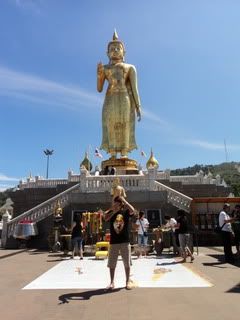
Hat Yai 4 Faced Buddha!


I was very excited about this temple becos devotees can purchase fire crackers! YES Fire Crackers and light them up at the designated place, but... that day was BUDDHIST day and hence fire cracker is prohibited... sigh...

Anyway, we still pray there and purchase 2 wooden elephant for worshipping of Brahma. The view there was beautiful.

Wednesday, 9 February 2011

Hat Yai

Hat Yai Municipal Park (สวนสาธารณะเทศบาลเมืองหาดใหญ่) At the foot of the hill near the avarium stands the statue of King Rama V. And at the southern foothill near the boy scout camp stands the jade statue of Guan-yin, the Chinese Goddess.


Kwan Im Statue for those born in the year of Rabbit!

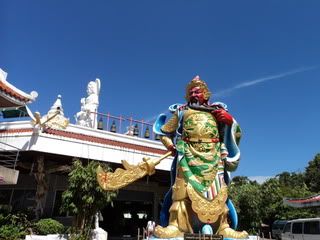
Went to Hat Yai because of the stainless steel temple. It's really worth going! Not only that, we went to the 4faced buddha and Kwan Yin at the hill top too!

Friday, 28 May 2010

Chiang Mai Day 1 ( 24.04.2010) Wat Don Chan

Kruba Anan!

Building in progress, the University of the temple

One of the classroom. Student waiting for their test result.


Campus/hostel

Chiangmai! Finally~~ After so many years, dwelling so much to be here, I've step on this beautiful land. After checking into the hotel and had our lunch, we took the tuk tuk to Wat Don Chan.

I thought we are the only one who will be excited to see Kruba Anan, to my surprised, he remembered us. He knew that we are from Singapore and where we came from. We had a good chat ( thou chicken & duck talk) thru hand gesture and not so fluent english interpretation. Understand that he missed some of our friends like (To**, Ran**& Fran***, he really named them) and he was asking me why they are not coming to his temple? Well, i just told him they were too busy.. well, you know businessmen, not like us commoner... Anyway, you know who you are.
We were told by Archan there were 700+ boys/girls, 20 teachers and about 8 monks compared to 3years ago. Not only they have school for the younger kids, they are now building a U campus. The compound is bigger now and the kids are happier too.

Thursday, 18 March 2010

"啦壺天神"

Wat Srisa Thong วัดศีรษะทอง
Petchkasem road Tambon, Huaytako, Amphoe Nakornchaisri, Nakorn Pathom.
最方便包車去.. 由曼谷市中心去.... 車程45分鐘左右...
星期一, 二, 四, 五 09:00-17:00
星期三 09:00-21:00
星期六, 日 08:00 - 18:00
给有需要的人!

Monday, 30 November 2009

Year of Pig: Phra That Doi Tung Stupa, Chiang Rai

Phra That Doi Tung stupa is situated on top of a high hill, where some hill tribes live.


It is believed that the stupa was built in the reign of King Achuttarat of Yonok Nakphan to house the Buddha’s relics (left collarbones), as previously predicted by the Buddha himself. Before the building of the stupa, the King ordered a Tung (Lanna- styled flag) with the length of 2,000 meters to be made.

The Tung was placed on top of the hill and the King would build the stupa where the Tung was blown to. He bought lands from the people there with gold, and ordered 500 families to take care of the Buddha’s relics. Later on in the reign of King Mangrai, a monk, Phra Maha Wachira Phothithera, offered 50 pieces of the Buddha’s relics to the King. As a result, King Mangrai built another stupa near the old stupa to house these relics.
Some legends relate that the name Doi Tung derived from when Phra Maha Kassapa (a disciple of the Buddha) placed a Tung with the length of 14,000 meters on top of the hill. The Phra That Doi Tung stupa has been restored many times. The last time was in 1970 by which the original shape of the stupa was changed. The stupa is a place of worship for the Lanna people, Tai Yai people, as well as people from Luang Prabang and Vientiane. Every full moon night of the third lunar month there’s a ceremony to worship the stupa.
Location -Tambon Huai Krai, Mae Fa Luang district, Chiang Rai
Getting there
By Car -From Bangkok use highway no. 1 to Wang Noi district, Ayutthaya and then no.32 to Nakhon Sawan. After that, turn right to highway no. 117 to Phitsanulok and then take highway no. 11 to Phrae. Use highway no. 101 to Rong Kwang district and turn left to highway no. 103, which will meet highway no. 1 at Ngao district, Phayao, and go straight to Chiang Rai. The distance from Bangkok is 804 km. Once in Chiang Rai, use highway no. 1 to Mae Sai district through Mae Chan district. Once you reach the 870th km. turn left to highway no. 1149 which goes up to Doi Tung (17 km.).

Saturday, 28 November 2009

Year of Pig: Phra That Doi Tung Stupa, Chiang Rai

Phra That Doi Tung stupa is situated on top of a high hill, where some hill tribes live.

It is believed that the stupa was built in the reign of King Achuttarat of Yonok Nakphan to house the Buddha’s relics (left collarbones), as previously predicted by the Buddha himself. Before the building of the stupa, the King ordered a Tung (Lanna- styled flag) with the length of 2,000 meters to be made.
The Tung was placed on top of the hill and the King would build the stupa where the Tung was blown to. He bought lands from the people there with gold, and ordered 500 families to take care of the Buddha’s relics. Later on in the reign of King Mangrai, a monk, Phra Maha Wachira Phothithera, offered 50 pieces of the Buddha’s relics to the King. As a result, King Mangrai built another stupa near the old stupa to house these relics.
Some legends relate that the name Doi Tung derived from when Phra Maha Kassapa (a disciple of the Buddha) placed a Tung with the length of 14,000 meters on top of the hill. The Phra That Doi Tung stupa has been restored many times. The last time was in 1970 by which the original shape of the stupa was changed. The stupa is a place of worship for the Lanna people, Tai Yai people, as well as people from Luang Prabang and Vientiane. Every full moon night of the third lunar month there’s a ceremony to worship the stupa.
Location -Tambon Huai Krai, Mae Fa Luang district, Chiang Rai
Getting there
By Car -From Bangkok use highway no. 1 to Wang Noi district, Ayutthaya and then no.32 to Nakhon Sawan. After that, turn right to highway no. 117 to Phitsanulok and then take highway no. 11 to Phrae. Use highway no. 101 to Rong Kwang district and turn left to highway no. 103, which will meet highway no. 1 at Ngao district, Phayao, and go straight to Chiang Rai. The distance from Bangkok is 804 km. Once in Chiang Rai, use highway no. 1 to Mae Sai district through Mae Chan district. Once you reach the 870th km. turn left to highway no. 1149 which goes up to Doi Tung (17 km.).

Thursday, 26 November 2009

Year of Dog: Wat Ket Ka Ram Temple, Chiang Mai

For those born in the year of Dog, their place of worship is the Phra Ket Keo Chulamani stupa in the Tavatimsa Heaven, where the Buddha’s relics (his teeth) are kept by God Indra. These relics were once stolen by a Brahmin during the time the Buddha’s relics were divided and given to different Kings, but they were retrieved by God Indra. Since men can’t go to the Phra Ket Keo Chulamani stupa, they can worship the stupa at Wat Ket Ka Ram temple, whose name has the same meaning as the first. This temple is located on the bank of the Ping River in an international commercial area.

It is believed that the temple was built by a King, Phaya Sam Fang Kaen, in 1428, but the stupa collapsed in 1578. King Sutho built a new stupa in the Ceylonese-Lanna style. The temple also has a big hall built in the Rattanakosin period and a folk museum (opening time 08.00-16.00 hrs).

Location - Ban Wat Ket, Charoenrat Road, Mueang district, Chiang Mai

Getting there
By Car -From Bangkok use highway 32 to Nakhon Sawan and then highway no.1 passing through Tak and Lampang. Then use highway no. 11 to Chiang Mai. The distance is about 700 km. Once in Chiang Mai, cross the Nawarat bridge and turn left to Charoenrat Road. Go down the road for 500 meters. The temple is on your right.

Tuesday, 24 November 2009

Year of Chicken, Phra That Hariphunchai Stupa, Lamphun

Phra That Hariphunchai stupa has been with the city of Lamphun since the ancient time.

Legend has it that once the Buddha visited the land of the Meng. There, the King of Naga (mythical serpent) and the King of crow, came to wait on him. A man offered the Buddha a myrobalan fruit, and the Buddha predicted that there was going to be a city called “Hariphunchaiburi” there.

At that place there would be “Phra Suwan Chedi” (meaning a golden stupa) housing many different parts of the Buddha’s relics. The two kings asked for the Buddha’s hair strand and put it in a wooden tube inside a crystal container. It was kept in the cave the Buddha once resided. In 877, a palace was built on top of that cave. King Athittayarat of Hariphunchai wanted to use a bathroom inside the palace but there were crows preventing him from doing so. It was known later that the Buddha’s relics were kept there so the palace was abolished and the relics taken out from the cave to be worshipped. The King built a golden stupa to house the relics. The stupa had constantly been restored by the Kings of Lanna. The last restoration was done in the reign of King Tilokkarat of Chiang Mai about 500 years ago.

In the temple grounds, there are also Phra Suwan Chedi, one of the first stupas in Hariphunchai art style; Chiang Yan Chedi, an ancient stupa with five tiers; and a bell tower, for instance. On the 13th night of the waxing moon of the 6th lunar month every year, the relics bathing ceremony is conducted. Water used during this ceremony is to be taken only from a holy water well on top of a hill outside the city.

Location - 335 Intayongyot Road, Mu 1, Tambon Nai Mueang, Mueang district, Lamphun

Getting there
By Car-From Bangkok use highway No. 1 and then highway no. 32 to Nakhon Sawan. Then take highway No. 1 passing through Khamphaeng Phet to Lampang. From there take highway no. 11 to Lamphun. The distance from Bangkok is 670 km.

Sunday, 22 November 2009

Year of Monkey: Phra That Phanom Stupa, Nakhon Phanom

Phra That Phanom stupa, the religious heart of the Thais and Laotians along the Khong River, houses part of the Buddha’s relics (his chest bones), which his disciple, Phra Maha Kassapa Thera, kept on top of the Phu Kamphra hill.

Legend has it that the stupa was built jointly by five kings and that the decoration on the stupa was done by God Indra. The brick plates depicting ancient kings made by local artists can de dated back to the Dvaravati period (around 8th –10th Century AD). It is one of the oldest stupas in Northeast Thailand.

Phra That Phanom stupa had been restored and taken under royal patronage by successive Kings of the Lan Xang Kingdom. In 1680-1682, a monk, Phra Khru Pon Samet, brought 3,000 men from Vientiane, Laos, to restore and heighten the stupa to the form favored by the people of the Northeast. In 1940, the Government restored and heightened the stupa one more time. On 11 August 1975, the stupa collapsed due to heavy rainstorm, but it was once again restored to completion in 1979. There is a well inside the temple, which is one of the seventh wells around the country, whose water has been used during coronation ceremonies of King Rama VI, VII, VIII, and the present King. The annual Phra That Phanom stupa celebration is from the 10th night of the waxing moon until the 1st night of the waning moon of the 3rd lunar month.

Location -Chayangkun Road, Ban That Phanom, That Phanom district, Nakhon Phanom

Getting there
By Car -From Bangkok take highway No. 1 to Saraburi. Change to highway no. 2 at the 107th km. Go to Khon Kaen through Nakhon Ratchasima. Turn to highway no. 213 passing through Kalasin to Sakon Nakhon. Then, take highway no. 22 to Nakhon Phanom. The distance from Bangkok is about 760 km. Once in Nakhon Phanom, drive along highway no. 212 for another 50 km.

Friday, 20 November 2009

Year of Goat: Phra That Doi Suthep Stupa, Chiang Mai

Phra That Doi Suthep stupa is situated on top of the Doi Suthep hill.

In 1373, King Kue Na of Lanna invited a monk from Sukhothai to Chiang Mai. The monk, Phra Sumon Thera, brought with him a piece of the Buddha’s relics found at the city of Pang Cha. This relic performed a miracle by multiplying into two pieces. One relic was kept at the Wat Buppharam temple. King Kue Na placed another relic on a holy elephant and asked the elephant to find a place to house the relic. The elephant walked up to the top of the Doi Suthep hill; cried three times; walked in circle three times and fell dead there. As a result, the King built a stupa to house the relic there.
In 1538, King Phra Mueang Ket Klao restored and enlarged the stupa to its present-day state. It is believed that worshipping the stupa from all four cardinal directions will improve a person’s intelligence. In the past, on Visakhabucha day, people will make a pilgrimage to the stupa.

Location - Mueang district, Chiang Mai

Getting there
By Car -From Bangkok take highway no. 32 to Nakhon Sawan and then take highway no. 1 passing through Tak to Lampang. After that take highway no. 11 to Chiang Mai. The distance from Bangkok is around 700 km. Once in Chiang Mai, drive along Huai Keo road to Doi Suthep hill.

Wednesday, 18 November 2009

Year of Horse: Swedagon Pagoda, Myanmar and Wat Phra Borommathat Stupa, Tak

Those who were born in the year of horse can pay homage to the Phra Borommathat stupa in Tak instead of the Swedagon pagoda in Myanmar. Phra Khru Phitak, a chief monk at the Wat Phra Borommathat temple, built a stupa replicating the Swedagon pagoda over the original Phra Borommathat stupa.

It is believed that when the Buddha visited Tak, he arrived at the Mahiyangka hill where he gave his hair strand to his disciples. He asked them to keep his hair strand at that place after he entered nirvana. This temple is the place where the Buddha’s hair strand has been enshrined. On the 14th night of the waxing moon and the full moon night of the 7th lunar month every year, there is a celebration to pay homage to the Buddha’s relics.

Location - Mu 3, Ban Tha Phra That, Tambon Ko Tapao, Ban Tak district, Tak

Getting there
By Car-From Bangkok, drive along highway 32 to Nakhon Sawan and then highway no.1 to Tak. The distance from Bangkok is about 425 km. From Tak, take highway no. 1107 along the west bank of the Ping River for about 35 km. and turn left to highway no. 1175. Go straight on for another 1 km. before reaching the temple.

Monday, 16 November 2009

Year of Snake: Bodhi three at Wat Photharam Mahawihan Temple, Chiang Mai

Bodhi tree is important to Buddhists because the Buddha attained enlightenment under such tree.

Lanna people still believe that Bodhi is sacred and can eliminate suffering. There is a tradition to offer props to Bodhi trees for support, along with other things.

For those born in the year of snake, their place of worship is the Bodhi tree at Buddhagaya in India. If that is not possible, they can also worship Bodhi trees in any temples. The Wat Photharam Mahawihan temple is a significant temple where the 8th world semimar on the revision of the Tripitaka took place.

King Tilokkarat who built the temple brought Bodhi trees from Sri Lanka to be planted there, and the Great Seven Places where the Buddha resided before the propagation of his teaching were demonstrated there.
The temple’s principal stupa was a replica of the Buddhagaya Chedi. The outer facade of the stupa’s base is decorated with beautiful stuccoed designs.

Location - Superhighway Road, Mueang district, Chiang Mai

Getting there
By Car- From Bangkok drive along highway no. 32 to Nakhon Sawan, then take highway no. 1 passing through Tak and Lampang. After that use highway no. 11 to Chiang Mai. The distance from Bangkok is 700 km. Once in Chiang Mai go down the Chang Pueak road to the Superhighway intersection. Turn left and go straight for 600 meters. The temple is on your right.

Saturday, 14 November 2009

Year of Dragon: Phra Phuttha Si Hing, Wat Phra Sing Temple, Chaing Mai

Phra Phuttha Si Hing is one of the most significant Buddha images of Chiang Mai.

It is believed to have originated around 2nd Century AD in present day Sri Lanka and had been transferred from one city to another until finally reached Chiang Mai in 1440 in the reign of Phaya Saen Mueang. At first the image was meant to be housed in a temple called Wat Buppharam, but when its carriage passed Wat Phra Sing temple (known as Wat Lee Chiang Phra then), the carriage could not be moved further.

As a result, the Buddha image has been housed in this temple since. In 1520, a King of Lanna, Phra Mueang Keo, built a temple hall called “Wihan Lai Kham” to house the image. This temple hall contains mural paintings depicting a folk tale, done by Lanna artists, and a story from the past lives of the Buddha, done by artists from Central Thailand, from the period of King Rama V.

During the Songkran festival of every year, Phra Phuttha Si Hing is taken in a procession around the city so that people can join the bathing ceremony.
Location - Sam Lan Road, Mueang district, Chiang Mai

Getting there
By CarFrom Bangkok, take highway no. 32 to Nakhon Sawan and then take highway no. 1 passing through Tak and Lampang. Then take highway no. 11 to Chiang Mai. The distance is 700 km.

Thursday, 12 November 2009

Wat Phra That Chae Haeng ( Rabbit Temple) Chiangmai

Wat Phrathat Chae Haeng is a sacred place of worship, situated on a mound on the eastern side of the Nan River, at the former centre of the Nan town after moving from Pua town.

Wat Phra Borommathat Chae Haeng was constructed during the rule of Chao Phraya Kanmueang (the Feudal Lord of Nan during 1326 – 1359) as an enshrining venue of 7 Buddha relics, silver and golden votive tablets presented by King Maha Thammaracha Lithai on the occasion that Chao Phraya Kanmueang assisted in the construction of Wat Luang Aphai (Wat Pa Mamuang in Sukhothai Province at present) in 1354.

It features a chedi in a bell shape. The pattern of Phrathat Chae Haeng is assumed to have been influenced by the chedi of Phrathat Hariphunchai. It is plated with Thong Changko or Thong Dok Buap – a combination of brass and copper. The staircase up to the Phrathat is in a Naga shape, while the gable above the entrance gate to the wihan is the stucco relief depicting intertwined Nagas, the unique characteristic of Nan fine art.

Phra Borommathat Chae Haeng represents the Year of the Rabbit.

Lanna people believe that travelling to pay respect to the Phrathat of their Year of Birth or “Chu That” would reap them great results.
Tourists can visit the temple everyday from 6.00 a.m. – 6.00 p.m.
To get there: Wat Phrathat Chae Haeng is located in Muang Tuet sub-district, King Amphoe Phu Phiang. From the centre of Mueang district, cross the Nan River Bridge and go along the Nan – Mae Charim route or on Highway No. 1168 for 3 kilometres.
Birth Year: 1999, 1987, 1975, 1963, 1951, 1939, 1927, 1915

**Nan is a city in Northern Thailand. It is located some 668 km north of Bangkok

Tuesday, 10 November 2009

Year of Tiger: Phra That Cho Hae Stupa, Phrae

Phra That Cho Hae is located on top of a small hill. Judging from its architectural style, the temple can be dated back to the 14th Century.

However, it is believed that when the Buddha reached a hill called Kosithaya Chakkhabanphot, he met a Laotian prince named Lua Ai Khon. The prince offered food to the Buddha. The Buddha then predicted that there was going to be a city called Phrae there. Then, the Buddha’s disciples asked the Buddha for his hair strand, and gave it to the prince to be housed in a crystal container. The container was kept in a cave east of the hill. The Buddha stated that after his nirvana the relics of his left elbow would be kept there.

The name of the stupa was believed to have originated from the silk cloth (Cho Phrae in Thai) the prince used to accept the hair strand. Some also believed that the name was originated from silk cloths wrapped around the stupa. A big celebration of the Buddha’s relics is held annually on the 11th night of the waxing moon to the full moon night of the 4th lunar month. This important festival consists of the Tung (Lanna-styled flags) procession as well as other performances.

Location - Mu 5, Tambon Pa Daeng, Muaeng district, Phrae

Getting there
By Car From Bangkok use highway no. 1 and then no. 32 to Nakhon Sawan. Then take highway no. 117 to Phitsanulok, and highway no. 11 heading to Uttaradit. Once you reach Den Chai district, Phrae, take highway 101 to Phrae. The journey is about 580 km.

Sunday, 8 November 2009

Year of Ox: Phra That Lampang Luang Stupa, Lampang

Phra That Lampang Luang temple is an ancient temple of Lampang province.

Legend has it that when the Buddha reached the Samphagariwan village, a man called Khon offered him honey and coconuts. The Buddha predicted that there would be a city called Lampang there, then he gave a strand of his hair to Khon, which was later kept in the Lampang Luang stupa. After the Buddha entered nirvana, some Buddhist monks brought part of his relics to be kept there. The stupa is situated in an ancient city, which is believed to have served solely religious purposes.

There are many attractions in the temple such as the Wihan Phra Phut, a beautifully decorated traditional Lanna style wooden temple hall, where people, when looking through a small hole on the Wihan’s wall, can see an impression of the stupa on a piece of cloth placed inside the hall. Wihan Nam Taem contains ancient Lanna mural paintings. Wihan Luang houses Phra Chao Lan Thong, a significant Buddha image of the temple, as well as mural paintings from the reign of King Rama V depicting the Buddha’s life and his past lives. The hall of the Buddha’s Footprint (Ho Phra Phutthabat) is another place where the stupa’s impression can be seen, but women are not allowed to enter this hall. Ho Keo houses Phra Keo, the most important Buddha image of Lampang, which was taken from the Phra Keo Don Tao Suchadaram temple.

Location541 Ban Lampang Luang, Ko Kha district, Lampang

Getting there
By CarFrom Bangkok drive along highway no. 32 to Nakhon Sawan. Then take highway no. 1 passing through Tak to Lampang (approx. 599 km.). From Lampang, take highway no. 1 heading to Thoen and turn right at the 586th km. to Ko Kha district. Then turn right to highway no. 1034. Go straight for about 3 km. and the temple is on your left.

Friday, 6 November 2009

Year of Rat: Phra That Si Chom Thong Stupa, Chiang Mai

This stupa is located on top of the Chom Thong hill. It houses part of the Buddha’s relics. The relics are not buried, but instead kept in a small pagoda inside the temple hall, so people can bathe them.

Legend has it that the Buddha once visited this hill and stated that this place would later house part of his relics. In 1452, Two people, Meng and Soi, found the Buddha’s relics, so they built a pagoda to house them at the Ton Thong hill. This temple was later known as the Chom Thong temple. Phra Mueng Keo, the 14th King of the Mang Rai dynasty (1495-1525) enlarged the temple, and many Kings of Chiang Mai arranged for processions of the relics to Chiang Mai to be worshipped. On the full moon nights of the third and seventh lunar months of every year, the relics are brought to the temple hall where people can bathe them. Traditionally, the water used during the ceremony are to be taken from a river and scented with sandalwood.
Location 157 Ban Luang, Tambon Ban Laung, Chom Thong district, Chiang Mai
Getting there
By Car From Bangkok, drive along highway no.32 to Nakhon Sawan. Then, take highway no.1 through Tak to Thoen district, Lampang. After that, use highway no. 106 heading to Lampoon. Before reaching Ban Hong district turn left to highway no. 1010 to Chom Thong district, this road will meet highway no. 108. Turn left and the temple is on your left.
 
eckhart tolle